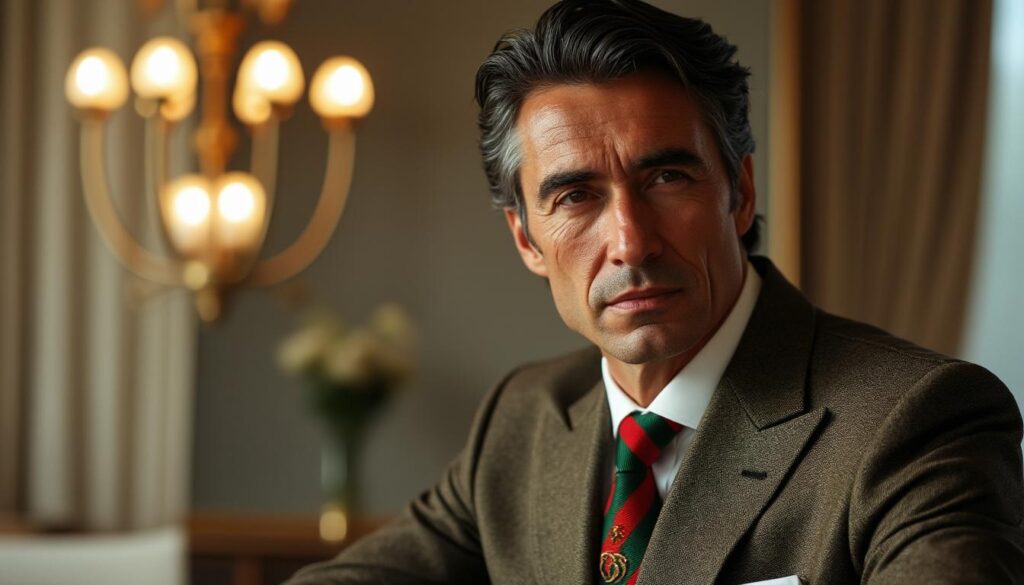
In the current cinematic landscape, Andrea Di Stefano stands out by playing Il Maestro in the film Le Parfum de Femme. With refined elegance, the character imposes himself as an iconic figure, dressed by the house of Gucci, a symbol of luxury and sophistication. Through this performance, he explores the nuances of modern masculinity and the contradictions of his era, while capturing the very essence of cinematic art.
In the landscape of contemporary cinema, Andrea Di Stefano distinguishes himself through his performance in the film Il Maestro, a work that aligns with the emblematic aesthetic of Gucci and the legacy of Italian comedy. This film, which evokes deep themes while juggling the flamboyant style of Sorrentino, succeeds in capturing the essence of an era while paying homage to its references. Through Andrea Di Stefano’s interpretation, the work unfolds as an exploration of contemporary Italian life, masculine identity, and cinematic craftsmanship.
A Remarkable Performance by Andrea Di Stefano
In the lead role of Il Maestro, Andrea Di Stefano delivers a captivating performance, oscillating between comedy and drama. The complexity of his character allows him to navigate a fragile balance between humor and melancholy. This duality makes his interpretation all the more rich and poignant.
Di Stefano, through his acting, shows how he can captivate the audience. He manages to make the audience feel the nuances of his role. Through his interactions with other characters, his talent shines through, anchoring his character in a palpable and human reality.
The Dazzling Visual Style Influenced by Gucci
The film is also distinguished by a breathtaking visual style, influenced by the aesthetic of Gucci. The flamboyant sets and refined fashion that permeate each scene enhance the narrative. This alliance between the cinematic world and haute couture like that of Gucci creates a captivating tableau.
The costumes worn by Di Stefano bring a dimension that transcends mere clothing. Each piece is chosen with care, bestowing the character with a particular aura. By evolving in this carefully curated visual environment, the performer is able to convey an undeniable elegance. Viewers can almost feel the influence of this great fashion house in every detail.
Cinematic and Cultural References
Following in the wake of the great works of Italian cinema, Il Maestro uses several references. Andrea Di Stefano’s filmography intertwines skillfully with the history of Italian comedy. Sorrentino, while having a very personal style, evokes memories of the classics while reinventing the modern narrative.
When discussing great films, one cannot help but think of works like Amarcord or even La Grande Bellezza. These references enrich the interpretation, which goes beyond mere entertainment, opening avenues of exploration into Italian society and its complexities.
Balance Between Humor and Drama
One of the most intriguing aspects of the film is its balance between laughter and emotion. Andrea Di Stefano, with subtle craftsmanship, leads the viewer to navigate between hilarious scenes and moments of profound introspection. Each sequence is carefully constructed to question the relationship between the comic and the tragic, without one overshadowing the other.
There are moments where the main character, in tandem with his companions, evolves in narratives that touch upon the reality of the human soul. Humor thus becomes a means of confronting the complexities of life. This gives a depth that makes the cinematic experience all the more poignant.
Viewers often find themselves entangled in plots that are sometimes light-hearted, sometimes poignant, maintaining a sustained attention throughout the film.
It is undeniable that Andrea Di Stefano, in Il Maestro, succeeds in weaving an inextricable link between his character and the flashy universe of Gucci. The way this film revolves around universal themes, while enriching its narrative with cultural and aesthetic elements, makes this work a true celebration of modern Italian cinematography.
To deepen your understanding of cinematic and cultural worlds, feel free to consult these articles: Discovery of Trench Town in Jamaica, Dive into the creative process of Luc Beraud, and Power with Olivier Assayas.
Andrea Di Stefano: The Elegance of Il Maestro in Le Parfum de Femme
In the film Le Parfum de Femme, Andrea Di Stefano shines brilliantly in the role of Il Maestro, a complex character who reinvents the codes of elegance. Through his performance, he manages to seduce the viewer while exploring the fractures and impulses of his character. His ability to play on nuances of comedy and drama provides an unexpected depth to the narrative.
The style of Il Maestro, often compared to Gucci, symbolizes an aesthetic that is both refined and bold. The costumes, carefully chosen, reflect his character: sophisticated and sometimes provocative. Each scene bears the mark of this flamboyant elegance which, while overshadowing, also reveals the darker aspects of masculine identity that the film addresses. The immersive staging, described with precision, allows the viewer to see how appearance, far from being superficial, becomes a revealer of the internal struggles of the protagonists.
Di Stefano, drawing inspiration from the great names of Italian cinema, manages to merge cultural heritage and modernity. His interpretation resonates with the contemporary era while paying homage to the iconic figures of the classics. Il Maestro stands at the crossroads between a rich cinematic tradition and current concerns, thus offering a critical and poignant view of Italian society, both past and present.
In summary, Andrea Di Stefano, in his embodiment of Il Maestro, delivers a fascinating performance that stands out not only for its artistic mastery but also for its ability to embody an ideal of elegance akin to Gucci. The film, through its visual and narrative choices, thus becomes a true homage to this Italian aesthetic, showing how fashion and cinema can jointly shape our perception of identity.