In his latest film, The Mage of the Kremlin, Olivier Assayas invites us on a fascinating dive into the arcana of power. Adapted from the bestselling novel by Giuliano da Empoli, this colossal feature explores the subtleties of post-Perestroika Russian geopolitics, shedding light on key figures and significant events of this tumultuous period. Through his narrative, Assayas confronts the challenges of ambitious storytelling, attempting to weave a connection between historical past and the contemporary realities of Russia under Vladimir Putin, an emblematic and controversial figure in modern history.
« The Mage of the Kremlin », directed by Olivier Assayas, stands out as an essential work for anyone interested in contemporary Russian politics. Adapted from Giuliano da Empoli’s novel, this film revolves around Vadim Baranov, a spin doctor whose fascinating trajectory exposes the subtleties and contradictions of power in post-Perestroika Russia. While the feature dives into the cynical mechanisms of political communication, it also raises questions about our time. Though the form resembles that of a museum, offering a chronological tour of significant events, the narrative sometimes suffers from its excessive ambition.
A historical narrative at two speeds
The long film by Olivier Assayas presents a chronology that explores different key events in the recent history of Russia. From the Chechen War to the current era of Ukrainian tensions, each scene appears to be a piece of a complex puzzle. It reveals the political strategy that, while filtering Baranov’s activities, highlights the mentality of a Vladimir Putin eager to cement his power.
Through striking images, political intrigues are exposed, sometimes with biting humor. Thus, the film illuminates during moments when Baranov must manage the complexity of human emotions, confronted with a reality where every gesture counts. This meticulous shaping of events confirms Assayas’s ability to juggle the nuances of power.
However, despite these ambitions, some might find the narrative dense, even tiresome. The film, in its desire to be exhaustive, ends up scattering, diluting the impact of certain key moments. The dialogues, while richly written, sometimes tend to show more than tell, plunging the viewer into a universe that can be too theoretical at times.
Vadim Baranov: embodiment of cynicism
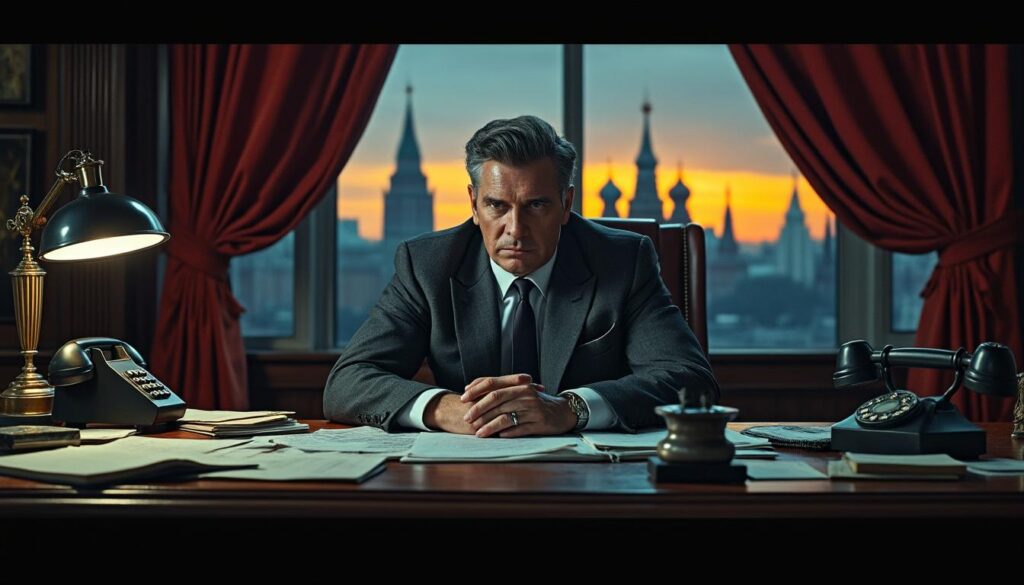
The main character, Vadim Baranov, brilliantly portrayed by Paul Dano, is the very embodiment of a modern spin doctor. Evolving from elitist theater to the production of unglamorous television programs, Baranov is a genius of communication. His transformation from an actor to a strategic informant is a winding road that does not go unnoticed.
At the center of this narrative, we find a character who is both *pragmatic* and *emotionally distant*. Baranov navigates easily between a world of media manipulation and power issues. The relationship he maintains with Putin, a coldly calculating man, starkly contrasts with the passion of the events that escape him. Assayas succeeds in capturing this delicate balance, enhancing the appeal of the protagonist.
This dynamic creates a mirror game where chaos and order reflect. However, this also means that some scenes may lose intensity when the underplay prevails for too long. This silence, which wants to convey much, sometimes becomes an obstacle to understanding certain motivations. The film thus oscillates between the fascinating and the frustrating.
The echoes of our current events
« The Mage of the Kremlin » does not settle for revisiting the past. It also resonates with our time. The way Assayas addresses the themes of manipulation and disinformation takes on particular resonance in the current context, where every political move is scrutinized and can have global ramifications. Putin, like a maestro, seems to orchestrate events that appear to have been predicted by the narrative lines.
By evoking the possibility of a Nobel Peace Prize while challenging its values, the character of Putin, portrayed by Jude Law, echoes a troubled era where the lines between good and evil blur. This underlying irony spices up the film and offers a reflection on our own relationship with authority. Moreover, through delicious scenes, the film invites us to question our own vision of power and responsibility.
A work at a crossroads
Assayas’s direction, although noted for its theoretical dimension, also suffers from a lingering pace. The dialogues can sometimes give the impression of aimlessness, while crucial moments are jeopardized. In this, the filmmaker chooses a classic style, but the sometimes academic treatment of certain scenes could leave the viewer searching for a more vibrant impulse.
This balance between the instructional and the cinematic makes « The Mage of the Kremlin » a two-faced work. Although this may bewilder some, one can only commend Assayas’s willingness to investigate essential questions. It is not just a journey into the past but also a map of our present that deserves close scrutiny.
As the film continues to spark debates, it invites reflection on the implications of power and its mechanisms in a modern world. The intelligence of the script, combined with the performance of a solid cast, can only enhance our interest in this narrative at the heart of humanity.
To dig deeper, explore related works such as those by Werner Herzog or discover engaging narratives from Luca Guadagnino.
Also, check out interesting games and gadgets, like this tracker pack or the Pixel 10, whose prices are constantly evolving.
Finally, open the door to other captivating reflections by reading our exchange with Alexandre Rockwell, which enriches our understanding of the arts.
With « The Mage of the Kremlin », Olivier Assayas invites us to a rich exploration of post-Perestroika (geo-)politics in Russia. This ambitious film, adapted from Giuliano da Empoli’s novel, depicts the trajectory of a complex character, Vadim Baranov, who finds himself thrust into the heart of Kremlin intrigues. Assayas constructs his narrative like a living museum, allowing for revisiting the significant events of this era, while exposing the political dynamics and underlying issues that have shaped contemporary Russian society.
However, this dive into power is not without limits. The director, in seeking to encompass a vast period of history, risks distorting the very essence of the narrative, at times transforming it into a mere exhibition. Despite a strong script, the film struggles in a sea of details and lengthy explanations that can induce a feeling of boredom in the viewer. Far from the passions and dramatic confrontations, Assayas opts for a more reserved and introspective tone, which sometimes slows down the already languid pace of the film.
The performances of the actors, especially that of Paul Dano, add a valuable dimension to the film, bringing nuance and depth to the character of Baranov. Their ability to embody figures with sometimes cold and cynical temperaments enhances the unsettling atmosphere of the work. Thus, « The Mage of the Kremlin » positions itself as both an instructive and frustrating work, which deserves to be seen for its attempt to describe the chaos of power, all while leaving the viewer in a state of reflection.