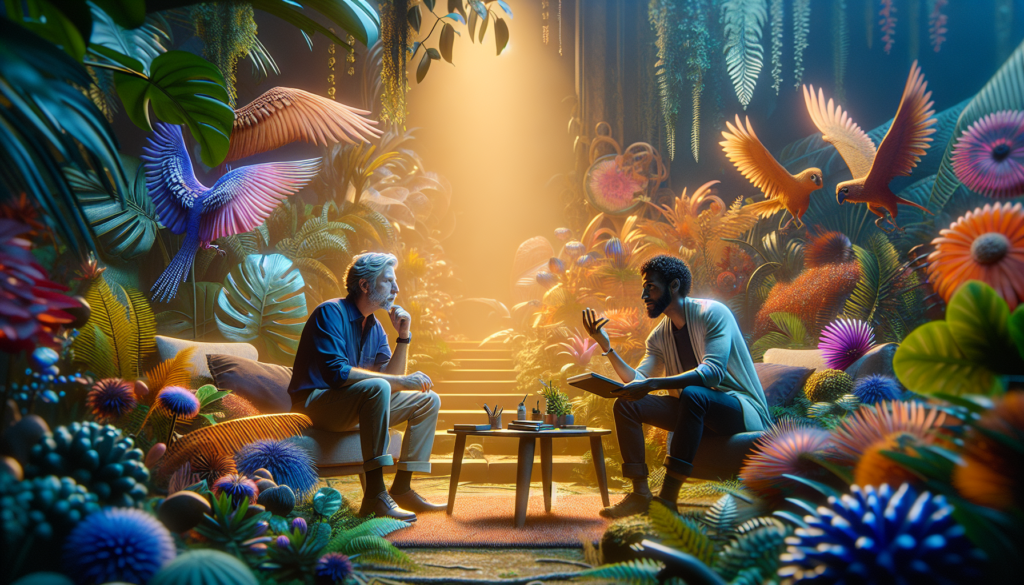
In a universe where cinema and video games meet in an unprecedented way, the project Knit’s Island emerges as a true work of reconciliation between these two arts. We had the opportunity to exchange ideas with Boris Garavini, producer, and Ekiem Barbier, director, to dive into the heart of this revolutionary initiative. Together, they share their passion, their vision, and the challenges faced during the creation of this feature film that redefines our relationship with the virtual and the real.
This text explores the reflections of Boris Garavini and Ekiem Barbier, two creators behind the project Knit’s Island. Through an enlightening exchange, they share their innovative approach to cinema, their passion for machinima, and the representation of virtual worlds. This discussion focuses on the challenges and perspectives this fascinating work brings, while highlighting the context in which it emerged.
The foundations of Knit’s Island
Knit’s Island represents a true bridge between the world of cinema and that of video games. This ambitious project illustrates how digital narratives can borrow the voices of documentary. Boris Garavini, passionate about the history of cinema, explains his desire to define what it means to produce in this technological era. Ekiem Barbier, for his part, mentions the inspirations that have led him down this bold path.
At the beginning, the collective saw in this initiative a chance to challenge traditional conventions. With characters and situations drawn from the digital universe, the scope of their work extends beyond mere representation. Garavini emphasizes the importance of this dynamic, aiming to build a rich narrative. They call it a form of reinvention of the documentary.
Innovations and challenges of machinima
Machinima is an art that deserves to be explored in depth. The integration of video games into cinematic creation raises fascinating questions. Garavini speaks of a cinematic approach where the documentary gaze of the directors meets the freedom of a virtual space. “It’s a unique opportunity,” he declares. The stakes of this work lie in the balance between real and virtual themes.
On the other hand, Ekiem reminds us that the use of games like DayZ was not just technical. It was also a discovery of the social dynamics hidden within. This immersion in digital worlds allowed for the capture of precious elements, revealing layers of unsuspected reality. The characters, often typical of gaming culture, pave the way for a multitude of interpretations and reflections.
A collaborative creation
The collaboration between Garavini, Barbier, and their team also played a crucial role. Ekiem speaks of the creation process, intelligent and intuitive. “We sought to explore different voices, and each brought their unique perspective.” However, it wasn’t without challenges. Their artistic visions sometimes clashed, but each conflict fueled their quest.
Above all, the film succeeded in drawing a delicate canvas where art, reality, and fantasy mingle. A true fusion. Thanks to their collective efforts, they managed to bring forth a story that is both personal and universal. The emotions of the characters transcend the game, touching the spectator.
A gaze toward the future
With the positive reception of Knit’s Island, the two directors display a determination to go even further. They plan to continue producing works that blend these two universes, thus creating new bridges between fiction and documentary. Garavini mentions an ongoing project with Arte, which focuses on simulations of real professions through video games.
This dynamic is not limited to games; it applies to a whole category of contemporary narratives. They believe that the future of cinema could be defined through this expanded prism. Ekiem insists on the importance of continuing to question and reinvent the stories we tell. “We want to encourage others to join us on this adventure,” he declares passionately.
Creating vocations
Their works could well inspire writers and filmmakers from different backgrounds. They hope that younger generations, who are growing up with gaming culture, see their practices enriched while exploring cinema. Workshops, classes, and screenings for young people are already on the agenda. They firmly believe that Knit’s Island could awaken vocations in these budding creators.
The encounter with these teenagers allowed them to realize how much video games can be valued. For these young people, the idea that a film could draw its essence from their daily practices is memorable. Discovering that their passion can resonate as a legitimate form of art was revealing.
A work in perpetual evolution
Knit’s Island is thus a project that does not stop at its simple conception. It is the result of a continuous reflection and constant evolution. Their dialogues with the public and critics will continue to enrich their approach. Through these exchanges, Boris and Ekiem hope to create a favorable climate for the art of creative documentary. An essential path for shaping engaging narratives that embrace the complexities of our digital world.
Ultimately, Boris Garavini and Ekiem Barbier remind us that cinema is, above all, a space for creation and freedom. Their project embodies a new era, offering innovative solutions to question our relationship with reality and imagination. Knit’s Island, beyond pixels and narratives, is a strong emotional journey and an artistic challenge that awaits exploration.
|
IN BRIEF
|
Conclusion on the Knit’s Island project
The dialogue engaged between Boris Garavini and Ekiem Barbier offers a rich perspective on the creation process of their project Knit’s Island. This feature film, which marries cinema and video games, highlights the importance of exploring new artistic territories. With an innovative approach, they show how Machinima can be a powerful tool for telling stories that transcend the boundaries of reality and virtuality.
The exchanges also reveal the passion that drives these young filmmakers. By engaging with virtual worlds, they aim not only to offer a new form of documentary, but also to change public perception of video games. By creating an authentic link between players and the narratives they inhabit, they challenge the stereotypes that surround this culture.
By analyzing the influences that have marked their work, such as the works of Gus Van Sant or Apichatpong Weerasethakul, it is clear that their artistic approach goes far beyond mere pixels. They strive to capture the essence of human emotions through the prism of digital universes. The way they question the boundary between the real and the fictional is both relevant and revealing of contemporary issues in cinema.
In summary, the trajectory of Knit’s Island appears promising, not only as a cinematic project but also as a manifesto on the transformations of artistic practices in the digital age. With a favorable reception and the growing enthusiasm for this type of narrative, it is legitimate to hope that this film may inspire an entire generation of audio-visual filmmakers.