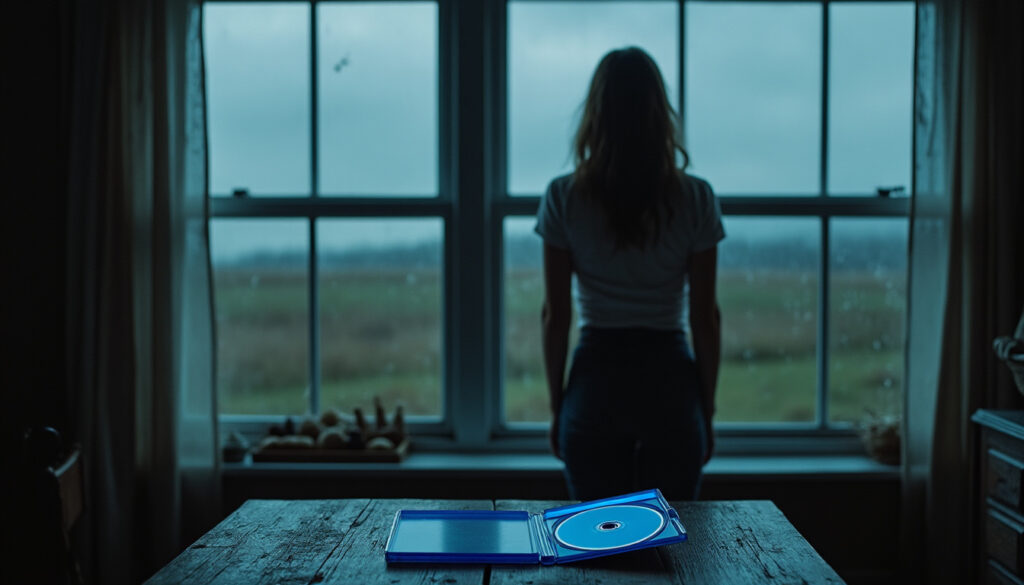
“Die, My Love”, the film by Lynne Ramsay featuring an intense Jennifer Lawrence, is now available on Blu-ray. Set in the vast spaces of Montana as well as within a closing household, the narrative explores motherhood, desire, and confinement through a visceral and sensory staging.
The release of Blu-ray for Die, My Love, Lynne Ramsay’s film starring Jennifer Lawrence and Robert Pattinson, provides the opportunity to revisit a work as intense as it is disturbing. In the landscapes of Montana, an ostensibly ordinary home gradually transforms into a space of confinement, as desire, motherhood, and anger collide. The experience benefits from being revisited to observe the details of staging, the color contrasts, and the sound work, which prolongs the unease long after the most spectacular scenes.
This transition to home video format brings back a film that resists overly simple summaries. Ramsay does not present Grace as a figure to be diagnosed, but as a woman whose body, gestures, and silences express tensions that words do not soothe. The narrative follows less of a classic progression than a succession of sensations, disruptions, and persistent returns.
A household closing in on Grace
Montana initially seems to offer the open space of great American cinema, with its roads and clear horizons. Yet, the vastness promises no escape for Grace. The paths lead back home, and home brings with it obligations she can no longer inhabit.
The house thus becomes much more than a backdrop. The kitchen, the bedroom, or the garden organize daily gestures and remind everyone of their expected roles. Beneath the reassuring appearance of family life, tasks and silences sketch out a form of constraint.
Jennifer Lawrence, a physical presence without refuge
Jennifer Lawrence’s performance relies on an expressiveness that often comes before dialogue. A neck stiffens, a breath breaks, a laugh lingers too long: each detail seems to foreshadow an inner jolt. The acting does not seek to make Grace immediately likable or easy to understand.
This freedom makes the character profoundly contradictory. Grace can be funny, fragile, desirous, aggressive, and then suddenly motionless, as if refusing to continue playing the social scene imposed on her. The film asks the audience to observe her without providing an instruction manual.
The mirror scene concentrates this fracture between the image Grace reflects and the intimate experience she undergoes. Ramsay does not use it as a mere psychological tool: the reflection seems rather unclear, incapable of bringing together the various facets of the character. It’s a powerful image for a film that is interested in identities that no longer fit within their frames.
The couple on the brink of misunderstanding
In front of Grace, Robert Pattinson plays a companion who is far from a spectacular antagonist. His gentleness and weariness coexist with a persistent misunderstanding of what his partner is going through. He does not perceive himself as violent, and it is precisely this normality that makes certain scenes so uncomfortable.
The film thus observes a violence that does not necessarily take the form of an open threat. It can reside in expectations, habits, or the inability to perceive the weight of daily tasks. Intimacy does not erase power dynamics; it can also make them less visible.
The presence of LaKeith Stanfield shifts the narrative towards a more uncertain zone, where desire and projection become difficult to distinguish. The character seems to offer a possible exit, but Ramsay never transforms this prospect into a clear promise. This ambiguity maintains the film’s unstable movement.
This relationship to perception reminds us that Ramsay favors impressions over explanations. The viewer must reconcile with fragments, incomplete gestures, and contradictory emotions. As in a video game narrative where an unusual object can open an unexpected path, certain details take on disproportionate importance; another register can be discovered in this selection of strange items from Baldur’s Gate 3.
A tight frame, an unsettling edit
The almost square format compresses bodies and gives scenes a feeling of tightness. Even when Grace is outside, the image seems to hold her movement back, as if the available space could never become true freedom. This visual choice subverts the codes of the western, traditionally associated with horizons and conquest.
The camera approaches fragments: the skin, the hands, the wet hair, the breathless moments. The body becomes the main landscape, where exhaustion and resistance are inscribed. The attention given to these details makes Lawrence’s presence particularly tangible.
The editing itself often refuses comfortable transitions. Ellipses interrupt the narrative flow, while some sounds seem to arise before the image explains them. Scenes respond to one another with their tensions rather than through a consistently clear chronology.
Amid this nervousness, a few suspended shots abruptly slow the gaze. A tree in the wind, a declining light, or an isolated silhouette evoke an almost meditative gravity. These calm moments do not dissipate anxiety; they allow it to settle.
The Blu-ray allows a return to these formal choices and to follow how each shot sometimes prepares the next without making it predictable. To extend a discovery through cultural and playful paths, this weekend gaming guide offers a detour into other narrative universes.
The colors and sounds as signs of rupture
The earthy tones and domestic beiges compose a fatigued environment. Occasionally, bursts of red or orange traverse it, bringing a warmth that feels less like refuge and more like warning. Color acts as a symptom: it signals that discomfort is already there.
Popular music also creates collisions instead of meekly accompanying the action. An upbeat melody can make a scene more chilling by highlighting the gap between its energy and the distress that inhabits it. Entertainment does not lighten the drama; it underscores its obscenity.
The sound work amplifies this impression of an unstable world. Hum, rumble, creak, and sudden silences sometimes seem to belong to Grace’s mental space as much as to the house. The daily routine seems to change frequency.
The sounds of the dog and the presence of animals contribute to fissuring the image of a civilized interior. Little by little, the house seems to groan, scratch, or bark, until it becomes a sounding board for anxiety. To explore another tradition of genre cinema where sound and atmosphere nourish fear, this dive into the terrifying universe of Lucio Fulci offers an interesting counterpoint.
Motherhood, desire, and assigned roles
Reducing the film to a representation of postpartum depression would not do justice to its complexity. Ramsay is also interested in the social expectations weighing on women, in the availability demanded, and in the domestic work presented as natural. Grace’s suffering intertwines with a painful lucidity about her place in the couple and the family.
The film sanctifies neither the mother nor the other household members. It does not turn the child into a convenient symbol, nor the partner into a monster designed to simplify the narrative. This absence of easy judgment preserves a troubled zone, where love and exhaustion can coexist.
Grace’s need for freedom clashes with a daily life regulated by functions and habits. Her desire does not vanish, but it is compressed by an organization that demands she remain available and readable for others. The house materializes this pressure even in its familiar rooms.
The Blu-ray release invites us to revisit this political dimension, inscribed in gestures rather than in pointed explanations. The film dialogues with a long history of works dedicated to feminine confinement while maintaining a distinctive sensory voice. In another artistic register, the panorama of the Locarno festival 2026 also allows following contemporary cinema proposals and their various ways of staging identities.
The fire that appears towards the end does not abruptly create the crisis. It makes visible a tension already present in the walls, in the couple, and in Grace’s body. Ramsay maintains this uncertainty between collapse and rebellion until the end, without offering the viewer a single interpretation.
Surrounding the film, the media narratives themselves can blur the perception of images and gestures. A remote example from Ramsay’s drama, but revealing of how a visual detail fuels interpretations online, is found in this story of a retired admiral filmed on television, whose appearance sparked numerous speculations.
A work to rediscover on Blu-ray
The arrival of Die, My Love on Blu-ray provides the opportunity to revisit a film that cannot be reduced to a narrative about motherhood or to a chronicle of a couple in crisis. Lynne Ramsay composes a sensory experience where space, sounds, and bodies tell what the characters cannot articulate. Montana, though immense, becomes a dead-end horizon; the house, far from being a refuge, confines Grace in the gestures and expectations imposed upon her.
At the center of the film, Jennifer Lawrence delivers a physical and unpredictable performance. Her acting comes through a gaze, a breath, a tension in the neck, and coexists fragility, desire, humor, and anger. Opposite her, Robert Pattinson embodies a gentleness that is not enough to comprehend Grace’s suffering. This opposition nourishes the film’s entire ambiguity: violence does not always take the form of a spectacular confrontation; it can reside in habits, silences, and roles considered normal.
The tight frame, abrupt editing, and sound work extend this feeling of suffocation. Domestic noises seem to intensify, while bursts of color and popular songs disturb rather than console. Ramsay does not offer a reassuring interpretation: she allows psychological distress, rebellion, and the desire for freedom to surface together, without clearly separating them.
Revisiting Die, My Love in its Blu-ray edition thus means rediscovering a work that favors unease over explanation and sensation over discourse. Its intensity lies in what it reveals beneath the apparent normality of the household: a fragile order, traversed by tensions long contained. The fire that marks its conclusion does not create the break; it makes visible a burn already present. Ramsay delivers a harsh and singular film, whose images continue to resonate long after the final scene.