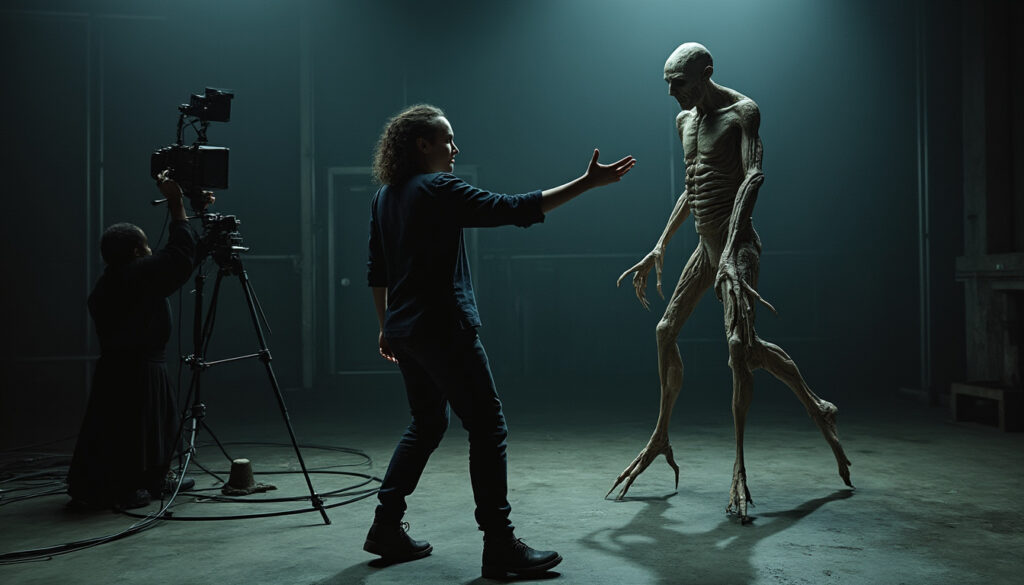
In Resident Evil, the most unusual monster is not solely the result of digital magic: choreographer Jakub Hudlický reveals the bewildering acrobatics of the stunt performers, whose entwined bodies served as the basis for this nightmarish creature.
A week after a record-breaking launch in theaters, behind-the-scenes details of the new adaptation of Resident Evil are starting to emerge. Choreographer Jakub Hudlický has shared images of his work on the most puzzling creature in the film. We see performers strapped together, rolling, tumbling, and intertwining to invent an inhuman movement vocabulary. The idea was not simply to show a monster, but to find out how a collection of bodies might move. Director Zach Cregger reportedly dubbed it the “human tumbleweed,” in reference to those dry shrubs swept away by the wind. Viewers, in turn, compared this moving mass to a strange video game creature. For Hudlický, the inquiry began with a simple question that was complex to resolve. How to make this collective body move without it looking like a troupe performing a classic routine? The movements needed to evoke something alive while remaining profoundly abnormal. Physical trials provided a foundation for the monster visible on screen. However, the production relied on digital effects to complete its transformation. This blend of choreography and CGI reveals a hybrid approach to fantastical cinema. It also sheds new light on one of the most talked-about visual choices of the film.
A creature born from a question of movement
In a post related to the release of the feature film, Hudlický explains that he participated in the project as movement coordinator. His team explored the possibilities offered by several performers attached to each other. Once connected by harnesses, they could bend, bounce, and contort themselves while synchronizing their efforts. The result aimed to disturb the gaze, as if each limb belonged to an impossible anatomy.
Entwined bodies to invent a monstrous gesture
The rehearsal footage shows specialists experimenting with different ways of gripping and moving. Some end up almost horizontal, while others seem to bear the weight of the group. Legs pass over shoulders, and torsos interlock in a disconcerting mechanism. Each movement requires precise coordination, as a poorly controlled impulse can upset the entire structure. The goal is not to make the creature elegant but to create a disordered presence that remains readable on screen.
This search gives the sequence a craftsmanship dimension often less visible in visually-rich productions. Before the computer, there are very real bodies, rehearsals, and trials, some of which do not succeed. The performers bring tangible material: weight, inertia, rhythm, and reactions to the constraints of the harnesses. Digital editing can then amplify these elements or alter their appearance. For genre film lovers, this making process reminds us how inventive behind-the-scenes work can be; Zach Cregger’s work on his captivating work “Evanouis” also provides an interesting point of comparison for diving into his universe.
Physical trials, then a digital metamorphosis
The production did not want to limit itself to a creature entirely generated by computer. The movements of the stunt performers served as a starting structure, giving the animators gestures and reactions inspired by reality. This choice can enhance the impression of mass, as the bodies do not float freely in the image. They hinder, pull, and support each other. The monster thus appears to adhere to a physical logic, even when its anatomy defies any explanation. The visual effects artists then take over to reshape this base and make it compatible with the director’s vision. The result plays on a fruitful tension between the tangible and the impossible.
Before arriving at this method, Cregger considered involving circus artists. He recounted tying five people together to ask them to imagine a continuous acrobatic wheel. Some had to remain inverted while legs crossed in cascade. The idea had a spectacular energy, but the trials also revealed limitations. According to the filmmaker, the group lacked agility, and their faces remained too visible. The attempt thus helped him understand why an exclusively human solution would not achieve the desired effect. In a film, a performance can be impressive without producing the unsettling silhouette expected.
This approach reminds that digital effects do not always replace physical work. Rather, they can extend it, transforming captured movements into a stranger form. For the audience, the difference sometimes lies in a detail: a joint that seems to bend too far, or a head that emerges from an unexpected place. Stunt trials provide reference points for the teams tasked with designing these anomalies. The creature thus retains an element of organic movement, even though its final appearance exceeds the capabilities of a human body. This dialogue between set and post-production has become an essential component of contemporary fantastical cinema.
A monster at the crossroads of Resident Evil and genre cinema
The assembled silhouette evokes the mutant creatures that the Resident Evil series has accustomed its audience to. However, its appearance strays from the more conventional monsters of the franchise. Some viewers recognized a writhing mass reminiscent of the “Huddle” seen in the game Inside. Others thought of a ball of bodies like Katamari Damacy, a comparison less horrific but revealing of its visual strangeness. These references do not necessarily define the film’s intent. Rather, they show how this creature escapes standard categories.
This aesthetic freedom has also raised reservations among fans most attached to Capcom’s games. Part of the audience criticized Cregger for straying from the familiar codes and figures of the series. The film, however, retains unique mutants and an atmosphere of biological nightmare. The central creature condenses these choices into an immediately memorable image. Its disordered appearance may be disconcerting, but it gives the narrative a visual element that is difficult to confuse with a more classic monster. It is precisely this type of bet that sometimes transforms an adaptation into a topic of discussion.
The making of this sequence will also interest those who enjoy observing the techniques behind the images. Video games, too, often combine graphical calculation and material constraints to produce believable worlds. Curious readers can extend this exploration with the article dedicated to the Valve console and FSR technology. To keep track of console releases, this guide to must-watch games during the PlayStation 30th anniversary sale can also supplement the reading. Horror universes thus circulate between cinema, games, and technical innovations.
Behind the scenes extend the viewer’s experience
The sharing of rehearsal footage allows us to measure the journey from an abstract idea to a finished scene. On screen, the gestures may seem spontaneous, while they have been prepared through a series of carefully structured trials. The harnesses ensure safety and allow performers to test difficult sequences. The choreography then gives a common rhythm to this group that must appear both unified and chaotic. This contrast is part of the creature’s unsettling charm.
On-set images also feed the curiosity of viewers who enjoy comparing the trickery to its final result. They reveal the decisions made before the effects, without diminishing the mystery of the scene. On the contrary, knowing that a group of stunt performers served as a starting point makes the on-screen appearance more surprising. One can take an interest in the making of the film while preserving the pleasure of discovering its mutants in their definitive form. The video thus becomes an extension of the spectacle rather than a mere technical explanation.
This curiosity naturally extends to physical editions and other gaming experiences. For cinephiles who enjoy collecting their films, the Blu-ray offers and video game recommendations bring together several avenues to explore. Players who prefer digital promotions can also check the best deals from the great autumn sale on Steam. These universes share a taste for strong imagery, memorable creatures, and technical behind-the-scenes work. Cregger’s monster is a particularly singular illustration of this.
Beyond comparisons, the scene reflects a collective effort where choreography, stunts, and visual effects respond to one another. Hudlický helped transform a simple question of movement into a physical challenge for several performers. The trials helped identify what could work, but also what could betray the illusion. The use of digital imagery then gave the creature its final appearance, without entirely erasing the energy of the filmed bodies. Between limbs rolling and silhouettes intertwining, the monster found a way to move that is uniquely its own. And perhaps it is this movement, even more than its form, that continues to haunt viewers.
The acrobatics behind the most unusual monster of Resident Evil
On screen, the creature seems to defy all anatomical logic: entangled limbs, torsos that tumble, and a silhouette that rolls like a living mass. Yet, before the digital effects, it was necessary to answer a very concrete question: how to make a monster composed of intertwined human bodies move? Choreographer and movement coordinator Jakub Hudlický shared images of the trials conducted to give a first form to this idea.
Strapped together, the performers explored a deliberately strange gesture vocabulary. They trained to bounce, turn, and move forward in coordination, while inventing ways to connect their bodies without producing overly natural movements. The goal was not to create a simple fast or threatening creature, but to give it a disturbing, almost unpredictable presence. Each roll and each imbalance contributed to this impression of a human mass that had become uncontrollable.
Zach Cregger described the concept as a sort of “human tumbleweed.” To test the idea, he even had several people tied together, seeking to achieve a continuous acrobatic wheel. The experiment allowed for the exploration of spectacular movements, but it also revealed the limitations of a fully practical approach: the performers lacked agility, and their faces remained visible. The result did not quite match the strangeness sought for the film.
Nonetheless, the performances served as a physical and choreographic base for the final creature. The production then turned to digital effects to transform these movements into a more fluid, stranger silhouette better integrated into the world of Resident Evil. This blend of real acrobatics and CGI explains why the monster appears both tangible and impossible. Behind its grotesque appearance lies a meticulous collective effort, where each human gesture contributed to shaping a creature that images alone would not have sufficed to invent.