With her latest project, Emerald Fennell immerses us in a familiar universe by revisiting the iconic novel “Wuthering Heights”. This new adaptation promises to be a captivating interpretation, oscillating between boldness and tradition, and is set to redefine the contours of Emily Brontë‘s work. By bringing her unique touch, the filmmaker hopes to enchant contemporary audiences while paying tribute to the psychological depth of the characters and the intense drama that makes this literary classic renowned.
The film “Wuthering Heights” highlights an intriguing adaptation of a literary classic, embracing the uniqueness of Emily Brontë‘s work. Under the direction of Emerald Fennell, this new interpretation promises to be as fascinating as it is controversial, oscillating between modernity and tradition. This article explores the main aspects of this bold cinematic project.
A fresh look at a timeless story
Since its publication, the novel “Wuthering Heights” has always sparked various interests and multiple interpretations. Fennell, with her singular vision, strives to make it a work that speaks to contemporary audiences. It is clear that the way this story is approached can unveil layers of meaning often overlooked.
The director attempts to grasp the complex elements of a narrative marked by vengeance and consuming passion. Indeed, beyond the expected romanticism, it is hatred and drama that underscore the depth of this literary masterpiece. Fennell remains true to this obsession of Emily Brontë, while allowing her narrative to resonate with the 21st century.
Bold stylistic choices
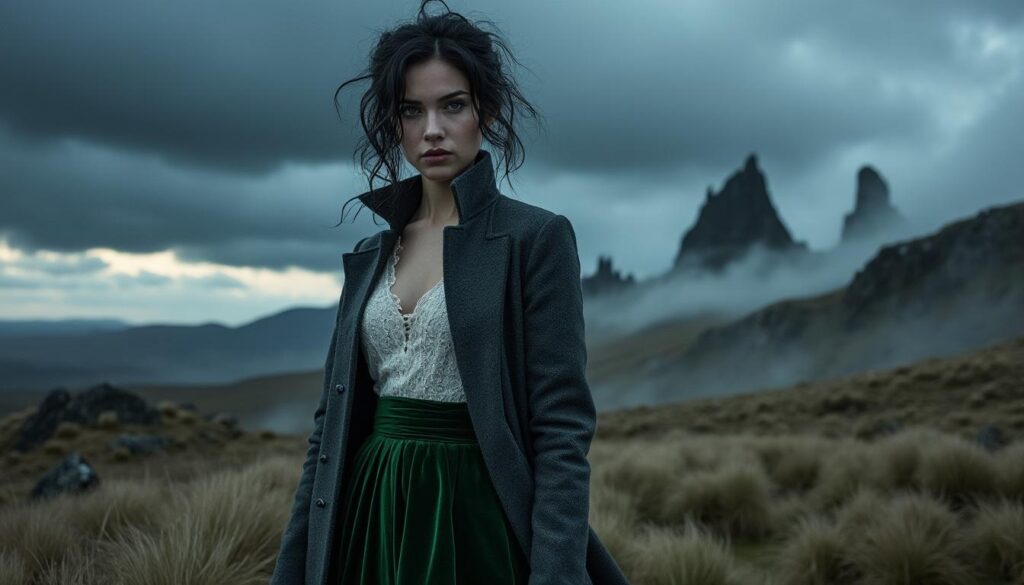
Fennell stands out for her bold use of visual and narrative techniques. The film, from its outset, plunges us into a rugged world marked by striking contrasts. The tortured landscapes of the English moors come to life through breathtaking visual aesthetics. The creator plays with light and shadow, anchoring the audience in an atmosphere of mystery and tension.
Thus, the choices of staging and cinematography become integral players in the story. Natural elements,
such as mist and jagged rocks, reinforce the idea that nature itself can be both beautiful and terrifying. It is a perfect reflection of the inner narrative of Brontë, where human passions run amok.
A promising but limited cast
In this adaptation, we find promising talents, including Margot Robbie and Jacob Elordi. Although their performances are commendable, they sometimes appear constrained by a script that stifles the depth of the characters. The choices of dialogue and situations are often too focused on a romantic approach, neglecting the more nuanced internal conflicts that characterize the novel.
It is crucial to mention that performances, despite all their energy, are subjected to a narrative framework that limits their potential. Their characters sometimes seem faded, lacking that intensity that could make them come alive. By seeking to avoid any controversy or provocation, the film misses out on the true richness of the original work.
Critics and audience reception
At the time of the first screenings, reactions are mixed. Some critics praise the boldness of the artistic choices, while others lament the lack of authenticity in interpreting the work. The promise of decadence and cruelty present in the book seems to dissipate in a version too watered down to appeal to a wide audience.
Ultimately, Fennell emerges as a relevant filmmaker but constrained in her choices by the dictates of commercial cinema. It would be interesting to observe her evolution over time and see if she can break free from studio expectations to unleash her creativity.
An elusive literary legacy
“Wuthering Heights” remains a delicate playground for directors. The complexity of the characters and the richness of themes such as passion, pain, or vengeance require a risk-taking that few seem willing to embrace. Fennell spreads her wings here, but is it enough to capture the tormented soul of Brontë’s work?
It is imperative that future adaptations dare to confront, without fear, the dark depths that inhabit the novel. For it is this darkness that imbues Brontë’s masterpiece with all its beauty. In the end, will Fennell’s challenge remain a memorable attempt or will it be seen as a lack of boldness?
The latest adaptation of “Wuthering Heights” by Emerald Fennell offers a bold perspective on Emily Brontë’s masterpiece. Although the film grapples with the usual reading errors that reduce the novel’s intense passions to a simple love story, it does not lack visual appeal that captures the viewer’s mind. The aesthetic choices made by Fennell, through bold staging, pay tribute to the dark and tumultuous universe of the characters while infusing it with a touch of modernity.
The first part of the film, with its impressive landscapes and an atmosphere that immerses the audience in the stormy ambiance of the English moors, echoes Fennell’s creativity. She brings an impudence and an inventiveness to the narrative that recalls a rich British cultural heritage. However, this boldness ultimately clashes with limitations imposed by the expectations of the general public, which dilutes the emotional impact of the relationships between the characters.
Although the cast, featuring talents like Margot Robbie and Jacob Elordi, attempts to bring depth to their respective roles, the psychological depth characteristic of the novel seems often absent. The film exhausts itself in a banal narration and a binary writing that sidesteps the complexity of human emotions, reducing the characters to lifeless figures. This raises an essential question: to what extent has Fennell been able to express her creative vision in the face of commercial constraints?
Ultimately, this interpretation of “Wuthering Heights” by Emerald Fennell, while captivating in some aspects, reflects the challenges faced by those attempting to reinvent a classic. The work could undoubtedly benefit from a more authentic approach to the brutality and passion that permeate the original text, thus offering viewers a truly immersive and profoundly unsettling experience.