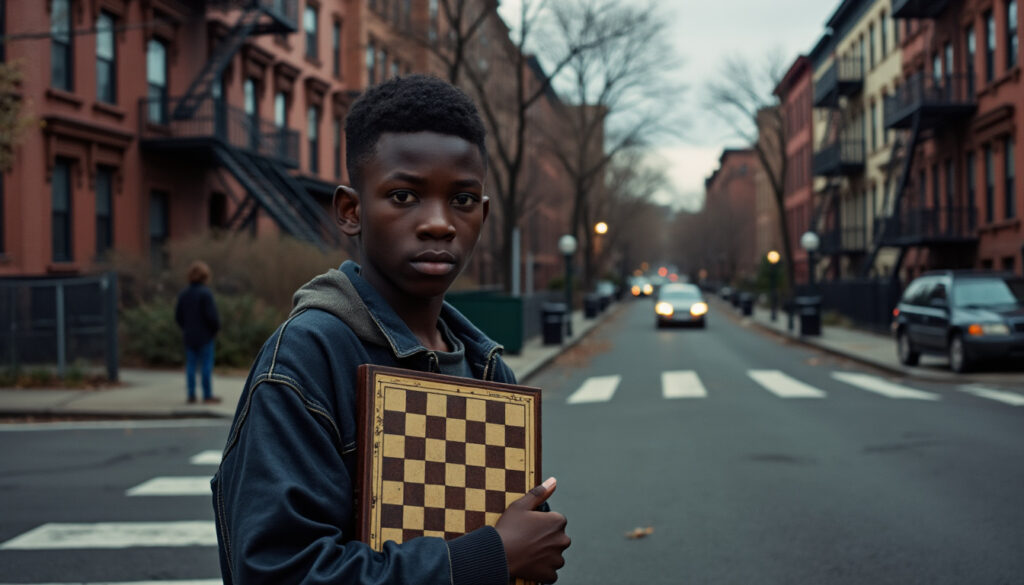
With Fresh, Boaz Yakin revisits urban drama through a sober and tense staging. At the heart of a neighborhood marked by precariousness and violence, a twelve-year-old boy mobilizes his father’s chess lessons to try to regain control of his destiny.
Contrary to the spectacular representations of gangster cinema, “Fresh” tells the story of a teenager who learns to survive by observing others and anticipating their moves. With a restrained direction and a narrative constructed like a game of chess, Boaz Yakin delivers a tense urban drama, whose subtlety contrasts with the conventions of the genre.
Released in the early 1990s, the film follows in the wake of American urban cinema that explores precariousness, social tensions, and the grip of criminal networks on working-class neighborhoods. However, Boaz Yakin chooses a singular path: rather than relying on excess, he establishes a sober atmosphere, attentive to silences and ordinary gestures. This restraint gives the narrative a particular intensity, as violence always seems close, even when it remains off-screen. The result is a portrait from a child’s perspective, but never naïve, where each encounter can alter the balance of an already fragile world.
An Urban Drama Against the Grain
In the late 1980s and early 1990s, several American films made African American ghettos the heart of narratives marked by injustice, violence, and inequality. Works like Do the Right Thing, Boyz n the Hood, or Menace II Society become landmarks of this vein, heavily carrying the imprint of their time. They often rely on a frontal energy, raw dialogue, and a nervous editing style, sometimes nourished by the legacy of New Hollywood. “Fresh” takes a different path, less demonstrative.
Yakin avoids both the aesthetics of the music video and the accumulation of shock scenes, without softening his subject. Violent acts sometimes emerge abruptly, but the camera does not linger on them: it focuses instead on the faces and reactions of those who witness them. This choice shifts the gaze to human consequences, toward the fear that settles in after the crash. To continue exploring worlds traversed by danger and mystery, one can discover the dossier dedicated to Maldoror presented by Fabrice du Welz, another dive into unsettling cinematic territories.
Michael, a Boy Who Learns to Read the World
The main character, Michael, whom everyone calls Fresh, is only twelve years old. He splits his days between school and the drug trafficking he participates in within his neighborhood, where his resourcefulness allows him to be useful to adults. He thus leads a double existence, moving from one universe to another without having the time or security typical of childhood. His youth does not prevent him from quickly understanding the power dynamics around him.
In his rare moments of freedom, Fresh meets his father, a marginalized man living in great precariousness. He teaches him chess, a game that gradually becomes a lens through which to view the narrative. Initially, these encounters seem to form a discreet parentheses in the boy’s daily life. However, they reveal a relationship built on affection, transmission, and advice, even if their true significance only becomes clear as events unfold.
A drama soon disrupts the adolescent’s equilibrium and transforms his way of envisioning the future. Rather than being swept along by the decisions of others, he builds a strategy and carefully observes the rivalries that divide the criminal milieu. His calm contrasts with the danger he faces, making his journey as fascinating as it is uncomfortable. We see him anticipate, disguise his intentions, and take advantage of what adults overlook.
This tactical intelligence does not make him an invulnerable hero. On the contrary, it highlights the cost of his precocity: to stay alive, he must relinquish part of his innocence and treat people like pieces on a board. The film does not transform this evolution into a simple success story, as the boy’s choices lead to losses and a deterioration of human connections. The tension precisely arises from this paradox: Fresh seems to master his environment, but this mastery threatens to trap him in a logic of calculation.
Chess, Between Transmission and Metaphor
The games with his father give the young boy tools to reflect on the movements of others. The game encourages observation, patience, and the ability to anticipate several outcomes, qualities he then applies to situations that are far more dangerous. Thus, chess gradually moves beyond the realm of family reunions to become a principle of organization within the narrative. The viewer is invited to identify strategies at the same time as Fresh, without always knowing the entirety of his plan.
This idea provides the screenplay with an effective structure, but it also has a limitation. At certain moments, the dialogue insistently explains the parallel between the board and the boy’s trajectory, at the risk of highlighting what the images had already rendered sensitive. The mystery surrounding his intentions then loses some of its strength. A greater trust in the audience’s gaze could have preserved more ambiguity in the character.
The mechanics of the narrative also evoke American noir fiction, particularly through its games of alliances and cleverly displaced rivalries. Fresh does not merely react to conflicts: he attempts to alter their course by encouraging opponents to turn against one another. This strategic dimension recalls certain narratives where cunning becomes a more powerful weapon than force. For another take on the intensity of crime cinema, the article dedicated to James Foley and Glengarry Glen Ross also explores the tensions and power dynamics that shape a group.
A Precise Direction, Far from the Spectacular
Boaz Yakin gives rare attention to ordinary places and moments. Classroom scenes, family exchanges, and moments of waiting construct a concrete environment, observed with an almost documentary attention. These breaths do not merely slow down the plot: they add depth to the neighborhood’s inhabitants, who are often reduced elsewhere to their role in a narrative of violence. The camera takes its time to watch them exist, with their habits, fragilities, and contradictions.
This refusal of agitation continues in the sound work. Where a rap soundtrack could have imposed itself as an expected code of the genre, the music composed by Stewart Copeland favors more delicate textures, between strings, discreet percussion, and wind instruments. This score does not deny the harshness of the subject; rather, it creates a contrast with the environment of the young protagonist. The sounds thus become a restrained presence, accompanying the images without dictating a single emotion.
The film’s influences are not limited to the noir or social drama. Its patient observation of individuals and spaces evokes a realistic tradition, while the construction of the narrative gradually shifts the everyday toward tragedy. This evolution remains measured: the film does not cease to pay attention to concrete details as it approaches the drama. To expand this discovery to other American trajectories, this dossier on the Sean Baker box set, dedicated to the forgotten of America and new beginnings offers another path through fragile lives.
An Edition that Accompanies Rediscovery
Long cited less frequently than several emblematic titles of its generation, Fresh regains visibility thanks to an edition designed to enrich the viewing experience. The supplements include an analysis by Nathan Renaud, storyboard elements attributed to Boaz Yakin and Erez Yakin, as well as an interview with the director. A presentation of the film by Aurélien Chapuis complements these contents. Together, they allow for an exploration of both the making of the feature film and its directorial choices.
This re-release also invites us to place the film within a broader history of independent American cinema and narratives dedicated to working-class environments. Its sobriety distinguishes it from works that associate urban chaos with a frenetic aesthetic without severing it from the social concerns of its time. The rediscovery reminds us that a drama can produce deep tension without multiplying effects, instead granting importance to gazes, expectations, and restrained gestures. It echoes, moreover, the diversity of proposals presented in the selection of the Locarno Festival 2026, where several works invite exploration of distinct forms and universes.
The film owes part of its impact to this alliance between realistic observation and almost tragic construction. The scenes of violence remain rare, but their consequences durably inscribe themselves in the narrative and modify the relationships between the characters. As Fresh progresses, his strategy appears less as a demonstration of mastery than as a desperate response to a world where childhood does not protect him. His performer carries this tension with great restraint, allowing exhaustion to surface behind his composure.
The final part gives this apparent coldness a heartbreaking dimension, without erasing the sacrifices that made it possible. After observing so many calculations and maneuvers, the viewer finally discovers what the boy has been holding back since the beginning. The emotion then arises from the contrast between the child forced to grow up too quickly and the vulnerability that remains beneath his tactical intelligence. This exit from the deadlock is situated within a journey marked by loss, while Darren Aronofsky’s exploration in Caught Stealing offers another example of cinema attentive to the mechanisms that imprison its characters.
In Fresh, Boaz Yakin depicts a neighborhood where childhood collides early with the brutal rules of the street. Michael, twelve years old, splits his days between school and the small trafficking that allows him to earn a place in a dangerous universe. Nicknamed Fresh, he observes adults with rare attention, as if he is already trying to understand the rules of a game whose stakes others ignore. His clandestine meeting with his father, a homeless chess player, offers him another learning ground: that of patience and anticipation.
The film diverges from the most ostentatious codes of street cinema. The direction focuses on faces, places, and silences rather than exhibited violence or frenetic editing. The everyday gestures — a conversation, a basketball game, a classroom — establish an almost documentary closeness with the neighborhood’s inhabitants. When violence emerges, it is often held at a distance, while the reactions of the witnesses reveal all its brutality. This restraint gives the narrative a muffled tension, without turning misery into spectacle.
The music by Stewart Copeland, delicate and distant from the expected rap sounds, accompanies this approach with guitars, percussion, and touches of clarinet. It sometimes softens the atmosphere without ever erasing the threat. Gradually, chess moves out of the role of a simple motif to influence Fresh’s decisions. The boy learns to read power dynamics, spot weaknesses, and maneuver his opponents. This metaphor, sometimes explicitly articulated, also sheds light on the ambiguity of the character: his intelligence protects him, but his strategies lead to irreversible consequences.
As the plot tightens, Fresh’s cold gaze contrasts with his age. Behind his calm lies a child forced to grow up relentlessly, amid fragile loyalties and successive losses. The drama thus takes on a tragic dimension, carried by a sober performance and direction attentive to restrained emotions.