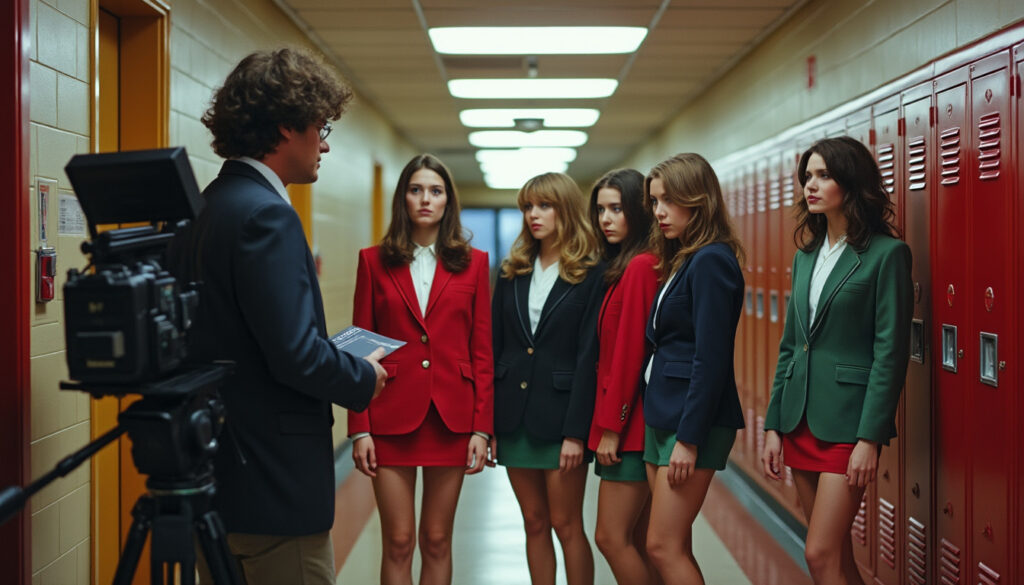
In 1989, Michael Lehmann blew up the conventions of the teen movie with Heathers, a dark, acidic satire of high school hierarchies. Led by Winona Ryder and Christian Slater, the film turns school corridors into a theater of cruelty, rebellion, and savage humor — a cult work whose irreverence has lost none of its bite.
Released in 1989, Heathers transforms school corridors into the setting for a dark comedy where popularity, conformity, and violence intertwine. Michael Lehmann orchestrates an acidic satire of adolescent hierarchies, led by Winona Ryder and Christian Slater. Initially a modest box-office performer, the film gradually established itself as a singular work whose biting humor continues to resonate.
At Westerburg High, Veronica Sawyer climbs the social ladder by joining the group of three Heathers, the school’s dominant figures. The power of Heather Chandler, Heather McNamara, and Heather Duke rests as much on their impeccably coordinated outfits as on their ability to humiliate others. Veronica, for her part, observes this little world with ironic detachment, without quite managing to break away from it.
The arrival of J.D., a rebellious student with a dark charm, upends the balance of her life. After a series of conflicts, Veronica and he take on the girls who torment her, then stage their deaths as suicides. The story then pushes its satire toward crime comedy, where horror mingles with sarcasm and the school seems to absorb every tragedy to preserve appearances.
The film thus defies the expectations associated with the teen movie of its time. Instead of portraying adolescence as a carefree period punctuated by romance and minor conflicts, it depicts a miniature society governed by fear of rejection, cruelty, and power struggles. Its darkness does not, however, erase all empathy: Veronica remains a contradictory young woman, capable of clear-eyed insight as well as morally compromised decisions.
A project born on the fringes of Hollywood conventions
Daniel Waters’s screenplay takes shape while its author is working at a video store and searching for a different way to tell stories about high school life. The popular teen comedies seem too polished to express the tensions he wants to explore. His initial ambition is outsize: he even imagines entrusting the project to Stanley Kubrick, a dream that will never come to pass.
The script eventually reaches Michael Lehmann through Larry Karaszewski, a friend of Waters. Lehmann, who had already made the student short film The Beaver Gets a Boner at USC, immediately appreciates the screenplay and wants to direct it. This daring first film had helped him attract the attention of New World Cinema and make the case for himself as a director.
The production nevertheless calls for changes, particularly to the ending, and the two writers initially resist these demands. Unable to secure other financing, they return to negotiate with New World Cinema. The version that made it to the screen therefore bears the marks of a compromise, while the screenplay’s provocative intentions remain at the heart of the project.
High school, a society of appearances and domination
The direction presents Westerburg as an artificial, almost theatrical world. Bright colors, carefully chosen costumes, and distinctive accessories sort the characters into immediately recognizable categories. The three Heathers, each associated with a color, embody a surface-level perfection that conceals everyday violence.
From the opening scenes, Veronica breaks the distance between the screen and the audience by looking into the camera and addressing her diary. This confession becomes a way to share her judgment of events, but also to show the gap between what she thinks and what she lets others see. The narration thus places us at her side, without sparing us from witnessing her hesitations.
The boys do not offer a healthier alternative to the girls’ power. The domination of the school’s queens is matched by that of young men who impose their own rules, with a brutality sometimes masked by the conventions of flirtation. A party with older students particularly exposes these expectations: the young women are encouraged to accept persistent advances, while Veronica’s refusal leads to her exclusion from the group.
This scene gives the satire a broader social dimension. Behaviors presented as normal are built on power dynamics, and reputation often serves to make injustices seem acceptable. Lehmann does not turn these tensions into an overt lesson: he reveals them through gestures, glances, and conversations, allowing discomfort to mingle with laughter.
Veronica and J.D., a dangerously seductive alliance
At first, Veronica sees J.D. as an escape from Westerburg’s rules. Their attraction, fueled by exchanged glances and a shared distrust of the established order, seems to open up a space of freedom for them. But their bond quickly becomes another form of control, because J.D. is not content to challenge the system: he wants to replace it with his own radical vision.
Winona Ryder gives Veronica a keen intelligence without reducing her character to an irreproachable heroine. Her reactions blend amusement, unease, and guilt, while her addresses to the audience reveal her inner contradictions. Christian Slater, meanwhile, plays J.D. with an alluring nonchalance that initially makes his nonconformity attractive, before revealing its disturbing side.
Their relationship keeps the film in a state of constant moral tension. Veronica takes part in the first criminal acts, but gradually understands that humor and the performance of appearances cannot erase the gravity of their consequences. Her journey is less about falling into line than about regaining the ability to judge for herself, after being caught between several forms of domination.
Violence spreads through the school without prompting any collective self-questioning. Students and adults reinterpret the deaths to fit their own narratives, sometimes even turning tragedy into an opportunity to gain popularity. This logic of absorption fuels the film’s dark irony: Westerburg knows how to give horror a respectable meaning, but refuses to examine the rules that made it possible.
Lehmann builds several scenes around the return of previously seen motifs, particularly funeral ceremonies. These repetitions are not merely comic reprises: they show how the group’s perspective shifts while the social setting remains unchanged. The contrast between the gravity of events and the characters’ formulaic responses becomes one of the satire’s sharpest devices.
A dark comedy with a distinctive visual identity
The film embraces theatricality, tonal shifts, and images that sometimes flirt with nightmare. The story does not seek to faithfully reproduce everyday high school life: it distorts it to make its codes and absurdities visible. In this stylized setting, excess becomes a way of revealing what normality conceals.
The dialogue plays a full part in this tone. The characters punctuate grave situations with dry one-liners, sometimes so incongruous that they heighten rather than dispel the discomfort. The film does not ask us to laugh at suffering itself; it mocks the conventions and rhetoric that cover it up.
The direction also plays with the viewer’s expectations. A scene may seem to replay a familiar moment before shifting it in a new direction, while a visual detail transforms a solemn situation into a grotesque image. This formal freedom allows Lehmann to move between satire, teen romance, and thriller without confining the whole film to a single genre.
At the heart of the film, Veronica moves from being an observer to becoming the agent of her own story. This shift is no simple or triumphant emancipation: she must acknowledge her share of responsibility before she can stand up to J.D. The heroine’s final choice gives her journey particular force precisely because it does not erase the actions that came before.
The resolution retains the brutality that runs through the story, while opening up the possibility of making amends. Veronica takes the initiative and turns J.D.’s taste for grand gestures against him. The film does not restore a suddenly benevolent high school; instead, it suggests a fragile way forward, based on personal judgment rather than the group’s rules.
A lasting cult classic and a restored edition
When Heathers opened in the United States in March 1989, it failed to achieve the hoped-for commercial success, despite generally favorable reviews. It later received several honors, including the Independent Spirit Award for Best First Feature. In France, where it was released in 1991 under the title Fatal Games, recognition came gradually, through rediscoveries and reissues.
Its influence can be measured in the persistence of its themes: high school cliques, social cruelty, manufactured identities, and violence concealed beneath appearances. The film anticipates some later teen satires and resonates with works that would go on to play with high school conventions in their own way. Its singular place rests on the balance between uncompromising darkness and a comic energy that remains surprising.
The careers of its two principal creators also extend the interest sparked by the film. Daniel Waters would continue his work as a screenwriter, notably on Batman Returns and Demolition Man. Michael Lehmann, meanwhile, would reunite with Waters on other projects, while the reputation of their teen comedy continued to grow long after its initial theatrical run.
In 2026, distributor Caméflex is releasing a new French edition in high and ultra-high definition, with a 4K restoration. The limited-edition set includes a UHD disc, two Blu-rays, a 32-page booklet, and a poster illustrated by Loïk Bihan. It also features Heathers: The Musical, a stage adaptation that retells the story by redirecting its irony toward the conventions of musical theater.
The bonus features shed light on the feature film’s creation and directorial choices. An interview with Lehmann looks in particular at the ending originally envisioned, while an analysis by Stéphane Moïssakis situates the work within the history of popular cinema. The filmed stage production, accompanied by features on its making and performers, makes it possible to compare two ways of bringing the same material to life: one darker and more direct, the other driven more by performance and song.
A teen satire whose sparks still fly
With Heathers, Michael Lehmann subverts the conventions of the high school film, turning Westerburg into a miniature society governed by popularity, appearances, and cruelty. The vivid colors, carefully assembled costumes, and school rituals give this world the look of an artificial theater. Behind this façade, power relations prove suffocating: Veronica wants to find her place, but discovers that belonging to the Heathers’ group requires her to give up part of her judgment. The film observes this machinery with razor-sharp irony, without reducing its characters to mere caricatures.
The relationship between Veronica and J.D. shifts this satire into a dark comedy where violent acts mingle with offhand dialogue. The contrast creates uneasy humor, while the direction highlights how the school digests tragedies and turns them into a spectacle. Winona Ryder gives Veronica a clear-eyed perspective tinged with contradiction; Christian Slater portrays J.D. as seductive, his rebellious pose gradually revealing a desire for control. Their duo reveals two incompatible ways of responding to an oppressive social order: one seeks to break free of it, the other wants to replace it with his own logic.
The restoration from Caméflex makes it possible to rediscover Lehmann’s visual work in a particularly rich edition. The mediabook brings together the film in high and ultra-high definition, a booklet, analyses, and several hours of bonus features, including Heathers: The Musical. This stage adaptation highlights the strength of the dialogue and the flexibility of the structure, while softening the feature film’s darkness through song and theatrical excess. Lehmann’s student short, made a few years earlier, also sheds light on the beginnings of a filmmaker already drawn to stylization, satire, and tonal shifts. The film’s release history thus brings its youthful experiments, its 1989 audacity, and the new artistic forms it continues to inspire into conversation.