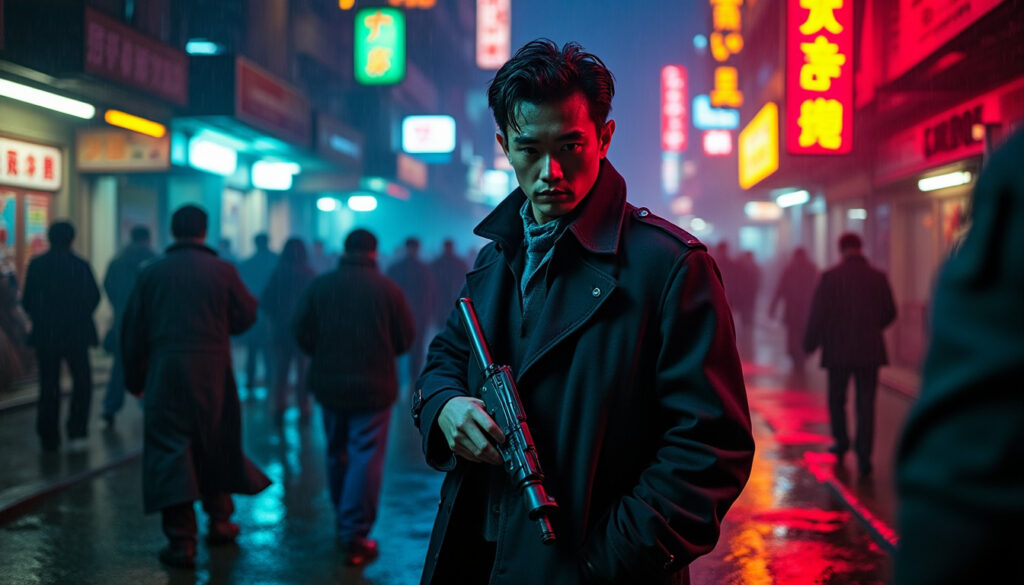
The world of Hong Kong cinema has often been marked by iconic directors, but few can claim an imprint as strong as that of Ringo Lam. With his masterpiece City on Fire released in 1987, Lam immerses us in an intense and poignant narrative, revealing the complexities of the human soul through the prism of an urban world where violence and loyalty clash. This film, often overlooked, transcends genre conventions and highlights a raw realism and an immersive approach, positioning Lam as an essential filmmaker of his time. Through the story of undercover policeman Ko Chow, City on Fire explores moral dilemmas and identity tensions, while bearing witness to the very essence of Hong Kong at the end of the 80s.
Ringo Lam and his intense masterpiece: “City on Fire” (1987)
The film “City on Fire” by Ringo Lam, released in 1987, is an iconic work of Hong Kong cinema. This feature film, often regarded as a masterpiece, stands out for its narrative depth and exploration of dark themes. Through an intense narrative and realistic staging, Lam immerses us in the intricacies of crime in Hong Kong, while revealing the complexity of the human soul. The characters are nuanced and face moral dilemmas, which contributes to making this film an essential reference, both for cinema enthusiasts and for aficionados of powerful stories.
Ringo Lam’s beginnings: a unique filmmaker
Ringo Lam is often perceived as a mysterious director, whose unique style deserves special attention. Originally from Hong Kong, he began his career in the film industry as an assistant director. Gradually, he made a name for himself, despite a career fraught with obstacles. His singular vision of gangster and cop stories incorporates elements of social realism, which sets him apart from his peers. Lam does not aim merely to entertain; he explores profound themes that resonate with the reality of urban residents. His films, notably “Mad Mission IV”, lay the groundwork for his recognition.
Before reaching fame with “City on Fire”, he directed several notable works. From the first images of his films, the viewer feels a particular atmosphere, a mix of suspense and tension. It is in this context that Lam develops his own style, far from genre conventions. He consistently emphasizes the characters’ internal conflicts while confronting the audience with sometimes brutal situations.
“City on Fire”: a dive into the criminal world
In “City on Fire”, Ringo Lam presents the story of Ko Chow, an undercover cop who finds himself caught between his duties and personal relationships. The tension escalates from the start of the film, where a jazzy atmosphere accompanies brutal action scenes. The narrative is based on real news events, thereby enhancing the credibility of the plot. Far from a simple genre film, Lam treats violence with a realistic and unembellished approach.
The plot begins when Inspector Lau sends Ko Chow to infiltrate a gang. The latter faces the dangers of a life where honesty and loyalty are constantly tested. This mission, much more than a simple infiltration, is also an exploration linked to moral choices. The complexity of his character, along with the dilemmas he faces, lies at the heart of the narrative. Lam succeeds in capturing the internal struggles of his protagonist, constantly reshuffling the cards between good and evil.
- Main themes:
- Friendship and betrayal
- Violence and consequence
- Identity and loyalty
A distinctive visual and narrative style
One of the major attractions of “City on Fire” lies in its intense and striking visual style. Lam employs staging techniques that enhance the tension. The camera, sometimes immersive, sometimes observational, accompanies the viewer through the twists and turns of the plot. A wide range of angles and fluid movements bring to life the urban atmosphere of Hong Kong. This artistic choice creates a certain contrast with the more stylized action narratives of his contemporaries.
Each scene is filled with significant details. The dialogues, often impactful, are laden with emotion and realism. Lam avoids clichés, thus offering authentic interactions. The absence of lyricism gives the film a striking brutality that captivates the audience. The conflicts between characters are not only physical but also emotional, solidifying the impact of the work. Ringo Lam relentlessly explores the darkest and most complex facets of human nature.
Impact and cultural legacy
“City on Fire” experiences resounding success, but its influence goes far beyond its initial reception. It paved the way for a new era for action cinema in Hong Kong. Many directors, including Quentin Tarantino, have acknowledged its imprint on their work. The hybridization of genres is a characteristic of a style that endures beyond the 80s. Lam is often the subject of studies due to his ability to transcend the notions of cop and film noir.
Today, the film continues to be studied in universities and analyzed by film enthusiasts across various forums. The notion of a changing Hong Kong, both urban and social, remains at the heart of various cinematic narratives inspired by it. The filmmaker not only contributed to establishing a new standard for action cinema, but also expanded the realm of possibilities for future generations of directors. His work, marked by a keen sensitivity to human emotions, remains timeless and relevant.
Ringo Lam and his intense masterpiece: “City on Fire” (1987)
Ringo Lam, an iconic figure in Hong Kong cinema, has made a lasting impression with his masterwork, “City on Fire.” This film, released in 1987, does not merely narrate a mundane story of violence and betrayal; it offers a deep exploration of the contradictions of the human soul. Through the trajectory of Ko Chow, portrayed by Chow Yun-Fat, Lam casts a sharp eye on the internal struggles of a man caught between his duty and his survival.
What distinguishes “City on Fire” from other works of the time is its brutal and realistic representation of urban violence. Lam refuses to confine himself to overly polished aesthetic codes and prefers to adopt a minimalist style, giving palpable intensity to the confrontation scenes. Lam’s narrative choices, such as the absence of lyricism, reinforce the tension and immersion, allowing the viewer to feel the protagonist’s anxiety in the face of a nihilistic and disenchanted world.
“City on Fire” also stands out for its ability to establish an atmosphere of fatalism, where the outcome seems inevitable. Through themes like camaraderie and loyalty, as well as a nuanced treatment of human relationships, Lam transcends the simple action film to offer a poignant reflection on the sacrifices one must make in the name of one’s convictions. His incisive view of Hong Kong society at the time still resonates today, making “City on Fire” a timeless work that continues to inspire and influence contemporary filmmakers.