
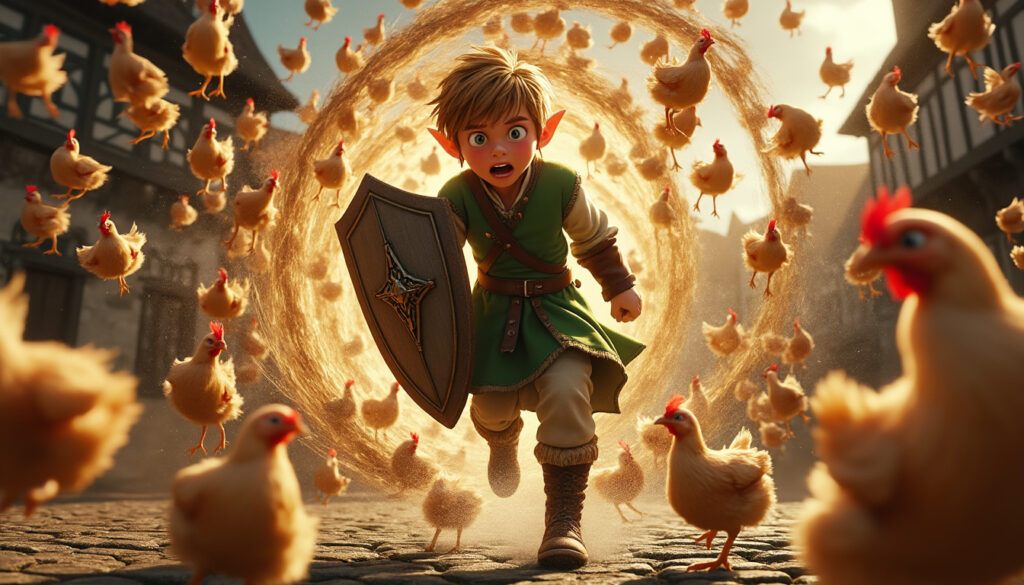
In the remake of The Legend of Zelda: Ocarina of Time, Link can play his instrument by humming melodies into the Switch 2’s microphone. An idea that’s as astonishing as it is hilarious: the game sometimes recognizes the most unlikely tunes… even when they’re sung off-key!
In the remake of The Legend of Zelda: Ocarina of Time, Link can now play his instrument after hearing the player hum into the console’s microphone. The new feature is magical enough to make fans smile, but its sometimes iffy interpretation also leads to some seriously funny moments. And when the community starts making it listen to unlikely tunes, the ocarina becomes a playground all its own.
The ocarina isn’t just a simple accessory in Link’s adventure. Its melodies open up passages, change certain elements of the world, and let you quickly travel to places you’ve already visited. They can even summon Epona, the hero’s faithful steed, when traveling on foot starts to feel endless.
In this new version, players can hum a melody near the console’s built-in microphone. If the system recognizes the tune well enough, Link responds by playing the corresponding song in the game. The result is both a nostalgic nod and a technical showcase, as if the adventure were finally responding to the voice of the person behind the controller.
An amusing voice command, but not necessarily the fastest one
As spectacular as the feature is, it doesn’t always beat the traditional method. Players who already know the button combinations will probably find it quicker to enter them than to hum until the console understands. For others, though, remembering a song’s tune may feel more natural than memorizing a sequence of commands.
That’s where the charm of this option really shines. It turns a usually abstract action—pressing the right buttons—into something more lively, almost theatrical. You sing, the microphone listens, then Link picks up the melody on screen: it’s hard not to appreciate the idea, even if it isn’t always the most practical.
The new feature also arrives at a time when Nintendo games are generating plenty of buzz. Curious readers can, for example, find the details about the Ocarina of Time remake that appeared early on the Australian Nintendo Store. Between the information making the rounds and players’ discoveries, there’s no shortage of twists and turns in discussions about the Switch 2.
The microphone sometimes recognizes far more than you’d expect
Tests shared online show a surprisingly accommodating system. It can respond to a hummed song, a real ocarina, or even a melody playing from another screen. In other words, Link doesn’t always seem to need a perfectly executed performance before he starts playing.
From shaky renditions to the funniest musical mischief
Several players have tested the recognition feature by belting out tunes, while others have simply held an instrument up to their console. Some even dug up an old Vine video in which a man vaguely sings something resembling Epona’s Song. Watching the game try to turn that sonic chaos into a Zelda melody gives the feature an irresistibly unpredictable quality.
The recognition feature doesn’t always require the tune to clearly match a known song. Faced with a muddled performance, the game sometimes seems to choose whichever song it thinks is most plausible. So it’s not an infallible interpreter, but more of a partner who listens, hesitates, and gives it a go anyway.
That room for error makes the attempts even more amusing. A player may think they’ve sung a particular melody, while Link confidently plays a different one. The scene feels less like a flawless performance and more like a music rehearsal where everyone improvises, including the console.
This kind of little extra is a reminder of why new features in a beloved series get so much scrutiny. Audiences dissect both the features and the visuals, as seen with the internet’s reactions to Star Fox’s new look. Online, sometimes all it takes is one idea to spark passionate debates—or a flood of ridiculous videos.
Fans turn the ocarina into a concert instrument
For those who have been playing Ocarina of Time since the 1990s, the instrument has always been much more than a tool for solving puzzles. The controls already let players have fun with the notes, and some have learned to work around the system’s apparent limitations. The new voice feature adds another way into a pastime the community never really gave up.
The notes available directly in the game are fairly limited. However, by moving the analog stick while playing, it’s possible to change the pitch and reach other notes. With enough patience, the musical possibilities go well beyond the repertoire of melodies featured in the adventure.
This freedom opens the door to unexpected covers. People online have shared familiar tunes, sometimes with no connection to the Zelda universe, played by Link using the ocarina controls. The result can be surprisingly faithful, especially when the person behind the controller has mastered the nuances and is willing to try again several times.
There’s also something surprisingly touching about these videos. Adults who grew up with the game discover that they can now sing or play the tune themselves, then hear Link reproduce it in his world. The technology builds a bridge between a childhood memory and a very tangible way of taking part in the music.
And, as often happens when a community gets a new tool, playful misuses soon follow. Some attempts produce strange, deliberately mangled tunes that sound more like sonic experiments than heroic serenades. Others, thankfully, show what the instrument can do when it falls into inspired hands.
Covers that travel far beyond Hyrule
Among the examples shared are songs from other video games, as well as Japanese animation themes. One player performed the main theme from Banished Court on the ocarina, while another fan took on the song of Tapion, a character from Dragon Ball Z. These choices give Link’s instrument a musical career even the hero probably never expected.
These performances work because the game gives players plenty of room to experiment. The available notes may seem limited at first, but transposition and stick movements expand the possibilities. Skill certainly matters, but curiosity already does a lot of the work.
You can imagine entire sessions devoted to trying out popular melodies, theme songs, or tunes composed by the players themselves. Some will aim for precision, while others will prefer to provoke the system and see what response it comes up with. Either way, the ocarina becomes a little open stage in the heart of the kingdom of Hyrule.
The feature doesn’t turn the game into music software, and that’s probably not its goal. Instead, it adds a spontaneous layer of play, where you can go from a serious quest to a completely botched vocal attempt in just a few seconds. That contrast is a big part of its charm.
So the remake doesn’t just bring a familiar adventure back into circulation: it also invites fans to interact with it in new ways. Conversations about purchases and preorders are still going strong too, sometimes leading to downright absurd situations, as this article about Zelda preorders canceled by Walmart explains. But for players already immersed in Hyrule, sometimes all it takes is a tune hummed off-key to kick off an entirely different kind of show.
When Link responds to a melody, even an imperfect one
Perhaps the best part is that everything doesn’t have to be performed perfectly. An uncertain hum, a note that slips, or a tune played on a real instrument may be enough to trigger the game’s response. This forgiving approach turns every attempt into a little musical surprise, with Link as a willing performer and the microphone as a sometimes-indulgent listener.
Fans can then replay an iconic song, cobble together a tune from somewhere else, or simply see how far the sound recognition can go. You hear a song, try to reproduce it, then wait for the console’s response. And depending on how well you perform, Hyrule might end up with a beautiful serenade or a delightfully chaotic version of Tapion’s theme.
When the ocarina answers your voice, the magic goes delightfully off the rails
Among the new features in the Ocarina of Time remake, the option to hum into the console’s microphone feels like a little spell. Link listens, recognizes the melody—sometimes—and then plays it on his instrument. No need to remember every button combination: all you need to know is the tune. In theory, it’s convenient. In reality, it’s mostly an invitation to see how far the game can keep up with players’ musical experiments.
And the system seems to have a surprisingly open ear. A song belted out at full volume, a few notes played on a real ocarina, or even a melody playing from another screen: anything can become material for interpretation. The recognition isn’t always infallible, of course. If the microphone picks up something that vaguely resembles a familiar melody, the game may take a chance and choose the tune it thinks is most plausible. It’s a kind of magical karaoke, with Link as a session musician.
For longtime players, the fun doesn’t stop there. The instrument’s controls can be repurposed to play much more than the tunes featured in the adventure. By moving the stick and using the available notes, some players turn Link’s ocarina into a mini concert stage. Themes from other games, anime songs, and unlikely tunes all find their way into Hyrule, with results that are sometimes splendid and sometimes delightfully wobbly.
This feature probably isn’t the fastest way to call Epona or open a secret passage. But it turns a familiar action into an unexpected gameplay moment: you hum, laugh when Link gets it wrong, then try again with another song. Combining nostalgia with experimentation, the voice-controlled ocarina gives the remake a playful personality—and reminds us that an old classic can still surprise us when it lets players make a little music their own way.


