
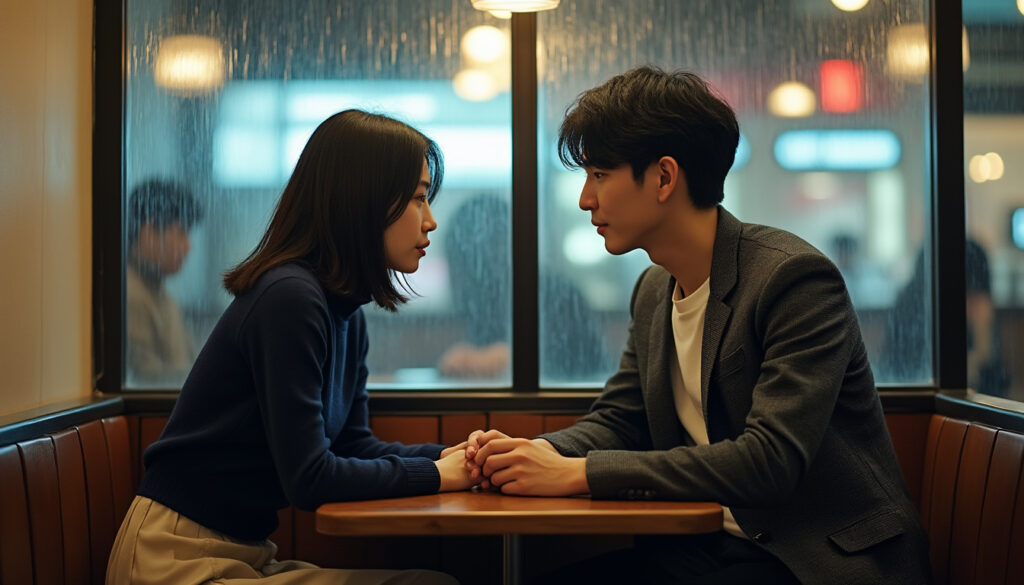
With Possible Love, Lee Chang-dong interweaves the paths of two couples separated by their social backgrounds. Amid layoffs, marital tensions, and intersecting gazes, the filmmaker explores the fragility of intimacy and the possibility of rekindling love, in a story where the past surfaces at the heart of the present.
With Possible Love, Lee Chang-dong returns to cinema after several years away and crafts a story in which marital intimacy meets social fractures. Two couples, separated by their economic circumstances, draw closer around a documentary about laid-off workers. Gradually, their habits and certainties unravel, revealing desires, wounds, and power dynamics. The film thus asks what love can still open up when precarity and inequality weigh on people’s lives. This eighth feature marks the return of a filmmaker who has become a rare presence, whose previous film, Burning, was presented in 2018. His new work gives great weight to everyday relationships, but never separates them from their social environment. The story unfolds unhurriedly, attentive to restrained gestures and words that sometimes spill over. This measured pace allows tensions to take hold before the characters themselves can name them. The project took shape over nearly a decade, inspired by a social event that had deeply affected Lee Chang-dong. Mass layoffs at a South Korean company had led to demonstrations that were harshly suppressed by the police. The director already saw in them the human consequences of economic and technological development that can render some workers superfluous. Here, that concern becomes a lived experience, embodied in Ho-seok’s gestures and silence. The film’s financing also says something about its times. Unable to secure the usual backing, Lee Chang-dong turned to Netflix, which reportedly offered him a deal after reading the screenplay. In return, the platform reportedly guaranteed him genuine artistic freedom. This compromise does not dispel every question: a film examining the concentration of economic power is itself dependent on a major player in the cultural economy. The story revolves around Ho-seok, a recently laid-off worker, and Mi-ok, his wife, whose optimism does not conceal the household’s difficulties. Their everyday life begins to open up when Ye-ji, a documentary filmmaker, comes to film their experience and that of former employees. She is accompanied by Sang-woo, her husband, a wealthy businessman whose world lies at the opposite end of the spectrum from Ho-seok’s. The meeting between the two couples gives rise to an unexpected closeness, without erasing the distance between them. Mi-ok agrees to take part in the shoot, but Ye-ji’s presence gradually transforms the domestic space. The camera enters the home, and ordinary scenes take on a new significance as soon as they become images intended for others. The filmmaker wants to make visible workers whom the system has cast aside. Yet her social ease and material resources keep her at a remove from their lived experience. Class differences emerge through small details, often more revealing than any direct explanation. Mi-ok discovers the price of Ye-ji’s bag on an app, then notices her clothes and mentions the cost of a blouse. These exchanges are not mere touches of realism: they show how objects signal social belonging and the ability to choose. The film also understands that inequality can be read in what each person can afford, ignore, or take for granted. Ye-ji wants to tell the story of the consequences of a redundancy plan, but her approach is marked by a contradiction. The daughter of a former company boss and the wife of a wealthy investor, she belongs to a world connected to the very mechanisms that have made the workers she films vulnerable. Her commitment seems sincere, while it may also stem from guilt or a desire to make amends. Lee Chang-dong does not reduce this ambiguity to an easy accusation; he makes it one of the film’s most sensitive points. The film-within-a-film sustains this uncertainty. Cameras and equipment remain visible in the frame, while some scenes seem to shift their source of imagery partway through. The viewer must then distinguish what belongs to Ye-ji’s documentary from what belongs to the feature film they are watching. These variations redirect our attention: filming someone does not automatically mean understanding them, just as giving them a voice does not guarantee an equal relationship. Sang-woo’s position deepens this line of inquiry. His investments tie him to a financial world whose decisions can contribute to restructurings and job cuts. He embodies a form of power that is rarely forced to look directly at the consequences of its choices. The film thus brings together, within the same family circle, the victims of an economic system and those who benefit from it. The resulting discomfort fuels the unease of their shared scenes. This question resonates with the way works circulate today. Lee Chang-dong’s difficulty in financing his film outside the platforms highlights the tensions between artistic independence and the concentration of distribution. The parallel with Ye-ji’s documentary is not an equivalence, but it sheds light on a shared question: how much freedom remains when one depends on a system one wishes to observe or criticize? Other distinctive cinematic offerings, such as the Fifigrot festival and its program of original films, also remind us of the diverse spaces where works can find their audiences. The film’s structure grows more complex as the two couples draw closer. Flashbacks appear without a consistent break, and some sounds seem to drift from one period to another. The past is therefore not confined to an explanatory block: it surfaces at the heart of the present, sometimes before we even realize that time has shifted. This movement gives the story a kind of unsettled continuity, as though the characters were living through their memories and their consequences at the same time. The story of Mi-ok and Ho-seok meeting as teenagers reveals the distance between their initial spark and the sadness of their lives today. The images of their youth have a tenderness that does not serve to idealize their relationship. Instead, they trace its transformations, its promises, and its accumulated wounds. The words spoken do not always match the faces, and this dissonance leaves it to the viewer to perceive what remains difficult to say. Ho-seok, too, carries a past he cannot simply move beyond. His layoff means more than the loss of a salary: it shakes his sense of usefulness and his place in the world. Reminders of his former working life, including an encounter with an ex-colleague who has become a driver, bring him back to what he has lost. As the violence he suffered during the demonstrations resurfaces, his silence takes on a deeper meaning. The filmmaker treats work as an experience that encompasses one’s entire existence. The factory is not some distant backdrop: its disappearance reverberates through dignity, family relationships, and the ability to imagine a future. Where some stories choose satire or the thriller to depict domination, this one opts for an intimate observation of a couple. Ho-seok’s anger is sometimes contained, but that restraint makes its outbursts all the more painful. It reveals the weight of a system whose effects continue long after a workplace has closed. Each character seeks a way out, but they do not all have the same means to find one. Ho-seok tries to regain his place in society, while Mi-ok seeks to preserve a degree of autonomy within her marriage. Ye-ji may wish to free herself from the social inheritance she still benefits from. These aspirations intersect, but they do not make their situations equivalent. The film thus reminds us that wanting freedom is not enough to have the means to attain it. Mi-ok and Ye-ji develop a genuine closeness, built on conversations, observations, and awkward moments. Yet the camera that brings them together also maintains a distance: one is filmed, while the other often decides what enters the frame. Their relationship can therefore be reduced neither to an obvious solidarity nor to an opposition between two classes. Gestures of trust coexist with disparities in resources, and this tension gives their bond a particular fragility. Young Cheol watches these adults without understanding their conflicts. His quiet presence reminds us that parents’ choices and class relations extend beyond the circle of conversation. In the film’s final section, a nighttime sequence adopts more of his perspective: the adults’ words briefly fade, giving way to a more instinctive attention. The connection between the child and the property’s caretaker takes on a particular significance, since both seem linked to modest worlds, even if they inhabit them differently. Around Sang-woo and Ye-ji’s home, the sounds of the garden and details of the landscape contrast with the wealthy couple’s elegant, carefully arranged world. A rainbow appears as Cheol waters the plants: the image resolves nothing, but opens up a brief moment of simple beauty. This attentiveness to the living world resonates with stories of travel and discovery, whether a couple’s getaway to Vienna, with its garden and wellness break, or the remote landscapes of Litla Dímun, a small Faroe Island. In Lee Chang-dong’s film, however, this moment remains tied to real lives and intersecting gazes. The title invites us to see love not as a sure promise, but as a fragile possibility. The film’s running time, nearly two hours and forty-four minutes, gives the silences and shifts in perspective time to reshape our understanding of the characters. The work also enters into an acknowledged dialogue with Krzysztof Kieślowski’s The Decalogue, which it references from its opening through to its final tribute. To continue exploring different forms of cinema, one can also discover two distinctive approaches to yakuza cinema, vastly different in tone and imagination.A return shaped by a long gestation
Two couples, two realities drawing closer
Filming others, being watched in return
Memory runs through scenes in the present
Unequal desires for emancipation
Possible Love: Lee Chang-dong explores the possibilities of love
In Possible Love, love is neither an untouched refuge nor a promise of happiness. Lee Chang-dong films it as a bond shaped by time, material hardship, and wounds the characters struggle to express. Ho-seok and Mi-ok share a long history, but their everyday life bears the marks of a layoff that has shaken far more than the household’s financial stability. One partner’s anger and the other’s optimism offer two ways of surviving the same precarity, without dispelling the distance growing between them.
The arrival of Ye-ji and Sang-woo in their intimate world reveals other fault lines. The two couples do not inhabit the same world: their clothes, habits, and resources reveal disparities that closeness alone cannot erase. Yet connections begin to form, particularly between the two women. Their relationship remains shaped by the inequality of their positions, but it opens up a space where curiosity and unease can coexist. The film does not turn these encounters into an ideal reconciliation; instead, it observes how they unsettle each character’s certainties.
The form reflects this uncertainty. The documentary Ye-ji is making introduces a second camera into the story and blurs the line between observation and intrusion. At times, the images seem to retain the trace of an outside gaze, while the flashbacks make memories resonate in the present. By revisiting the beginnings of Ho-seok and Mi-ok’s relationship, the film does not seek to restore a lost romance: it juxtaposes their early passion with their accumulated disappointments, allowing their story to emerge in fragments.
Surrounded by the adults, Cheol watches without having the words to understand their tensions. His gaze, more attentive to people and details than to words, brings forth another way of being in the world. In an environment shaped by money and appearances, a simple gesture or a natural phenomenon can briefly suspend power relations. Love then remains a fragile possibility, less an answer than an uncertain movement between people whom everything seems to divide.


