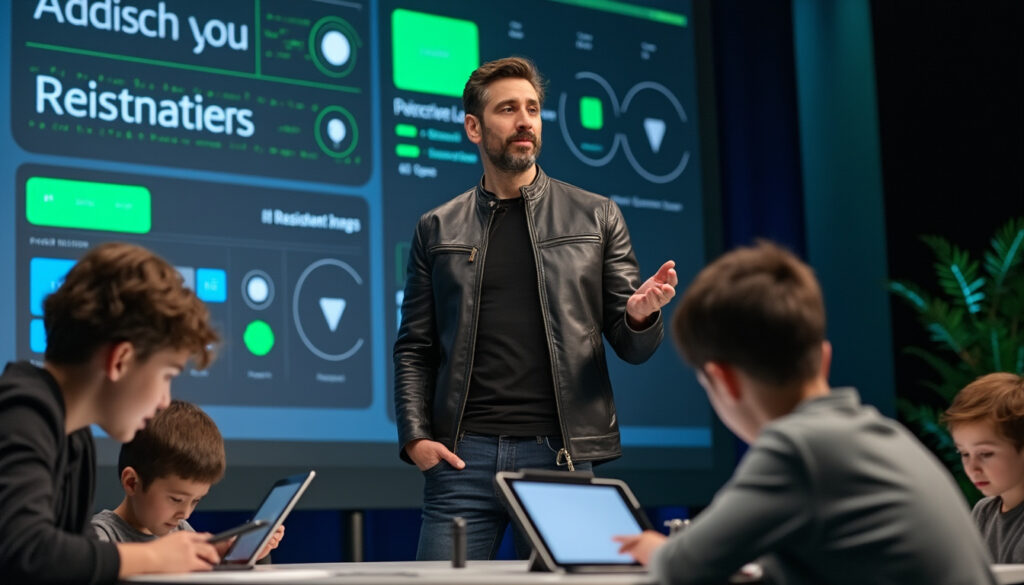
Jensen Huang, the head of Nvidia, acknowledges that AI can help children complete their homework while weakening the memorization of concepts, particularly in mathematics. He worries little about it — and even admits to having forgotten his own address and phone number from relying too much on technology.
In an interview with the New York Times, Jensen Huang, the head of Nvidia, acknowledges that the use of artificial intelligence could weaken children’s memorization and certain school skills. However, he does not seem to see it as a reason to panic, even when discussing his own memory lapses. Between the promise of new abilities and dependence on digital tools, his remarks reignite an essential debate: what do we lose when technology thinks a bit for us?
A school concern that Jensen Huang does not deem critical
AI tools can help students finish their homework faster. This is the picture painted by studies conducted in China, shared with the leader during the interview. But the speed gain may have its downside: the knowledge needed to complete exercises may not always be retained, and results on assessments could be affected.
Huang admits that this phenomenon is plausible among young people who rely heavily on these assistants. Yet, he downplays the gradual disappearance of reflexes such as multiplication, division, or calculating square roots. In his view, some skills deemed fundamental today may lose their significance, while other abilities may take their place.
Doing the homework is not always learning
The difference between producing an answer and understanding a method lies at the heart of the problem. A chatbot can detail an operation, rephrase an instruction, or quickly deliver a convincing result. If the student merely copies down the answer, the homework is done, but learning may not have commenced.
This distinction is particularly important in mathematics, where concepts stack up like bricks. A weakness in mental calculation can complicate the learning of more advanced concepts, even if an app can perform the operations on demand. The risk is therefore not only forgetting a multiplication table: it is sometimes not knowing how to spot when an answer seems incoherent.
However, it would be simplistic to attribute all academic decline to AI. Work habits, the quality of teaching, the time spent in front of screens, and access to support also play their roles. The useful question is not to banish every new tool but to determine under what conditions it genuinely helps understanding.
“I don’t know my address”: the executive’s admission
To defend the idea that certain knowledge can become unnecessary, Huang recounts that he does not remember his address or phone number. He recalls panicking once in a gas station when asked for his postal code. His wife, Lori, could confirm this anecdote, he notes.
This confession has a humorous, almost disarming quality. It also illustrates a form of delegation that has become familiar: contacts are saved, routes assigned to GPS, and practical information entrusted to devices. As long as the phone works, memory seems to remain on standby.
But this convenience hides a very concrete fragility. A dead device, a locked account, or an emergency can turn a mundane piece of information into an unfindable data. Not remembering every detail is not necessarily grave; being unable to manage when the digital assistant disappears is more concerning.
Huang also talks about a possible loss of certain “intellectual delicacies,” while predicting that individuals will become better systemic thinkers. The expression remains vague in the reported exchange. Without a clear definition or precise examples, it serves more as an enticing promise than as a skill whose acquisition could be measured.
The comfort of delegation has its blind spots
Memory is not a simple repository that can be emptied without consequence. Remembering a phone number, an address, or a basic operation sometimes allows one to act quickly, but also to relate information and verify what a tool offers us. A useful assistant should therefore complement these capabilities rather than make them entirely useless.
Mental calculation, for example, also serves as an alert system. It helps estimate a price, spot a cash error, or question an absurd result. If an assistant claims that four times three is twelve, it is hard to dispute; but in the face of a less obvious mistake, the absence of reference points can complicate verification.
Moreover, digital tools are not limited to classrooms. In video gaming, hardware and online services also transform usage, with very concrete constraints: the Steam Deck frequently being hard to find reminds us that access to technology depends as much on its availability as on its promises. And for gamers, developments in hardware are just as important as software innovations, as shown in this article about a gaming PC manufacturer predicting a particularly difficult year.
Economic interests at the heart of the AI debate
Huang’s remarks also deserve to be placed in their industrial context. Nvidia provides a large share of the graphics processors and equipment that power AI data centers. The more these technologies spread, the more the demand for infrastructures capable of supporting them can grow.
This link does not invalidate his arguments, nor does it prove that his convictions are driven solely by business. However, it does remind us that a leader whose company benefits from the rise of AI does not approach its effects with the same detachment as a teacher, a parent, or a child development specialist. Economic interests are an element of the debate, not a complete answer.
The race for artificial intelligence already spills over from personal computing to transportation, tourism, and leisure. The Canary Islands, for example, are presented as a future hub of applied AI in tourism, with tools likely to change the way visitors prepare for and experience their stays. This expansion makes it all the more necessary to reflect on the skills we want to preserve.
Humanoid robotics offers another glimpse into this acceleration and the imaginaries that accompany it. An article discusses Eric Trump’s desire to build a army of humanoid robots. Between the chatbot that helps a child with their exercises and the machine designed to act in the physical world, the uses differ, but the question remains familiar: what tasks to entrust to automated systems, and which skills to keep in hand?
Lastly, the digital culture of youth is also built on entertainment platforms where trends spread at great speed. The most viral Roblox games testify to the considerable place these universes occupy in online practices. AI adds to this set of tools and distractions: it does not solely replace learning, but it can change the habits associated with it.
Learning with AI, without delegating reasoning
A relevant educational use could consist of asking AI to explain a process, then allowing the student to redo the reasoning without help. It can also be used to generate tailored exercises, compare several methods, or identify an error step by step. In these situations, the tool supports the effort instead of making it disappear.
Teachers and families can also distinguish tasks where assistance is useful from those where training should remain autonomous. Remembering a few operations, formulating an idea in one’s own words, or verifying information are simple but valuable exercises. The goal is not to turn every child into a human calculator: it’s to give them enough foundations to understand what the machine produces.
Ever more viral tools, conversational assistants, and interfaces designed for instant responses create an obvious temptation: to prioritize immediate results. However, learning often requires slowing down, making mistakes, and starting over. A homework assignment completed in a few minutes does not measure, by itself, what will remain in memory the following week.
Institutions are thus beginning to find a balance between blanket bans and blind trust. They can teach how to question an answer, spot errors, and cite the help received, while maintaining exercises completed without assistance. This approach acknowledges that AI has now become part of the landscape without confusing access to information with mastery of the subject.
Huang’s phrase, “I don’t even know my address,” strikes because it condenses a familiar reality: we willingly forget what our devices keep for us. It does not demonstrate that basic knowledge has become unnecessary. It rather highlights the collective choice that is emerging, between a technology that enhances our capabilities and a dependence that risks making them less available.
When AI does the homework, what remains in the mind?
The head of Nvidia, Jensen Huang, does not seem particularly alarmed by research indicating that children can finish their homework faster with artificial intelligence, while retaining less of the studied concepts. In his eyes, the forgetting of basic operations may not be so serious: other abilities might take their place. A perspective that is thought-provoking, especially when basic mathematics are also used for reasoning, verifying information, and spotting errors.
Huang acknowledges, however, that this knowledge is already fading among some young people. He refers to division, multiplication tables, or square roots before downplaying their importance. The idea is enticing in its promise of the future: if machines take over repetitive tasks, we could develop broader thinking, become better “systemic thinkers,” and focus on more complex problems. But this evolution depends on whether new skills actually emerge — and whether they are accessible to all.
His personal anecdote makes the debate more tangible. Huang recounts that he knows neither his address nor his phone number and that he has panicked when asked for his postal code. He presents these lapses as an acceptable compromise in the age of digital tools. Yet, delegating information to his phone or to AI can become uncomfortable as soon as the device is dead, when there is no connection, or when a simple question must be answered without delay.
Therefore, the problem is not only whether children memorize their tables less. It also concerns their ability to understand an answer rather than merely obtaining it, to check a calculation, and to continue a task when the digital assistant is not available. AI can support learning, as long as it does not replace the effort that allows knowledge to take root. Between speed and understanding, how it is used — and what the school chooses to teach with it — remains at the heart of the debate.