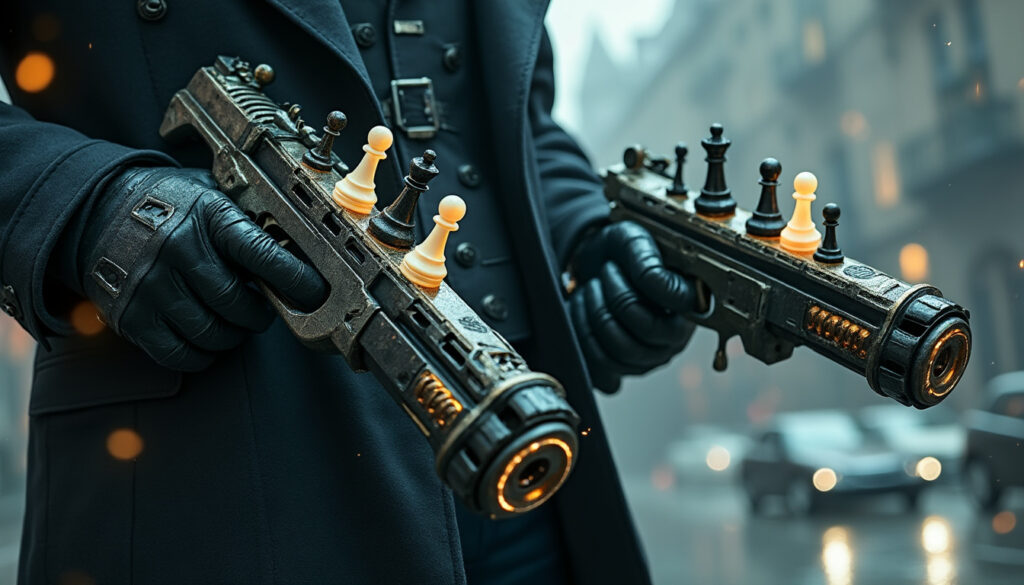
In Deadlock, the new hero Solomon turns every reload into a nod to chess history: the pieces on his chessboard take positions inspired by famous games, while his grandmaster skills come to life on the battlefield.
In Deadlock, reloading is not just about filling a magazine: the new hero Solomon turns this pause into a nod to chess history. With each change of ammunition, the pieces positioned on his chessboard take on a different configuration. Players have noticed that these positions reference actual famous games. A meticulous detail that already gives the mysterious grandmaster a unique place in Valve’s game.
Sitting in a lotus position and haloed by an enigmatic presence, Solomon seems to have stepped straight out of a game played in the heart of a New York park. But this chess master doesn’t just contemplate his next move. In battle, he can summon giant reproductions of pieces and direct them on the battlefield, as if his chessboard suddenly spilled into the streets.
A grandmaster deploying his pieces in combat
Solomon’s silhouette evokes the elderly player one might encounter, motionless and focused, near the chess tables at Union Square. His calm contrasts with the frantic clashes of Deadlock. This opposition reinforces his identity: behind the appearance of a patient strategist lies a fighter capable of turning the tide of a skirmish.
His power transposes the logic of chess into a fantastical universe. The miniature pieces are not mere decorative accessories: their giant doubles become offensive tools, moved according to their traditional movements. Each appearance thus feeds the feeling that Solomon is not shooting randomly but orchestrating the battle in his own way.
A reload animation designed down to the finest details
It is, however, while reloading that the character reveals another facet of his design. The pieces on his chessboard change arrangement depending on the number of ammunition he has left. The sequence, brief in the heat of battle, becomes a small visual puzzle for attentive players.
The configurations don’t seem to have been chosen randomly. They draw inspiration from positions arising from historical encounters, giving this animation an unexpected depth. Even an action as familiar as reloading can thus tell something about the hero and his inspirations.
Among the referenced games are famous matches from chess history, including the famous “immortal game” played in 1851 between Adolf Anderssen and Lionel Kieseritzky. Enthusiasts have also recognized a position associated with the clash between the computer Deep Blue and Garry Kasparov. This latter duel, emblematic of the encounter between human intelligence and computer calculation, resonates particularly in a game where magic and technology coexist.
Legendary games hidden in the squares
These nods reward observation rather than mere mastery of the controls. With each reload, one only needs to glance at Solomon’s chessboard to try to identify a new arrangement. Enthusiasts can compare positions, debate their origins, and share their discoveries with the community.
The reference to Anderssen and Kieseritzky recalls a game from the 19th century, famous for its audacity and spectacular sacrifices. That of Deep Blue against Kasparov echoes a pivotal moment in computer history. These choices surpass mere decoration: they connect the character to a tradition where reflection, risk-taking, and anticipation meet.
Not all configurations have yet been definitively identified by players. Lists are already circulating online, fueled by captures and comparisons with archived games. This hunt for references transforms Solomon’s presentation into a field of collective investigation.
The attention to these details contrasts with the usual speed of combat. A discreet animation can thus become a lasting topic of discussion, especially when each new discovery illuminates an aspect of the character. In a game still in development, this level of attention naturally piques curiosity.
A newcomer in a fantastic New York
Deadlock takes place in an alternative version of mid-20th century New York. The city is shaken by a catastrophic event, the Maelström, which has opened the door to fantastical creatures. In this urban backdrop, two rival deities seek to exert their influence and attract heroes ready to fight for favor.
Solomon joined the game with the “City Never Sleeps” update, alongside five other characters. This group enriches a cast already marked by references to magic, folklore, and unexpected figures. The grandmaster stands out with an immediately readable concept, yet singular enough to fuel theories.
The presentation of heroes is one of the driving forces behind the growing interest in the title. In a genre where it has become challenging to create characters that stand out, Valve bets on strange silhouettes and stories rooted in its universe. To discover how the game gained visibility despite its limited access, also check out this article dedicated to the Deadlock phenomenon on Steam.
The game remains accessible as part of a closed beta, which does not slow down conversations about its new features. On the contrary, this progressive dissemination maintains the impression that each update may hold a surprise. Players dissect animations, abilities, and decor elements with the precision of genuine detectives.
Solomon’s personality contributes to this dynamic without relying solely on his appearance. His chess theme permeates his powers, animations, and the details of his staging. The result gives the impression of a character designed around a precise idea rather than an assortment of visual gadgets.
An artistic direction seeking its own way
The success of a hero game also relies on how it makes players want to inhabit its world. Deadlock prefers a gallery of quirky characters, set in a city marked by the strange, to already familiar heroic figures. This approach helps its universe stand out in a heavily populated landscape.
The recipe does not rely on a simple stacking of spectacular powers. The characters seem linked to the decor and the conflicts that traverse the city, while their abilities extend their identity. In Solomon’s case, the chessboard offers an immediately recognizable thread.
This coherence is noticeable in even the most ordinary gestures. A reload becomes a historical reference; a piece movement can signal an attack; a contemplative posture aligns with a methodical fighter. These elements compose a personality that players can understand and comment on even before mastering all its subtleties.
The attention given to hero design comes as the audience becomes more demanding regarding live service games. In a saturated market, a new arena or an original mode is not always enough to create attachment. Details like those of Solomon give communities material to explore between skirmishes.
Discussions are already ongoing about the hidden positions on his board and their place in chess history. As players verify their hypotheses, the animation reveals new possible associations. And, in the bustling streets of this parallel New York, the grandmaster’s next move remains to be discovered.
When every reload becomes a game of chess
In Deadlock, reloading is not just a gesture between two exchanges of fire. With Solomon, this action becomes a discreet nod to chess history. With each new ammunition, the pieces arranged on his chessboard change configuration, drawing a position inspired by a real game. The player who carefully observes his hero thus discovers a detail that does not directly alter the fight but enriches his identity.
This choice matches Solomon’s personality, a grandmaster floating in a lotus position, whose talents far exceed mere parlor strategy. On the battlefield, he can materialize enormous pieces and direct them like their miniature counterparts. The boundary between reflection and confrontation blurs: the rules of the chessboard take on a spectacular dimension, while each movement evokes a carefully considered tactic.
The configurations visible on his board reference famous clashes, notably the “immortal game” played in 1851 between Adolf Anderssen and Lionel Kieseritzky, or the victory of the computer Deep Blue against Garry Kasparov in 1996. These landmarks give the animations a second reading. A reload can thus catch the eye of enthusiasts, who try to recognize the position, transforming an ordinary gesture into a small game of observation.
This attention to detail helps distinguish the hero in a universe where characters must quickly stand out. Solomon does not rely solely on a unique appearance or impressive powers: his board tells something about him, even when the action speeds up. Players can thus track his ammunition while watching for the next arrangement of pieces, as if the game continues in the background. In this fantastical city inspired by a post-war New York, his chessboard blends historical references, magic, and combat, with each reloads’ rhythm.