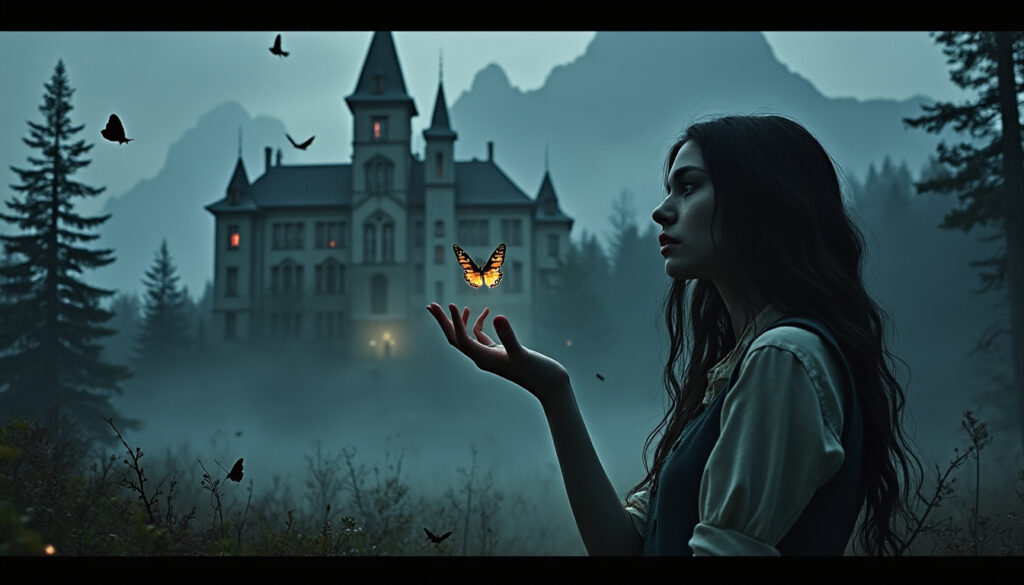
With Phenomena, Dario Argento plunges a young boarding school student into a supernatural nightmare where insects become her mysterious allies. Presented in 4K UHD and Blu-ray by Les Films du Camélia, this captivating film blends fantasy, macabre poetry, and visions of an elusive nature.
With Phenomena, Dario Argento shifts his cinema towards a more openly supernatural fantasy, where a teenager communicates with insects and navigates a world that escapes her. Long associated with a rift from a portion of his audience, this 1980s film has since regained a unique place in the filmmaker’s work. Its new 4K UHD and Blu-ray edition, offered by Les Films du Camélia, invites viewers to rediscover this fable that is both poetic, unsettling, and profoundly morbid. Upon its release, Phenomena perplexed admirers who expected the director to deliver a new variation on the mechanisms of giallo. After Inferno and Tenebrae, Argento partially abandons complex enigmas and mental architectures to position his narrative within a more direct fantasy. Jennifer Corvino is not only confronted with strange events: she herself possesses a gift that connects her to the world of insects. This teenage heroine recalls certain supernatural figures from popular cinema and literature of the time, notably the young protagonists of Carrie and Charlie, adapted from Stephen King. One might also think of Regan, a character associated with the world of The Exorcist, and its variation in The Omen by John Boorman. However, Jennifer remains a unique figure: her perceptions tie her less to a destructive power than to a vast, mysterious nature indifferent to human certainties. The film also reflects an evolution in the way the filmmaker creates, as he controls the production from start to finish. His ambition is not merely to construct a puzzle to be solved. Rather, it consists of allowing fear, contemplation, and a form of sensory communion with the living to coexist. Jennifer arrives at a Swiss boarding school after being largely left to herself. The daughter of a movie star, she is surrounded by adults and young girls, yet struggles to find her place among them. Her solitude imparts an unusual fragility to the narrative, which the film expresses with genuine tenderness. The insects are not mere macabre accessories. They compose an immense network, which the heroine accesses through a sensitivity that eludes the other characters. Human beings appear as a part of the living, not as its masters. This vision, almost pantheistic, contributes to the strangeness of the film and helps to understand the resonance it has found among viewers distant from its original Italian context. In Phenomena, the progression resembles less a methodical investigation than a drift. Jennifer traverses the locations in a state close to somnambulism, guided by impressions and invisible bonds. The narrative adopts a circular form, where each advancement seems to bring her closer to a mirror whose other side offers no reassuring explanation. This journey distances Argento from the labyrinthine construction that characterized several of his previous films. Here, the mystery does not resolve neatly: it leads to brutal violence and an almost primal disorder. The direction retains its penchant for ruptures but is more focused on the experience of the teenager than on intellectual demonstration. The character seems to carry a part of intimate experience. Argento was inspired by his daughter’s complaints to shape this child of a star, placed in luxurious boarding schools yet left to her solitude. The film does not explain this wound; it gives it a presence, particularly sensitive when Jennifer evokes a painful Christmas memory. Her connection with Professor McGregor, played by Donald Pleasence, extends this attention to isolated beings. A scientist in a wheelchair, he depends on the companionship of his pet chimpanzee and shares with the teenager a solitude that words cannot dispel. Their meeting does not rest on a paternalistic relationship, but on the quiet recognition of two existences pushed aside. This tenderness does not erase the cruelty of the narrative. The trials inflicted on certain characters can be read as an expression of familial turmoil, in a period marked by the filmmaker’s personal tensions. Part of this anger seems to crystallize in the presence of a monstrous figure, who transforms private wounds into a collective nightmare. The film, however, maintains its areas of shadow. One can perceive autobiographical echoes, thwarted projects, or even anxieties related to modernity and authoritarianism. These avenues do not point to a single explanation; rather, they reinforce the impression of a work shaped by several obsessions that cannot be entirely unraveled. The music constitutes one of the most discussed traits of Phenomena. Alongside compositions associated with Goblin and Claudio Simonetti, the original soundtrack includes tracks from contemporary hard rock and metal bands. This abundance has fueled criticisms: some saw it as a convergence with Hollywood productions seeking songs apt to attract MTV audiences. The film, however, does not merely place well-known titles over the images. The musical choices contribute to the rhythm of the narrative and its shifts in atmosphere, sometimes creating a disconcerting contrast between melody and horror. This interplay of sound, editing, and image belongs to the very identity of the work, even when it divides opinions. The blending of genres also evokes the circulation of influences in popular culture: like a playlist that dialogues with distant universes, Argento’s music opens the film to different sensibilities. To further explore this reflection on video games and their styles, one can consult this guide dedicated to five games that hold attention or discover the must-have game releases and tips for the holiday season. After a previous appearance in a box set dedicated to Argento, the film is now released in a combo Blu-ray and 4K UHD edition by Les Films du Camélia. The new master highlights the image, whose visual richness is particularly suited to contrasts, colors, and details of the sets. This presentation allows viewers to revisit the film in conditions designed to enhance its unique atmosphere. The soundtracks replicate those already provided in the Arrow editions, based on the same masters. The original version retains its Dolby Stereo mix spread over four channels, a choice that allows the film’s sound construction to be experienced without reducing it to a simple accompaniment to the image. The supplements include a presentation by Dario Argento, interviews with Jean-Baptiste Thoret and Luigi Cozzi, as well as various content around the film. Viewers can notably discover sequences titled “The Three Sarcophagi,” “Backstage,” and “Music.” Italian and English trailers complete the ensemble. More than four decades after its creation, Phenomena retains a troubling charm, straddling contemplative beauty and unvarnished violence. It marks a significant shift in Argento’s oeuvre: the filmmaker moves away from a certain theoretical distance to give more space to his characters’ vulnerability and their connection with the natural world. This evolution does not soothe the film; it makes its contrasts more palpable. Jennifer’s solitude cohabits with a nature that exceeds human perceptions, while the poetry of certain scenes prepares for eruptions of striking brutality. The edition from Les Films du Camélia thus allows viewers to rediscover a work whose uniqueness is measured as much by its images as by the questions it leaves unresolved. Curiosity about real landscapes can extend this reflection on natural forces, with a discovery of the vast spaces of Mongolia or an excursion to Kirkjufell mountain in Iceland. And for those who love to imagine new forms of play, this reflection on the possibility of transforming Mario Kart into a role-playing game extends, in a completely different register, the pleasure of hybrid universes.Dario Argento signs “Phenomena”: a supernatural nightmare presented by Les Films du Camélia
A supernatural turning point in Dario Argento’s cinema
A teenager facing a nature that surpasses her
Somnambulism, solitude, and wandering towards chaos
Vulnerable characters at the heart of horror
An original soundtrack between experimentation and popular culture
A 4K UHD edition worthy of its visual universe
A film still open to multiple interpretations
A supernatural nightmare between poetry and cruelty
With Phenomena, Dario Argento shifts the boundaries of his cinema. Where his previous works favored suspense mechanics and mental labyrinths, this film ventures into a more open fantasy, led by Jennifer Corvino, a teenager capable of communicating with insects. Her gift is not merely a plot device: it places her at the heart of a natural world that embraces her as much as it overwhelms her. The forest, the animals, and the nocturnal spaces thus compose a strange, almost contemplative landscape before violence tears it apart.
This approach accompanies a surprisingly sensitive portrait of solitude. Jennifer, estranged from her family and isolated among the students at her boarding school, finds an unexpected connection with Professor McGregor. Their meeting, marked by fragility and devoid of any condescension, imparts an unusual emotion to the narrative for Argento. Donald Pleasence imbues the character with touching melancholy, while his friendship with a pet chimpanzee underscores the central importance attributed to connections between beings, humans or otherwise.
Yet, the film retains a fierce dimension. Its narrative progresses through drifts and visions before plunging into a denouement of striking brutality. The original soundtrack, which features compositions by Goblin alongside hard rock and metal tracks, fully participates in this contrasting experience: it does not merely accompany the images but alters their rhythm and intensity. Poetic, macabre, and imbued with ecological unease, Phenomena reveals a less distant Argento, without losing any of his taste for strangeness.
The new 4K UHD and Blu-ray edition from Les Films du Camélia highlights the textures and colors of the film with particularly radiant imagery. The original Dolby Stereo tracks are spread across four channels. The supplements include a presentation by Dario Argento, interviews with Jean-Baptiste Thoret and Luigi Cozzi, sequences around the filming and music, as well as Italian and English trailers.