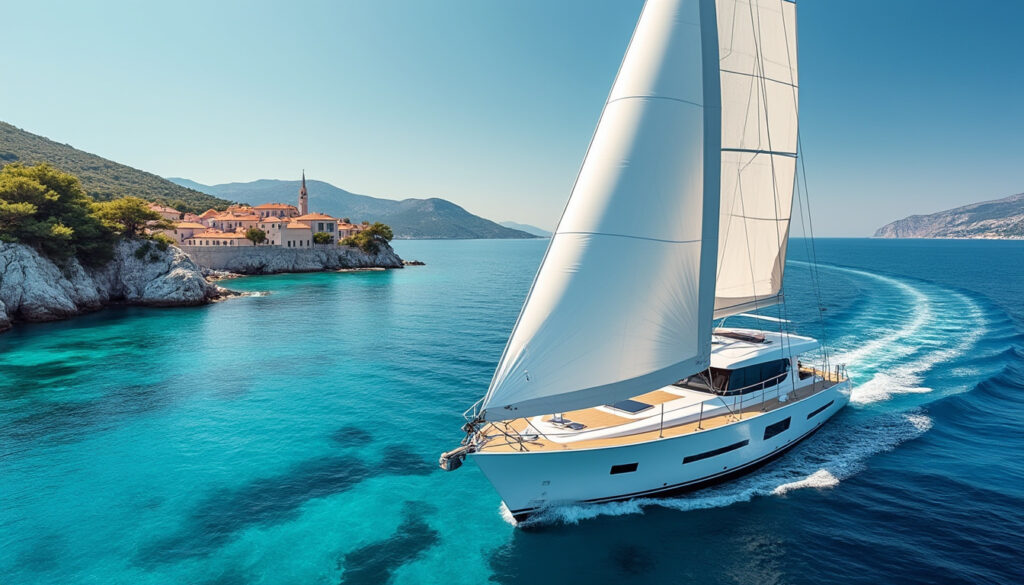
Sailing from Dubrovnik to Split allows you to discover the Dalmatian islands at a leisurely pace, amidst historical villages, vibrant ports, and turquoise coves. Each stop reveals a new face of Croatia, without lengthy journeys or hotel changes.
Connecting Dubrovnik to Split by yacht lets you explore the Dalmatian coast by water, avoiding the need for multiple car trips or changing hotels every night. In one week, the itinerary can lead to Mljet, Korčula, Hvar, and Brač, with stops in historical towns and swimming breaks in coves accessible only by boat. Aboard a small yacht, the journey alternates between tranquil sailing, free time, and evenings in the ports, far from the bustle of large cruise ships.
The crossing between Dubrovnik and Split unveils a succession of Dalmatian landscapes, featuring ancient walls, pine-covered hills, and rocky beaches. The yacht serves as both a means of transport and a place to rest, as the islands gradually appear on the horizon. This option provides a comfortable way to traverse the region, with luggage remaining in the cabin and a new setting at each stop.
The pace is generally moderate, as the days are not dedicated to long hours at sea. Depending on the itinerary and conditions, the boat sails for a few hours before reaching a port or a sheltered bay. The rest of the time can be spent swimming, visiting the shore, or simply relaxing on the deck.
An intimate cruise rather than a large ship
Croatian coastal yachts often accommodate a few dozen travelers, spread across a limited number of cabins. This reduced capacity makes onboard movement simpler and stops less impersonal. You can enjoy the common spaces without experiencing the atmosphere of a true floating city.
The cabin is usually functional, with a private bathroom, but the comfort of the journey mainly relies on its organization. Upon waking, the islands sometimes appear behind the windows, followed by a day that may continue with lunch on board and arrival at the port in the late afternoon. Evenings remain free, allowing for a choice between a stroll through the alleys and dinner on a terrace.
An itinerary from Dubrovnik to Split among Dalmatian islands and towns
The route north can be organized in several stages, each presenting a different atmosphere. Some cruises prioritize historical towns, while others linger more in bays and small island communities. The exact itinerary depends on the boat’s program, the weather, and the time allocated at each stop.
Dubrovnik, the starting point in the heart of the Adriatic
Planning a night in Dubrovnik before boarding allows for a visit to the old town without rushing. Its walls, cobbled streets, and stone facades create a remarkable setting facing the sea. From the heights, the roofs and the Adriatic provide a first glimpse of the landscapes that will accompany the week.
On the day of departure, it is useful to arrive at the port a little early to settle on board and get your bearings. Once the luggage is dropped off, the journey often begins with a sail along the coast or among the Elaphite islands. The first crossing sets the tone: time slows down, and views are revealed from the deck.
Mljet and Korčula, between protected nature and medieval heritage
Mljet provides a particularly peaceful interlude after the hustle and bustle of Dubrovnik. The island is known for its abundant vegetation, walking paths, and salt lakes, inviting exploration on foot or by bike. The clear waters of the surrounding coves are also conducive to swimming when conditions allow.
Further north, Korčula combines a medieval historic center with a rugged coastline, punctuated by small bays. Its narrow streets are easily explored on foot, while the port’s terraces offer a pause facing the boats. Even when the sky clouds over, the walls, stone houses, and coves retain the charm of the stop.
The time available on land varies from program to program, and it is better to choose a few visits than to try to see everything. A walk in the old center may suffice to grasp the atmosphere of Korčula. Travelers seeking more relaxation can also enjoy the seaside before the yacht departs.
Hvar and Brač, two islands with different temperaments
Hvar stands out for its lively port, light-colored facades, and sun-drenched streets. It has a more vibrant atmosphere than the quieter stops, with cafes, restaurants, and seaside promenades. A visit to the center can extend to a viewpoint over the port and the nearby islands.
Brač often offers a calmer atmosphere, made up of stone villages and island landscapes. Depending on the mooring location, discovery can be organized around a walk, a meal on land, or a moment of relaxation in a cove. This alternation between lively stops and peaceful rests adds variety to the navigation.
Split, urban arrival and departure towards the inland
In Split, Diocletian’s Palace forms the heart of the historic center and blends with shopping streets, squares, and cafes. The city is more urban than the small islands, but its heritage remains closely linked to daily life. You can stroll without following a strict route, passing from ancient ruins to lively quays.
Some itineraries extend the discovery towards Omiš, located near Split, at the mouth of the Cetina River. The landscape then changes sharply: cliffs and mountains frame the city while the river winds through a spectacular gorge. A boat trip on the Cetina allows you to observe these landscapes from the water, in an atmosphere different from that of the island ports.
The daily life on board and the rhythm of the stops
A typical day combines navigation, a stop in a bay, and exploration on land, without imposing a busy schedule on each passenger. Schedules may vary, but the crossings are often short enough to allow time for activities. This organization is particularly suitable for travelers who prefer to savor the stops rather than rush through them.
Swimming in the coves and moments of relaxation
Swimming breaks are some of the highlights of a coastal cruise in Croatia. The yacht can anchor near a bay where the transparent water and rocks create a natural setting. You can then swim, read on the deck, or simply enjoy the peace before continuing on.
The bottoms are often rocky, making suitable shoes useful for entering the water. A mask also allows you to observe small fish near the shore. The sea temperature varies depending on the season, and is generally cooler in spring than in the midst of summer.
Meals, visits, and evenings in the ports
Meals can be served on board or taken freely on land, depending on the chosen option and the day’s program. The ports offer the opportunity to taste local specialties in small venues while observing the activity of the waterfront. It is advisable to check in advance what is included in the cruise price.
Guided tours may be offered in some towns, particularly to better understand the historical sites. They are sometimes optional, allowing the possibility to create your own walk. After the visit, everyone can return to the boat at the agreed time or extend their evening in the surroundings.
Choosing a yacht and preparing for your cruise in Croatia
Before booking, it is useful to consider the size of the boat, the number of cabins, and the services included in the rate. A traditional yacht with around twenty cabins can accommodate nearly forty passengers, with an ambiance that generally remains calm. However, the level of comfort varies depending on the ships, cabin categories, and the season.
Who is this type of travel suitable for?
This option appeals to people who want to visit several islands without organizing each transfer themselves. It can be suitable for couples, friends, and travelers attracted to maritime landscapes, strolls, and cultural stops. The pace also allows for relaxation, with free periods both on board and on land.
However, a small-capacity yacht does not necessarily offer the entertainment, large pools, or ongoing activities of a cruise ship. The interest lies more in the proximity to the stops and in a less crowded atmosphere. Travelers seeking a very festive week would do well to check the style of the boat precisely before choosing.
What period to favor for departure?
May often allows for the discovery of the islands with lower attendance and less animated ports. However, the sea can still be cold, making swimming shorter for travelers sensitive to temperature. Spring is also a pleasant time for walks through historic centers.
June and September generally offer an interesting balance between summer conditions and more moderate crowds than in mid-summer. In July and August, the water is warmer, but the ports and the most known places are more frequented. The weather, schedules, and stops can also vary depending on the chosen week.
Budget and practical aspects for a week at sea
For a week-long cruise on a small yacht, an indicative budget of around 2,000 euros per person can be considered, depending on the cabin and season. This corresponds to an approximate figure close to 300 euros per day, excluding international flights, but the included services should be examined carefully. Expenses on land, excursions, and drinks can affect the final amount.
It is recommended to compare accommodation options and booking conditions before confirming the trip. Cabins may differ in their location, size, or configuration, and spots on board are more limited than on a large ship. To fully enjoy the stops, be sure to bring comfortable shoes, sun protection, and a light bag for shore excursions.
Sailing between Dubrovnik and Split, at the rhythm of the islands
Connecting Dubrovnik to Split by yacht means discovering the Dalmatian coast from the sea and appreciating a different way of traveling in Croatia. Along the stops, the landscapes change: ancient walls and historic streets, bustling ports, stone villages, and secluded coves succeed each other without requiring multiple land trips or repacking every day.
This sailing allows exploring several iconic islands, such as Mljet, Hvar, Brač, and Korčula, while taking the time to enjoy each one. The stops alternate between strolls in ancient centers, breaks on terraces, and swims in clear waters. The crossings are generally short enough to leave ample time for discoveries and moments of relaxation on board.
The format of a small yacht gives the stay a more peaceful atmosphere than that of a large cruise ship. Days are simply organized around navigation, stops, and individual desires. You can read on the deck, rest after lunch, explore a port at your own pace, or enjoy a stop in a bay accessible only by boat. In the evening, arrival in a new city offers the opportunity for dinner on land and to taste the atmosphere of the Dalmatian quays.
To fully appreciate this experience, the periods of June and September often provide a good balance between pleasant weather and moderate crowding. The budget depends on the season and the cabin, but expect around €2,000 per person for a week, excluding international flights. Amid maritime landscapes, heritage, and a relaxed pace, this cruise is mainly aimed at travelers who want to discover the Croatian islands without haste.