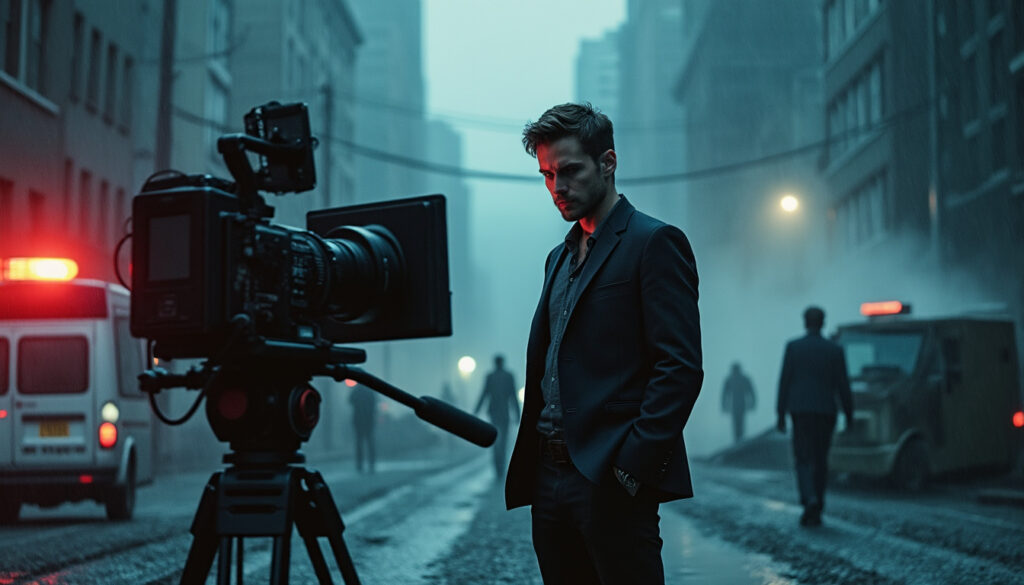
With Resident Evil, Zach Cregger takes the helm of a new interpretation of the saga, where dark humor gradually gives way to visceral horror. In a night that turns into a nightmare, an ordinary delivery driver faces a monstrous contamination and a world that is losing its bearings.
With his reinterpretation of Resident Evil, Zach Cregger abandons the codes of spectacular action to reconnect with organic, dark, and unpredictable horror. The film follows Bryan, an ordinary medical courier caught in an increasingly nightmarish night in Raccoon City. Between macabre humor, deformed creatures, and the collapse of references, this new adaptation transforms a mundane trip into a tragic dive into a contaminated world.
After Barbarian and Vanishing, the filmmaker returns to a universe where the threat does not just appear on screen: it infiltrates every space, cracks relationships, and contaminates the narrative itself. His approach favors a gradual fear, nourished by the impression that the daily life can tip over before the characters understand what is happening to them. The result moves away from loud action adventures to reconnect with a stickier tension, close to the atmosphere of the original games.
A night race with a farcical air
At the beginning, Bryan seems mainly like a victim of his own clumsiness. Played by Austin Abrams, already seen in a supporting role in Vanishing, this medical courier is simply trying to validate the delivery of a package in an overwhelmed hospital. The scene takes on an almost farcical tone: the instructions become garbled, the corridors seem endless, and the hero struggles to find his place in a facility in complete disarray.
A manager ultimately assigns him a new job, this time to Raccoon City, in the heart of the Colorado mountains. The refrigerated bag he carries gives a destination to his journey, but also a material challenge to a story where everything seems to quickly slip out of human control. For viewers who enjoy extending the video game experience after a screening, this selection of must-have games to grab during the PlayStation anniversary sale offers another way to find remarkable universes.
When laughter enhances fear
The lightness of the initial moments does not serve to reassure for long: it prepares an increasingly cruel contrast. On a snowy road, Bryan encounters infected beings and creatures whose appearance transforms the landscape into a hostile territory. The episode of an isolated farm alternates between genuine chills and physical comedy, sometimes based on clumsiness that is as predictable as it is delightful.
This blend may surprise, but it gives the film a distinct identity. Laughter does not neutralize violence; it sometimes makes it more uncomfortable, because the bodies are at once objects of gags, suffering, and transformation. This alliance between the grotesque and the gore reminds us that horror can also come through absurd gestures, a failed movement, or a situation whose brutality eventually exceeds all measure.
As the night progresses, the social farce dissolves into a much larger threat. The successive stages of the journey strip Bryan of his references, while the familiar space becomes foreign and the city transforms into an almost infernal backdrop. This escalation recalls certain tales of nocturnal drift, where every detour pulls the protagonist further away from any reasonable exit.
An ordinary protagonist facing collapse
Bryan is far from a hero immediately ready to save anyone. His awkwardness makes him relatable, and his status as a simple delivery driver grounds him in a recognizable reality before the narrative sweeps him towards the extraordinary. One can thus read his evolution as a gradual deformation of humanity: he becomes more effective in a world that rewards brutality, but this adaptation threatens to render him unrecognizable.
The package he carries then becomes much more than a narrative pretext. It represents the only concrete resource he has to confront the infection, even as the catastrophe seems to spread faster than his ability to act. The tension arises from this disproportion between an isolated individual and a threat that engulfs institutions, places of refuge, and personal ties.
A metamorphosis at the heart of the narrative
The character’s transformation does not follow the classic path of a triumphant hero. Bryan remains vulnerable, makes mistakes, and is often overwhelmed by events. Yet, each trial forces him to act differently, until his awkward body learns the necessary gestures for survival, at the cost of an unsettling closeness to the surrounding violence.
This trajectory echoes the film’s central idea: the infection does not only alter bodies, it also disrupts values and behaviors. The character who initially tries to avoid trouble gradually finds himself in the midst of a world where compassion is no longer enough to protect anyone. His progression retains a tragic dimension, as becoming more adept at survival does not necessarily mean preserving what makes him human.
The catastrophe thus takes on a form that is both intimate and collective. It traverses the inhabitants of Raccoon City, but also the emotional relationships Bryan thought he could still preserve. In the face of this disintegration, his journey guarantees neither a clear victory nor a return to balance: it rather depicts the struggle of an individual against a night that keeps gaining ground.
Monsters conceived as collective nightmares
The creatures are among the most striking elements of this reinterpretation. Their deformed silhouettes sometimes evoke the visual excesses of 1980s fantasy cinema, without reducing to a nostalgic wink. Their disturbing appearance also comes from the way several bodies seem to merge, giving rise to composite forms where arms and legs no longer compose a familiar anatomy.
This work on deformity places the monsters in a logic of recomposition rather than simple mutation. They appear as living assemblages, almost organized, whose cohesion evokes a community as troubling as it is aggressive. Beneath their grotesque appearance lies an image of a defeated family, recomposed by disease into a collective presence that moves forward, attacks, and devours.
The snowy farm effectively concentrates this unease. Its isolation evokes the enclosed places of horror science fiction, notably the world of The Thing, where the threat transforms trust into suspicion. But here, the anxiety does not remain confined within a few walls: it escapes into the streets and gradually spreads throughout the city.
For video game enthusiasts, these creatures remind us that horror does not solely rest on the power of a machine or the sharpness of the image. The announcements surrounding a console capable of running a large part of the Steam catalog in 4K at 60 frames per second thanks to FSR also illustrate the evolution of gaming technical means; the details can be found in this article about FSR technology and Valve’s new console. In Cregger’s film, however, it is indeed the design of bodies and their physical presence that gives monsters their staggering power.
The fragile traces of a world before
Two discreet images illuminate the darkness of the narrative without interrupting its flow. In the farmhouse, a brief look at a photograph shows the former owners before the contamination, peaceful and united. This simple detail coexists with two states of the same place: the tranquility of the past and the present brutality, condensed in a nearly furtive change of shot.
Another scene takes place in an underground parking lot, as Bryan hides. On the rear window of a car, a sticker depicts a family accompanied by their dog. The drawing echoes the photograph of the farm and touches on a more personal anxiety: the character also wonders about a possible fatherhood, a subject of disagreement within an already fragile couple.
His emotion in front of this vignette stems from what it represents as much as from what it announces. Families once recognizable are threatened with becoming monstrous forms, unrecognizable bodies fused in a same violence. The film then suggests that horror does not only destroy individuals: it erases the bonds that allowed them to recognize each other as close.
A faithful adaptation to the spirit of the games, without easy nostalgia
By approaching the dark atmosphere of the early games, the film chooses a different path from previous adaptations that were more action-oriented and focused on physical prowess. The tension relies less on the virtuosity of combat than on the impression of being trapped in an environment that gives way. This orientation should resonate with players attached to threatening places, limited resources, and uncertainty, rather than just the accumulation of spectacular scenes.
However, the narrative still maintains a playful dimension in its progression. Each new step brings a threat, a strangeness, or an obstacle that changes the perception of what precedes it. This structure maintains curiosity without transforming the narrative into a mere succession of challenges: the danger evolves alongside Bryan and the world he traverses.
The current state of video games reminds us that adaptations and major franchises are part of an ever-evolving sector. The debates about production methods bear witness to this, as shown by the comments of a former Capcom employee denouncing the time that some Western studios allocate to Jira, mentioned in this article about management tools and studio organization. On screen, Cregger prioritizes the construction of a sensory experience, where the progression of the nightmare gives coherence to the whole.
A darkness traversed by the burlesque
The tone of the film does not allow itself to be confined to a single category. Its graphic violence is accompanied by deliberately grotesque situations, while the initial humor becomes harsher as bodies become the supports of fear. This contrast prevents the viewer from settling comfortably into a single genre, and gives the comedic passages a sometimes macabre resonance.
This audacity also stems from the focus on the protagonist’s weaknesses. Bryan does not suddenly become an invincible figure; he retains something of his embarrassment, even when danger forces him to surpass himself. Identification thus builds on a visible fragility, making every act of survival more concrete and the shift toward monstrosity more disturbing.
The film thus moves between two poles: the bodily laughter and visceral dread. One never cancels the other, as both are built around battered, exposed, and transformed bodies. The violence becomes all the more striking as the narrative has sometimes preceded it with a gag that seemed, a moment earlier, almost innocent.
This hybridity is part of a landscape where releases, updates, and adaptations constantly fuel player conversations. To follow another anticipated appointment around video game licenses, one can check this post on announced developments for the longest Nintendo Direct. The film, however, stands out for an approach that prefers persistent anxiety over the simple celebration of a known brand.
An horror experience prioritizing visual impact
Fans of gore and impressive creatures will find in this adaptation a particularly physical offering. The staging emphasizes silhouettes, distortions, and the proximity of threats, rather than a reassuring distance. The horror sequences thus seek to mark the memory through their strangeness as much as through their brutality.
The darkness of the script does not prevent it from maintaining a very pronounced entertainment energy. The film knows how to provoke, surprise, and reignite its narrative through tonal shifts, without hiding the gravity of what it tells. This coexistence between genre pleasure and pessimistic vision gives the whole a unique color, where the spectacular never completely chases away the discomfort.
The care given to the atmosphere contributes to this impression of engulfment. The saturated hospital, the snowy road, the isolated farm, and urban spaces compose successive stages in the loss of bearings. Each setting seems to hold a threat, as if the catastrophe had already taken possession of the places even before Bryan enters.
Spectators sensitive to very graphic images might prefer to avoid certain scenes, while enthusiasts of visceral horror will find a generous direction. The film is aimed at those who appreciate tales where characters do not have the assurance of emerging unscathed from their confrontation with the unknown. To extend an evening devoted to cinema and gaming, this guide dedicated to Blu-ray offers and several PS VR2 games also gathers some discovery paths at home.
With this new version of Resident Evil, Zach Cregger abandons spectacular effects in favor of a more troubling horror, rooted in bodies and in the gradual loss of bearings. The narrative, however, opens on an almost light note: Bryan, an awkward delivery driver charged with a medical mission, navigates a chaotic hospital routine before being sent to Raccoon City. This introduction, close to dark comedy, makes the shift to a contaminated world all the more striking, where each step brings its share of threats.
The director organizes this descent like a night that gradually closes in on its character. The isolated farmhouse under the snow constitutes a first territory of trial, where physical farce mingles with genuinely worrisome eruptions. Then the catastrophe extends to the city and transforms the setting into a nightmarish landscape. Humor does not lighten this violence; it rather emphasizes the absurdity of the situations and makes certain scenes even more uncomfortable. Bryan’s clumsiness first nourishes identification before his body and gestures are drawn into a troubling metamorphosis.
The monsters fully participate in this vision. Their composite forms evoke assemblages of limbs and bodies, as if the contamination abolished even the integrity of individuals. This imagery connects to the rare signs of a peaceful family life that the film scatters throughout its setting: a photograph, a sticker, fragile traces of attachment. Their contrast with the surrounding violence gives the nightmare a tragic dimension, beyond immediate dread.
By reconnecting with the sticky atmosphere of the video game, Cregger offers a singular approach to the franchise, both bloody, grotesque, and dark. Resident Evil thus becomes the terrain of an experience where fear progresses with a macabre irony, as humanity unravels before our eyes.