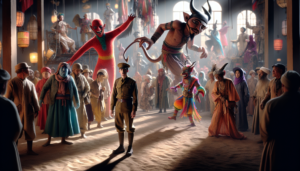
In this remastered version of Caligula by the famous director Tinto Brass, immerse yourself in the intense and captivating world of the Roman emperor with unbridled desires. Discover an iconic cinematographic work, enhanced by a new artistic vision.
A Project of Colossal Egos
In 1976, Franco Rossellini, nephew of Roberto, proposes to Tinto Brass to make the film Caligula. This project would become the fruit of the collaboration and confrontations between three creative personalities: the writer Gore Vidal, the producer Bob Guccione, and director Tinto Brass. Each had a distinct vision of the film: Vidal wanted a classic intellectual saga, Guccione aimed for a film erotic and commercial, while Brass wanted to create a political satire of ancient Rome.
An epic shoot
Filming began in the summer of 1976 in Dear Studios in Rome. The budget quickly exploded, reaching $22,000,000. Danilo Donati, Fellini’s faithful collaborator, designed 64 extravagant sets as well as 3,500 costumes and accessories. The cast shone with its diversity with actors like Malcolm McDowell, Helen Mirren, and Peter O’Toole.
Behind-the-scenes conflicts
Tensions arise very quickly between Brass and Vidal. Vidal’s ideas on the intellectualization of the film oppose Brass’s baroque and ironic vision. The screenwriter leaves the project, followed by a series of conflicts that continue into post-production. Guccione, dissatisfied with Brass’s vision, appropriates the editing to add pornographic scenes secretly toured.
A Film Without a Name
The original edit of Brass never saw the light of day. Caligula remains a film without a definitive version, mixing elements of different creative visions. Brass’s version is permanently lost, making each attempt at reconstruction incomplete and imperfect.
Rediscovery and Remastering
In 2019, 90 hours of unused footage was found in the Penthouse archives. Thomas Negovan, writer and art historian, accepts the challenge of re-editing the film using the original script and reincorporating the original voice. Despite some frustrations with this reconstruction, Negovan aims to honor Brass’s original project.
The Strengths and Weaknesses of the New Version
This new version eliminates pornographic inserts and attempts to find the political and contemporary vision by Tinto Brass. However, it lacks the exuberance and madness
characteristics of Brass’s films. Some iconic moments disappear, and questionable choices are made, such as digital additions.
A Heritage Reevaluated
Despite its imperfections, this remastered version allows you to rediscover Caligula from a new angle. The film gains in tragic depth and introspection what it loses in grotesqueness. The relationships between the characters are better explored, and the acting, particularly that of Helen Mirren, shines.
A Monstrously Mesmerizing Film
This new montage partly rehabilitates the artistic chaos that was Caligula. Even if it remains quite far from the version that Tinto Brass would have liked, it allows us to better understand the director’s initial ambition: to create a film that is both political and deeply contemporary.
Don’t miss the opportunity to experience this ultimate, remastered version, which manages to do justice to Tinto Brass’ complex and daring vision.