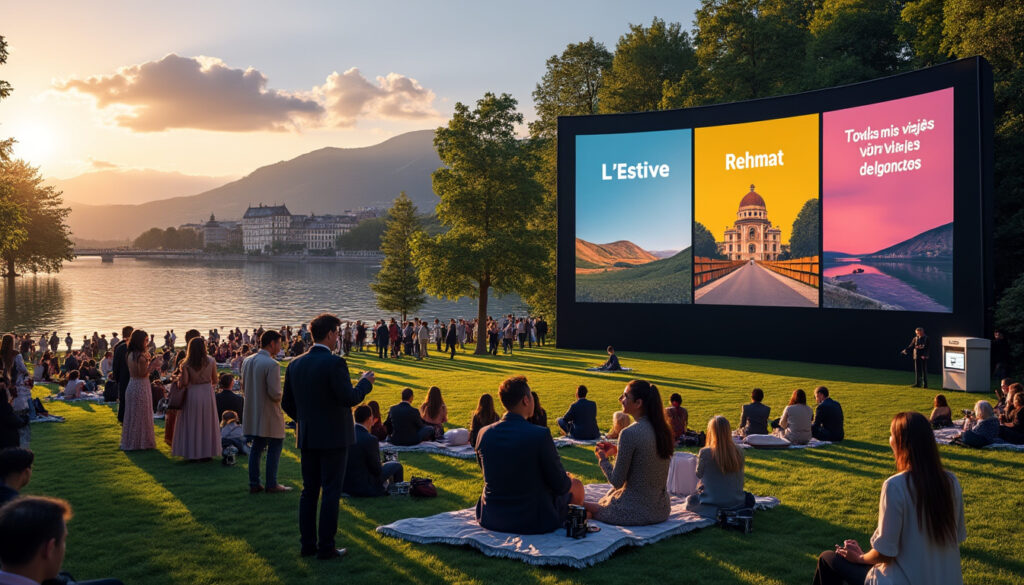
The Locarno Festival 2026 stands out for its bold programming, highlighting cinematic works that question the relationships between time and space. Among the films presented this year, L’Estive by Naël Khleifi and Lisa Debauche, Rehmat by Gurvinder Singh, and Todos mis viajes son viajes de regreso by Manuel Ponce de Léon stand out for their sensitive and contemplative approach, each in its own way revealing narratives deeply rooted in contemporary social and existential realities.
This year, the Locarno Festival 2026 promises to be rich in emotions and reflections through a selection of captivating films. Among them is L’Estive, a striking work that addresses deep social themes. Rehmat, on the other hand, immerses the viewer in a poignant social critique through a specific visual slowness. Finally, Todos mis viajes son viajes de regreso offers a unique sensory experience, filled with wandering and beauty. This article aims to explore these films that brilliantly illustrate contemporary issues.
L’Estive: an introspective journey in the high mountains
The film L’Estive, directed by Naël Khleifi and Lisa Debauche, poetically illustrates the complex relationship between time and space. The work, lasting 1 hour and 5 minutes, avoids the superfluous embellishments often associated with festival films. Here, everything unfolds in the majestic Alps, without losing sight of the heart of its narrative, centered on the character of Hana, portrayed by Manal Issa. This young woman, who arrived from war-torn Lebanon, learns to become a shepherdess. She is confronted with migrants crossing her territory, seeking a better future.
The themes of isolation and connection to roots are beautifully represented, notably through a phone call scene that underscores Hana’s disconnection from her mother. The film transforms into a thoughtful metaphor for social realities, where the sheep become reflections of lost migrants. The filmmakers capture the movements of the various grasses of the landscape, thus showing a contrast with humanity in suffering.
Rehmat: slowness as a reflection of a frozen society
In a completely different register, Rehmat, by director Gurvinder Singh, immerses us in a structured critique of Indian society. This film addresses the difficulty of evolving, imbued with a captivating slowness that, although heavy, represents the stagnation of the characters. Through subtle staging, we discover the tension of a village in Punjab, where men are often absent, dead, or on the run. The early parts of the film mark a duality between the inside of the house and the outside world, which remains invisible.
The duration of the shots is often excessive, but this approach is contrasted with moments of clarity and urgency. This duality raises questions about power and patriarchy, here revealed by a British character imposing himself strangely in this frozen microcosm. Beyond provoking thought, the work can sometimes flirt with boredom, losing itself in its own ambition. However, this slowness still serves to depict an eloquent social picture.
Todos mis viajes son viajes de regreso: a poetic wandering
The film Todos mis viajes son viajes de regreso, by young Colombian filmmaker Manuel Ponce de Léon, brings a fascinating sensory dimension. Inspired by the poet León de Greiff, it tells the story of two Swedes looking to colonize a piece of land in South America. The filmed landscapes are both beautiful and hostile. The characters are imprisoned in their solitude. The sensory experience intensifies through the slowness and silence of the film, making the fragility of their quest palpable.
Ponce de Léon’s staging creates an immersive universe, where the viewer can feel the acceleration of time through the lost gazes of the protagonists. The film evokes the cinema of Lisandro Alonso through its search for radical immersion. The stories repeat, creating a feeling of temporal wandering, almost dreamlike. The characters and the viewer thus confront an emotional labyrinth, where time becomes liquid, and where the journey is more than just a physical displacement.
This festival is also distinguished by unique perspectives within the current cinematic landscape. The works, each in their own way, question our understanding of the world, from migrants to patriarchy, thus offering an essential pathway of reflection. Through these deeply human narratives, the Locarno Festival 2026 reminds us that cinema remains a powerful vector of societal questions.
Conclusion on the Locarno Festival 2026
The seventy-ninth edition of the Locarno Festival has provided a remarkable platform for cinematic expression, highlighting works such as L’Estive, Rehmat, and Todos mis viajes son viajes de regreso. Each of these films offers a unique exploration of the themes of wandering, time, and identity, while critically examining contemporary realities.
L’Estive, by Naël Khleifi and Lisa Debauche, stands out for its ability to capture the beauty and harshness of life in the high mountains, while illustrating the complexity of humanity in the face of migration and war. The softness of its landscapes contrasts with the anxiety of some characters, thus creating a cinematic experience rich in emotions and reflections. The film asserts itself as a powerful tableau of the link between nature and the human condition, inviting the viewer to contemplation.
In contrast, Rehmat, while ambitious in its attempt to address social issues, faces clumsiness that dilutes the impact of its message. Gurvinder Singh explores patriarchy and social stagnation in India; however, his overly forceful aesthetic choices generate an impression of slowness that may lead to some boredom for the viewer. This highlights the difficulty of capturing the essence of time while maintaining interest.
For its part, Todos mis viajes son viajes de regreso by Manuel Ponce de Léon succeeds in creating a fully immersive atmosphere, where the physicality of time and places is palpable. The film, rich in symbolism and poetry, convinces with its ability to plunge the audience into a wandering that is both spiritual and geographical, echoing universal questions of identity and memory.