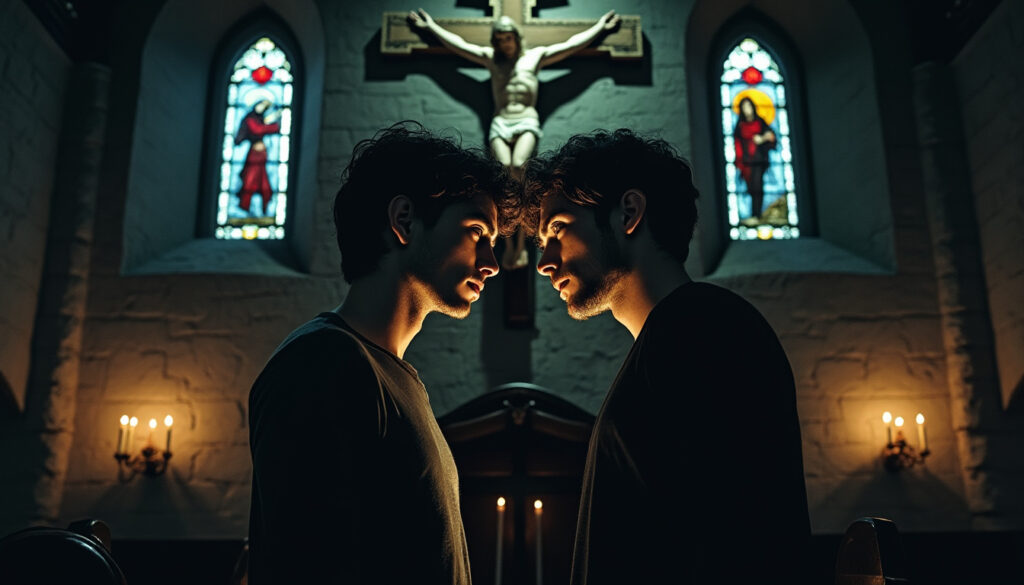
In Leviticus, Adrian Chiarella transforms a forbidden teenage romance into a supernatural nightmare. At the heart of a strict religious community, faith becomes oppressive, desire a threat to conceal, and horror the mirror of a very real violence.
With Leviticus, Australian filmmaker Adrian Chiarella turns a teenage love story into a fantastic nightmare. Naim and Ryan grow attached to each other in a small town where religion shapes the rules of life as much as the silences. Released on October 7, 2026, this first feature film makes supernatural fear a reflection of very real oppression.
The film particularly left an impression during the 2026 edition of L’Étrange Festival, where this review was published. It extends the tradition of horror cinema capable of conjuring fear within ordinary situations while developing a unique voice. The impressions and images from this edition can also be found in this recap of L’Étrange Festival 2026.
Two adolescents under the gaze of a community
Naim, reserved and little noticed at school, evolves apart from Ryan, a popular boy who seems more comfortable in his body and in the world around him. Outside of school, however, the two teenagers grow closer and discover a feeling that surpasses their initial attraction. Their relationship takes shape in the margins, away from prying eyes, as their strict Catholic environment offers them no space to love freely. The contrast between their budding tenderness and the harshness of their surroundings gives the narrative its initial dramatic tension.
Fear as an extension of religious violence
A denunciation, born of pain and jealousy, leads the boys to a clergyman who claims to be able to correct their desires. His conversion methods plunge the story into supernatural terror when a deadly presence begins to haunt the affected youth. It can take the form of a loved one, transforming trust into a trap and the desire for closeness into a threat. This idea gives the monster a precise function: it makes visible the grip of a system that condemns teenagers instead of protecting them. The creature terrifies, but the authority that allows it to enter their lives seems equally worrisome.
The title refers to a biblical text whose interpretations have been used to justify the exclusion of homosexual individuals. Chiarella does not treat faith as an abstraction: he shows how its most dogmatic uses are inscribed in gestures, habits, and family relationships. Adults are not only figures of authority; they also live within an order that limits what they can hear or recognize. Thus, oppression does not solely depend on explicit threats. It spreads through unspoken words, looks that divert conversation, and beliefs presented as indisputable.
The staging places great emphasis on what cannot be put into words. Conversations between generations often seem hindered, while collective rituals offer the community its rare moments of common expression. The music of Jed Kurzel accompanies this atmosphere without reducing each scene to a simple suspense effect. Silences then become a form of pressure: they isolate the characters and leave them alone in the face of interpretations that condemn them. When the fantastic emerges, it seems to give a body to what was already weighing heavily on them.
A curse targeting intimacy
The supernatural threat targets those whom their surrounding community refuses to accept. It appears particularly when its victims are isolated, but its power is rooted in the social gaze that watches over them and forbids them from feeling safe. Even love, which should offer refuge, can become the bait of the creature. By making attachment a risk, Leviticus reveals the cruelty of a world where the intimacy of young people is constantly put into question. This horrific mechanism is therefore not detached from the drama: it prolongs the wounds under a physical and threatening form. Moments of terror gain their strength from this proximity between fantastic danger and emotional reality.
The film recalls certain aspects of It Follows, a work by David Robert Mitchell where an inexorable threat accompanies the upheavals tied to desire and adolescence. But Chiarella shifts the center of gravity toward characters caught in a particularly hostile religious and social framework. The fear of growing up intertwines here with the fear of being discovered, denounced, or rejected by the adults who should serve as reference points. This perspective gives the narrative a collective dimension: the young lovers are not just fighting against an entity but against an environment that transforms their existence into a fault. The comparison highlights a kinship of atmosphere, without erasing the unique sensitivity of Chiarella’s first film.
The filmmaker also nourishes his narrative with an intimate experience of harassment and exclusion. This autobiographical dimension adds weight to the film’s anger, without reducing its characters to symbols. Naim and Ryan retain their hesitations, their clumsiness, and their contradictory desires, qualities that make their bond credible and vulnerable. Their story does not merely illustrate a thesis on intolerance: it follows two boys trying to understand what they feel while adults are already imposing an answer on them. As the threat approaches, their affection becomes both a source of courage and a point of fragility. It is this attention to emotions that prevents horror from closing in on its visual effects alone.
A first film that embeds its horror in the real
The direction favors a form of sobriety that allows situations and faces to create discomfort. Rather than multiplying explanations, it maintains an uncertainty where each appearance can shake the characters’ trust. The threat thus retains an element of opacity, while its effects on the young protagonists remain concrete. This choice reinforces the impression of a daily world becoming gradually uninhabitable. Terror arises as much from what is perceived as from what is sensed behind closed doors. The family settings and community spaces then take on an almost gothic tone, without losing their realistic grounding.
Joe Bird portrays a withdrawn Naim, whose vulnerability is visible in his attitudes before fully expressing it in words. Stacy Clausen brings to Ryan a confidence that neither cancels out his doubts nor the consequences of his choices. Their performance avoids locking the couple into an overly simplistic opposition between victim and perpetrator and gives the narrative a true emotional depth. Nicholas Hope, as a clergyman involved in conversion practices, embodies an authority whose apparent calm makes the methods even more chilling. The actors thus help maintain the balance between teenage romance, social drama, and horror narrative, without any of these registers overshadowing the others.
This alliance of genres is what makes the film distinctive. The scenes of threat do not interrupt the social message: they make it tangible by materializing the consequences of a fear fostered by the surroundings. Conversely, the political dimension does not neutralize the suspense, as the peril is tangible and the characters cannot turn away from it. The narrative moves along this double line, between the hope of a shared love and the danger of a society that treats it as a transgression. Its violence is sometimes harrowing, but it is accompanied by a constant attention to those who suffer it. By giving the two teenagers a life more complex than their sole function in the plot, Chiarella imbues his nightmare with real human significance.
Faith, desire, and horror in Leviticus
In Leviticus, Adrian Chiarella makes horror much more than a mere suspense mechanism. The curse that pursues Naim, Ryan, and the other youths in their community materializes the violence of an environment where desire is condemned even before it can be named. It takes on the traits of a loved one, turning romantic passion into a trap and intimacy into a threat. This idea gives the fantastic a singular force: the monster emerges from the fears that the community nurtures, as much as from the shadows haunting the characters.
Faith, in the film, is not reduced to a personal belief. It structures daily gestures, family relationships, and collective rules, to the point of suffocating any word that deviates from the norm. Rituals offer a common language, but exchanges between adults and teenagers remain hindered, sometimes overshadowed by music or silence. Naim and Ryan navigate a world where they must hide their feelings while adults pretend to correct them in the name of an unquestionable truth. Horror also arises from this contradiction between the discourse of protection and the reality of persecution.
The staging, attentive to familiar spaces that have become unsettling, accompanies this oppression without reducing it to a spectacular effect. Chiarella takes the time to characterize his characters and to feel what their isolation costs them. Terror therefore works on two levels: it provokes physical fear, but also reveals the social mechanisms that deprive these adolescents of security and freedom. By giving a visible form to the threat, the film exposes what, in their environment, lies hidden behind religious precepts and familial silences.
The encounter between faith, desire, and horror gives Leviticus its lasting unease. The fantastic and the intimate drama intertwine, while the love of the two boys confronts a community that treats it as a fault. This tension nourishes a narrative where each appearance shakes the boundary between supernatural threat and very real violence.