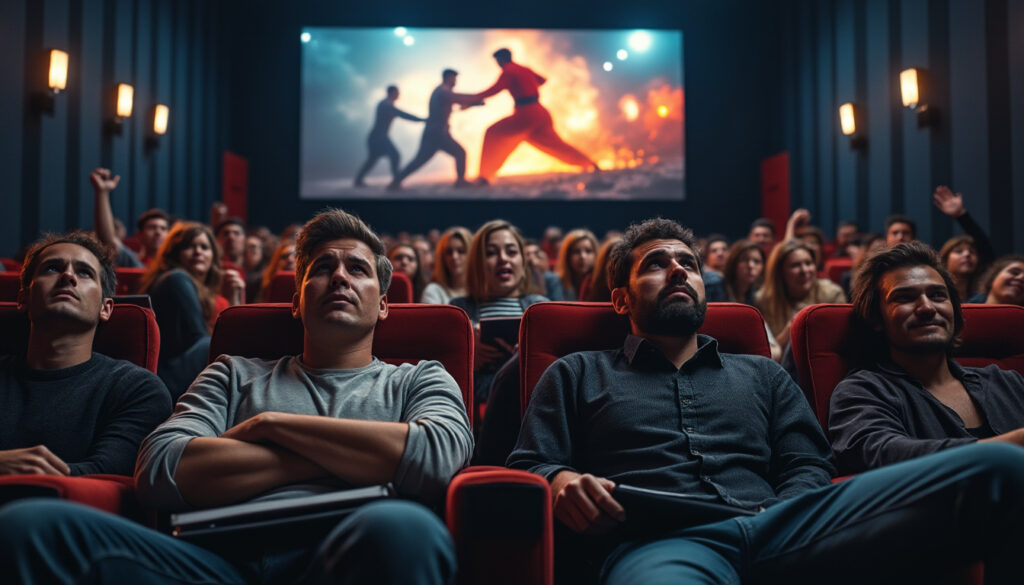
The new Street Fighter is facing a barrage of criticism, accused of losing track between its spectacular battles and its unbridled humor. However, some viewers actually appreciate its chaotic energy and B-movie spirit: a wild uppercut, but not necessarily without charm.
With its sprawling cast, extravagant fights, and deliberately quirky humor, the new Street Fighter promised a grand spectacle inspired by a cult franchise. In the end, critics often denounce a disjointed narrative and jokes that fall flat. However, a few voices defend a disordered film that is energetic enough to entertain fans of outrageous brawls.
On paper, the ingredients seemed to be in place for a spectacular adaptation. Noah Centineo plays Ken Masters, Andrew Koji lends his features to Ryu, and Callina Liang portrays Chun-Li, while David Dastmalchian takes on the role of the antagonist M. Bison. This cast includes Cody Rhodes as Guile, 50 Cent as Balrog, and comedian Eric André as host Don Savage. The film therefore lacks neither familiar faces nor surprising choices.
The direction is by Kitao Sakurai, known for his work on The Eric Andre Show. The promotion did not hide the ambition of old-fashioned entertainment, deliberately excessive and filled with references to video games. But early reviews describe a work where ideas clash without always finding their place. The result, often labeled as confusing, struggles to turn its energy into true coherence.
A hitting adaptation that sometimes misses its target
Several critics complain that the screenplay juggles too many characters and plots without giving them enough room. Ken and Ryu’s arcs sometimes seem rushed, while the tournament is overshadowed by a conspiracy involving M. Bison. Some jokes also appear to come at the wrong moment, as if the feature hesitated between parody, serious action, and nostalgic tribute. This indecision feeds the impression of a film that changes direction mid-fight.
The editing and sound treatment are also part of the complaints reported in initial reviews. Variety notes particularly difficult-to-hear dialogues, masked by particularly loud mixing. TheWrap, in turn, depicts an unconvincing nostalgia for the 1990s combined with a form of cultural mismatch. In other words, even the elements meant to reinforce the film’s identity sometimes become obstacles to its readability.
Severe reviews, despite some visible qualities
The critical reception is particularly cold: the film has an early score of 41% on Rotten Tomatoes. Multiple observers judge it far from being a success, even if some place it above the 2024 adaptation of Borderlands. The phrases used in the reviews are not kind, ranging from “incoherent disaster” to an unflattering comparison to a box of rocks. The prevailing verdict is clear: the potential of the franchise has not been enough to convince the press.
Polygon, however, gives an enthusiastic welcome to David Dastmalchian. In the opening minutes, his portrayal of M. Bison fully embraces the taste for grand guignol and B-movie cinema. The critic believes that the actor understands better than his partners the extravagant tone sought. This performance stands out as one of the few bravura moments that several viewers might remember.
The flaws do not prevent some form of enjoyment. For IndieWire, the film is overflowing with complicated plots and awkwardly constructed gags, but at least it does not become boring. The paper also appreciates its spectacular appearance and its approach that allows the audience to project their own memories onto the action. The enjoyment may then come less from the story than from the visual energy.
The messy charm of unrestrained fighting films
The New York Times likens the experience to the unfettered imagination of a child who has spent his coins in an arcade. The fights pile up, the fighters showcase their styles, and the narrative sometimes seems driven by a game-like logic: “and then, another fight.” This accumulation can be exhausting, but it also possesses a form of spontaneity. Here we find the primal appeal of fighting games: choosing a character, watching the punches fly, and savoring the chaos.
Why some viewers can still have fun
IGN summarizes this contradiction with a deliberately provocative comparison: the film would be as dumb as a box of rocks, but throwing rocks at things can be fun with the right people. The phrase underscores the importance of the viewing atmosphere. Among friends, in a receptive theater to excesses and awkwardness, some scenes can become moments of shared laughter. The disorder, a flaw for some, then becomes part of the spectacle for others.
This tolerance for imperfect films has existed for a long time in fighting cinema. Fans of muscular narratives and outrageous choreography can find this tradition by exploring this dive into the world of Bloodsport, a classic fighting film released in 1988. The comparison does not mean that the two works are equivalent but reminds that an action film can entice through its intensity as much as through its narrative finesse. When the punches rain down, some viewers willingly accept that the story follows behind.
The film also plays on an arcade nostalgia whose effectiveness strongly depends on the audience. For long-time fans, spotting familiar fighters and recognizing nods can be enough to spark immediate pleasure. Others will expect more: well-constructed stakes, developed characters, and confrontations that truly serve the narrative. The franchise has offered a rich imaginary for decades, but cinema still needs to find how to translate it without reducing it to a succession of references.
Fighting game enthusiasts do not necessarily need a complex plot to have fun. They may be looking primarily for distinctive styles, memorable rivalries, and scenes where each fighter seems to impose their personality. This also explains the lasting appeal of narrative and spectacular video games, as shown by our selection of must-play PS5 games to discover. On screen, however, the action must retain enough clarity for the audience to understand what is happening.
An experience more suited for fans than newcomers
Several reviews suggest that this adaptation works better as a chaotic attraction than as an entry point into the series’ universe. Slashfilm believes it can be watched without difficulty in the moment while leaving a hollow and bitter impression. The film therefore seems primarily aimed at those who already know the characters and accept their extravagances. For a newcomer, the abundance of characters and nods may conversely complicate immersion.
A cult franchise tested by Hollywood
Adapting a fighting game series poses a particular challenge: much of its enjoyment hinges on direct confrontation, iconic moves, and the visual personality of the fighters. Cinema must connect these elements to a narrative without slowing down the pace or obscuring what makes each character recognizable. Here, critics believe that this balance is disrupted, especially when the tournament and M. Bison’s schemes vie for attention. The grand spectacle does not automatically replace a solid structure.
The comparison with other video game adaptations inevitably arises. The audience has recently experienced very different offerings, and announcements of new games continue to fuel community expectations, as highlighted in our overview of notable announcements from the Game Awards 2025. But the enthusiasm generated by a franchise does not guarantee a favorable reception in cinema. Fans may hope to find the spirit of the battles while judging harshly the directorial choices.
The desire for tangible objects and physical editions remains very much alive among gamers. The interest generated by the Switch 2 among collectors, particularly around games like Elden Ring, illustrates this desire to keep a concrete trace of their favorite universes. Our article on the enthusiasm of collectors for physical games on Switch 2 extends this reflection. In cinema as in gaming, the attachment to a franchise often relies on personal sensations and memories.
The mixed reception of the film ultimately reveals two coexisting expectations among viewers. Some seek a controlled adaptation, faithful to the spirit of the characters and constructed around a readable narrative. Others more easily accept tonal shifts as long as they are accompanied by generous fights and unpredictable humor. Current offers on several Nintendo titles, presented in our selection of must-play Switch games offered at an interesting price, also remind that the pleasure of rediscovering a franchise can take many forms.
Scheduled for theaters from October 16, the feature arrives with a somewhat mixed reputation. The harshest critics point to confusing dialogue, too many characters, and gags that miss their target. Others acknowledge a certain energy, a few delightful performances, and a potential for collective entertainment. For some, it will be a hard-to-defend miss; for others, a chaotic screening where the flaws are almost part of the spectacle.
A chaos that divides, but does not leave indifferent
With its icy critical reception, the new Street Fighter seems to be missing its K.O. with many journalists. The complaints keep repeating: disjointed narrative, uneven humor, too many characters, and direction that sometimes seems to waver between parody and serious action film. Even the spectacular cast does not always provide a clear direction for this adaptation, where plots and fights pile up at the risk of blurring the stakes.
However, the film does not face unanimous opposition. Some critics acknowledge that its flaws have a particular energy: Street Fighter is rarely boring, and some fight scenes have the colorful flair expected from a series born in arcades. Its taste for spectacle, excesses, and B-movie ambiance can even become assets for viewers ready to embrace disorder as a component of entertainment.
This is where the divergence in opinions plays out. Those hoping for a coherent adaptation capable of carefully developing its heroes and universe may mainly remember the abrupt transitions and the jokes that fall flat. In contrast, fans of deliberately extravagant films may appreciate the fights, unexpected appearances, and the almost childlike pleasure of seeing these cult fighters come to life on screen. The film seems less focused on telling a perfectly crafted story than on multiplying spectacular moments, even if it loses the thread along the way.
This mixed reception reminds that a video game adaptation is not solely measured by its fidelity or narrative quality. The experience also depends on expectations, attachment to the characters, and a taste for chaotic cinema. Between disappointment for some and guilty pleasure for others, Street Fighter elicits reactions as vivid as its battles, while each viewer decides which part of this great disorder deserves to be celebrated.