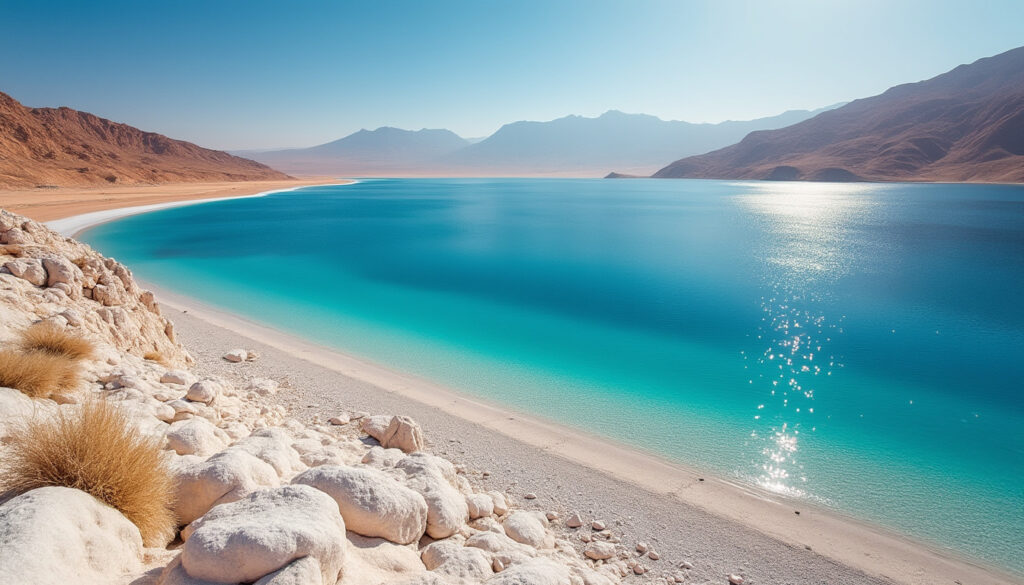
Between Israel, Palestine and Jordan, the Dead Sea reveals a striking landscape in the heart of the Jordan Valley. This salt lake, located more than 400 meters below sea level, is famous for its highly concentrated saltwater, in which you can float almost effortlessly.
In the heart of the Jordan Valley, the Dead Sea offers striking landscapes and a unique experience: floating almost effortlessly. This vast salt lake lies between Jordan, Israel and the West Bank, a Palestinian territory on its western shore. Its exceptionally low elevation, mineral-rich shores and spiritual history make it a memorable stop for travelers curious about geography, culture and nature. Despite its name, the Dead Sea is not a sea connected to the oceans, but an endorheic salt lake, meaning a basin whose waters do not flow into the sea. It stretches along the Jordan Valley, between Jordan to the east and Israel and the West Bank to the west. This location makes it a place closely associated with several territories and a long regional history. The Jordan River is its main source of fresh water. It rises in the Mount Hermon region and flows through areas where water is used for agriculture and the needs of local communities. In this arid climate, supplies from the river and neighboring waterways struggle to make up for the intense evaporation caused by the heat. The lake’s surface lies more than 400 meters below sea level, making it the lowest point on Earth’s land surface. Its elevation varies over time, as the water level continues to fall. From the surrounding heights, the landscape reveals a dark blue expanse framed by desert hills. The salt concentration in this lake is exceptionally high. It approaches one-third of the water’s composition, several times the average salinity of the oceans. This abundance of mineral salts increases the water’s density and makes floating particularly easy. The sensation is immediate: the body rises to the surface and stays afloat with little effort. However, it is best to enter the water slowly and avoid splashing, as the salt can irritate the eyes or a small cut. The usual swimming movements are not suited to this fragile, highly concentrated environment. The high salinity also explains the scarcity of visible life in the lake. Fish and most aquatic organisms cannot survive there, although some microorganisms, including bacteria and forms of plankton, are able to thrive. This characteristic is said to have inspired the name “Dead Sea” in ancient Greece. You can swim in designated areas, where access to the water is easier and services are generally available. It is best to avoid diving, touching your face and staying in the lake for a long time. After getting out, a thorough shower helps remove the salt deposited on your skin. The mud and salts from the shore are sometimes promoted as natural skin treatments. They are also used in some cosmetic products, but their effects are no substitute for medical advice or dermatological treatment. People with sensitive skin or a skin condition should seek advice from a professional before applying them. The lake’s water level has been falling for several decades. Water withdrawals from the Jordan River and its tributaries, particularly for irrigation and water supplies, reduce the amount reaching the basin. Drought and high evaporation further intensify this trend. The retreating water is transforming the shores and can cause sinkholes, sudden ground collapses linked to the dissolution of underground layers. Some roads and facilities must then be monitored or relocated. For residents and visitors alike, the landscape is therefore not unchanging: it is undergoing a major transformation. The annual decrease in water volume is considerable, and specialists are closely monitoring the site’s evolution. Regional projects are regularly discussed to support water supplies and limit environmental impacts. Their implementation involves complex technical, political and ecological issues. Visiting the area thoughtfully, respecting protected zones and choosing supervised activities helps reduce the impact of tourism. The need for conservation is a reminder that this spectacular setting depends on a fragile balance. To extend your exploration to the surrounding landscapes, an account devoted to the mysteries of Sinai also offers another perspective on the desert territories of the Middle East. The areas around the lake hold a place in several religious traditions. Ancient texts refer to this region by names such as the Salt Sea or the Eastern Sea. These references have fueled the imaginations of generations of travelers, researchers and pilgrims. The historic sites in the surrounding area bear witness to the diversity of civilizations that have crossed the valley. Fortresses, archaeological remains and pilgrimage routes make up a highly varied heritage. A visit can therefore combine natural landscapes with the stories that have shaped the region’s memory. Popular culture, too, explores places where the body and perception are put to the test. In a very different vein, Alejandro Amenábar’s film “Tesis” examines violence on screen, while the world of David Cronenberg focuses on the boundaries between the body, technology and the unsettling. These works offer different ways of looking at things for those wishing to extend their journey through cultural discoveries. Genre cinema also lends itself to stories about unusual places and societies under pressure. The article about Larry Cohen and horror coming to New York explores another way of turning a city into a fictional setting. For a lighter break between stops, gaming fans can also read the news about the production of Pokémon TCG cards. The major cities near the lake make it possible to plan an excursion or a longer stop. From Jerusalem, some access points are about 40 kilometers away, while Tel Aviv is nearly 110 kilometers away, depending on the destination chosen along the shore. Amman is also close to the Jordanian coast, but exact distances vary depending on the starting point and the site you plan to visit. A rental car offers flexibility for exploring scenic overlooks and designated beaches. Travelers who prefer not to drive can choose a guided excursion departing from a nearby city. However, travel times, traffic conditions and crossing options depend on the area being visited. It is important to check entry requirements and travel regulations before planning an itinerary between Israel, the West Bank and Jordan. Border crossings, required permits and available connections may change. A tour arranged by an agency familiar with the region can simplify the logistics, especially if the trip includes several territories. To make the most of the site, bring drinking water, sun protection and suitable footwear for shores that can be rocky or encrusted with salt. The coolest hours are often the most pleasant for admiring the hills and swimming. Visitors can then round off their day with historic sites or viewpoints over the Jordan Valley.Discovering the Dead Sea: between Israel, Palestine and Jordan
A salt lake in the heart of the Levant
A shoreline at a very low elevation
Why do you float in its waters?
Precautions for enjoying a swim
A changing landscape and an environment under pressure
Between ancient accounts and cultural references
Planning a visit between Israel, Palestine and Jordan
Discovering the Dead Sea: between Israel, Palestine and Jordan
In the heart of the Jordan Valley, the Dead Sea forms a distinctive landscape, shared between Jordan to the east and Israel and the Palestinian territories to the west. Despite its name, it is a salt lake, fed in particular by the Jordan River. Its shores lie more than 400 meters below sea level, making it one of the lowest points on Earth’s land surface.
The exceptionally high salt concentration makes swimming an unusual experience: the body floats easily on the surface. This high salinity severely limits animal life and explains the name “Dead Sea,” inherited from antiquity. The waters and mineral mud have also contributed to the site’s reputation, although their effects on health should not be considered medical treatment.
The region also has a strong historical and spiritual dimension. The Dead Sea is mentioned in several religious texts under different names, and the surrounding area features desert landscapes, archaeological sites and places of remembrance. Depending on which side of the border they visit, travelers can plan their stay from Jerusalem, Amman or other major cities in the region. Renting a vehicle or joining a guided excursion makes it possible to discover the shores and nearby attractions.
The lake is, however, facing a significant drop in its water level. Natural evaporation, combined with water withdrawals from the Jordan River basin, is contributing to its retreat and gradually changing the coastal landscapes. Areas that were once accessible may move farther from the shore, while the ecological balance becomes more fragile. A visit to the Dead Sea therefore takes place in a remarkable but also vulnerable region, where water-related issues are central.