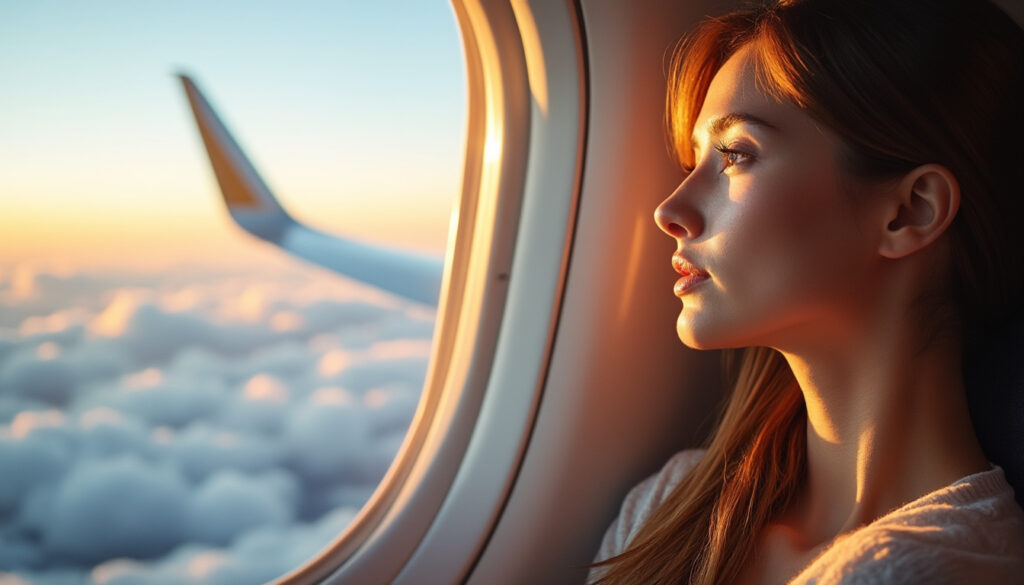
Between freedom, adventure, and wonder, air travel has always fed the imagination. These famous quotes evoke the pleasure of taking to the skies, discovering the world from a different perspective, and embarking on new horizons.
An air journey can be a pause of freedom, an adventure that begins as soon as the plane takes off or during a few hours spent observing the world differently. Writers, pilots, and aviation pioneers have often described this experience with humor, poetry, or seriousness. Here are reflections inspired by their words, to accompany your thoughts between sky and earth.
In an airplane, everyday life sometimes seems to drift away with the ground. Jonathan Coe associates this moment with a rare opportunity to disconnect, while Amelia Earhart sees it as a chance for adventure. These two perspectives remind us that travel begins in the mind as well.
Gaining altitude, changing perspective
To Leonardo da Vinci, the idea of flight evokes a form of poetry in motion. This image aptly conveys the sensation of witnessing the drift of clouds from a window seat. The landscape transforms into a living tableau.
Amelia Earhart emphasizes the particular wonder that comes from seeing the world from the air. Cities become shapes, roads reduce to lines, and the terrain forms an immense map. This change in scale invites one to observe differently what they thought they knew. Even a familiar route can then reveal an unexpected scene.
In his reflections on the desire to fly, Wilbur Wright reminds us that humans have long watched birds freely overcome obstacles. Aviation extends this ancient fascination, transforming a longing into a means of transport. Each departure carries a part of curiosity and invention. The landscapes seen from above seem to belong to an unexplored world. The traveler discovers a new way to measure distances.
Inspiring words on courage and adventure
The sky is also a space where boldness meets caution. Amelia Earhart links adventure to the gust of wind, while Henry Ford turns taking off against the gales into a metaphor for perseverance. These thoughts celebrate the capacity to move forward despite difficulties. They do not claim that the path will always be easy. Rather, they suggest that the obstacle can become a foothold.
Otto Lilienthal sums up the dream of flight by distinguishing between invention, construction, and the actual experience of flying. His idea highlights the gap between conceiving an ambition and living it fully. The first step counts, but action gives it meaning. In a journey, this progression is found right from the preparation and then at the moment of departure. The horizon only draws nearer by taking the road.
Charles Lindbergh connects flight to a freedom that allows one to break free, even if only for the duration of a flight, from earthly constraints. This sensation has fed travelers’ imaginations since the first grand aerial raids. It relies as much on the distance traveled as on the feeling of elevation. The sky becomes a passage to other places and other habits. To depart is also to consent to be dislocated.
Risk, caution, and trust
George Bernard Shaw attributes the invention of the airplane to the optimist and the parachute to the pessimist. This witty formula contrasts two ways of viewing progress. One imagines possibilities; the other anticipates precautions. Both are useful in the history of aviation.
Louise Thaden reminds us, in her own way, that fear can be part of the pilot’s experience. Acknowledging apprehension does not negate courage. On the contrary, it underscores the importance of preparation, attention, and respect for flight conditions. A safe journey relies on precise skills and procedures followed seriously.
A saying often associated with pilots contrasts experience with recklessness: years of flying teach one not to confuse boldness with thoughtlessness. It encourages knowing when to give up when circumstances demand it. This restraint protects crews and passengers. In the air, trust is built with thoughtful decisions, constant vigilance, and a good understanding of limits.
Humorous remarks about airplanes sometimes express passengers’ unease. George Carlin jokes about the robustness of black boxes, while Orson Welles ironically describes the alternation between boredom and fear during a flight. These observations bring smiles because they resemble familiar thoughts. However, they do not summarize the experience of all travelers. For many, calm sets in as soon as the aircraft reaches cruising altitude.
The poetry of the sky and new horizons
Antoine de Saint-Exupéry links the meaning given to existence to the possibility of rising. This image transcends the simple movement from one point to another. It evokes aspirations that guide a life. Flight then becomes a metaphor for inner momentum.
An African proverb compares wisdom to the fuel that leads to new horizons. The image underscores the importance of discernment in each departure. Traveling is not just about accumulating kilometers. It is also about choosing one’s direction and understanding what one discovers along the way. A destination takes on a different value when one knows why they are going there.
Another African proverb celebrates the one who moves forward without being held back by the past. Their gaze is turned towards the horizon and the still-unknown possibilities. This idea corresponds to the spirit of departure, when familiar references fade away. It reminds us that openness to novelty can begin well before arrival. The traveler carries their memories without allowing them to block the road.
The Japanese haiku dedicated to steel birds captures their song as they soar towards the north. A few words suffice to combine movement, direction, and the land observed from above. This brevity makes the image particularly vivid. One can imagine the contrast between mechanical wings and the silent landscape. Poetry sometimes arises from a very simple scene.
For Anne Morrow, travelers crossing the sky discover a space without signs indicating past paths. This remark gives the journey a unique dimension: each flight opens an experience that belongs solely to it. The same route never produces exactly the same impressions. Light changes, clouds shift, and thoughts flow in their own course. Air travel thus exists in a present that does not repeat itself.
Images to dream of the next departure
François David imagines a wonderful land where airplanes leave suspended garlands in the sky. The image transforms white trails into festive decorations. It offers a gentle vision of aircraft passing over the clouds. The sky then seems to retain the memory of each crossing. A simple observation can be enough to awaken the desire to depart.
A pilot’s proverb describes the ideal office as one that offers the most beautiful view. The phrase connects daily work with the vastness of the aerial landscape. It also expresses the privilege of discovering the world from a cockpit. For passengers, the window plays a comparable role. It transforms an ordinary seat into a privileged observation point.
A reflection often attributed to an unknown author compares the existence of an airplane to a balance between direction and altitude. The image invites one to consider both the goal and the means to reach it. Staying on course does not mean ignoring changes around oneself. Sometimes it is necessary to adjust one’s trajectory to continue the journey. This flexibility holds true both in the air and in personal projects.
The novelist Marc Levy evokes, with a celestial image, an airplane that would have continued its ascent to the stars. This poetic exaggeration gives flight an almost unreal dimension. It expresses the desire to push the boundaries of the possible. The sky becomes the backdrop of a dream rather than a simple thoroughfare. In narratives as in travels, imagination knows how to go further than the visible horizon.
The words of pioneers and aviation observers do not all speak of the same things. Some celebrate human ingenuity; others describe freedom, caution, or wonder. Together, they present several faces to an experience shared by millions of travelers. They accompany both the wait at the airport and the silent moments above the clouds. With each departure, new impressions enrich these images of the sky.
The best quotes about air travel: words to gain altitude
The thoughts inspired by aviation tell much more than merely moving from one point to another. They express a desire to rise, to cross borders, and to discover the world from a new angle. In the words attributed to pioneers such as Amelia Earhart, Charles Lindbergh, or the Wright brothers, flight becomes an adventure where curiosity, courage, and freedom meet. The sky is no longer just a space to traverse: it opens up a perspective on immensity and human possibilities.
Some quotes evoke the unique sensation of being at altitude. For some, the airplane offers a rare moment of distance from everyday concerns; for others, it blends wonder, impatience, and apprehension. The humor of George Carlin or Orson Welles reminds us that the air travel experience is not the same for everyone. Between the wait aboard and the dreaded turbulence, each passenger copes with their own emotions. This diversity makes reflections on the airplane familiar and accessible.
The words dedicated to pilots shed light on another dimension of flight: the balance between control and caution. Trust does not consist of ignoring risks but of preparing, making decisions, and knowing when to relinquish control when conditions demand it. This idea extends beyond the aeronautical world: moving towards a goal sometimes requires changing course, keeping an open eye, and not confusing boldness with recklessness.
Finally, the poetic images associated with clouds, wind, and horizons give air travel an almost dream-like dimension. They invite us to observe the earth from the sky and to let our imagination soar. Read before a departure or during a journey, these quotes can accompany the wait, nourish the desire to leave, and remind how the desire for discovery continues to carry travelers to new landscapes.