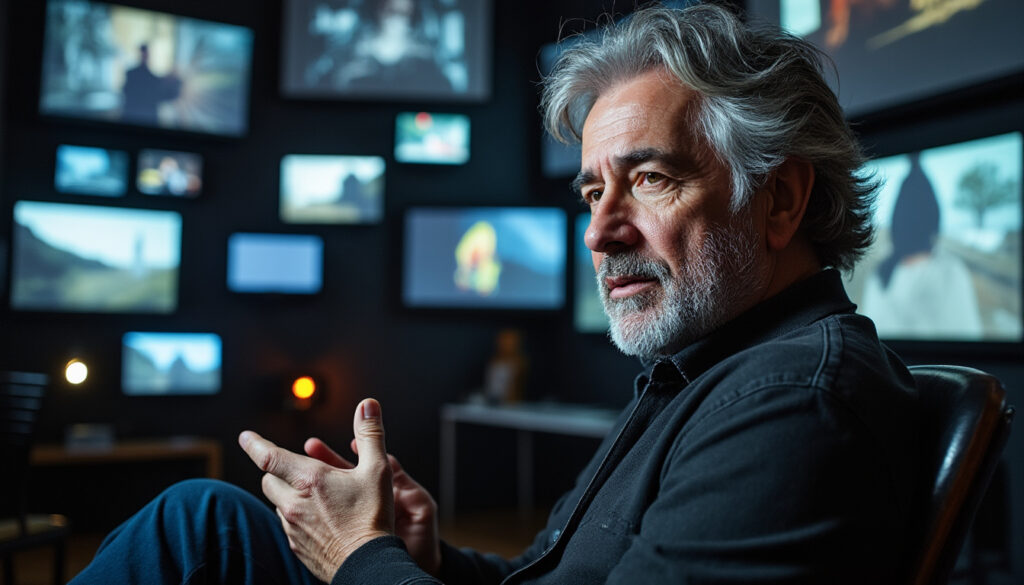
In Guerrilha no asfalto, Edgar Pêra blends archival footage, newly shot images and artificial intelligence to blur the boundaries between reality and fiction. In this interview, the filmmaker reflects on the visual profusion of our time: for him, making cinema is not about accumulating images, but giving them form, meaning and truth.
With Guerrilha no asfalto, Edgar Pêra transforms Portuguese political memory into a whirlwind of archival footage, reenacted scenes and images generated by artificial intelligence. The film blurs the landmarks without giving up the search for truth, and questions the filmmaker’s place in a world saturated with competing narratives. In an interview conducted in his Lisbon studio, Pêra discusses his collaborative method, his relationship with the militant past and one essential conviction: accumulating images is not the same as making cinema.
A film that prefers questions to answers
In Guerrilha no asfalto, viewers are given no guide to help them distinguish archival footage, personal memories, reenactments and digital creations. This uncertainty is not a trap designed to reveal a final solution, but a way of making contemporary unease tangible. As the editing accelerates, watching becomes an exercise in attention.
Between lived memory and constructed narrative
The film revisits Portugal’s clandestine history and the director’s youthful political commitments. At sixteen, Pêra briefly joined a far-left party, before learning that several members of an armed group had come from that organization. These lived experiences inform the work, but the filmmaker refuses to draw a precise map of them. Revealing which scene is true would risk, in his view, immediately indicating where fiction begins.
This refusal sustains a productive tension. The images may have been shot at different times, reworked or produced with recent tools, while the narrative shifts between experience, invention and political commentary. Pêra does not claim that all versions are equally valid: rather, he suggests that fiction can contribute to a search for truth, while a supposedly factual account can serve a lie. The question then becomes less “where does this image come from?” than “what is it trying to make us believe?”
Artificial intelligence, a tool and a zone of doubt
Following Cartas telepáticas (2024), a film that fully embraces an aesthetic generated by artificial intelligence, Guerrilha no asfalto presents a more hybrid landscape. The director explains that AI is not used throughout the film and that some sequences that seem artificial rely on other methods. The confusion is deliberate: it highlights the growing difficulty of establishing where an image comes from.
For Pêra, this blurring goes beyond technical virtuosity. It encourages us to be wary of images and sounds, but also of the people who disseminate them, whether they speak through cinema, television or social media. In a stream that leaves almost no time to think, editing can carry audiences along before they have even formed a judgment. The filmmaker describes this pace as a kind of heaven and hell at once: stimulating on screen, exhausting to create.
The ethical question behind the tools
AI’s creative potential does not make the concrete conditions of its production disappear. The interview addresses, in particular, the human labor needed to train and correct these systems, often performed at low cost far from the places where the technologies are marketed. The fascination with increasingly realistic images must therefore be accompanied by reflection on who works, who benefits and who decides.
Pêra offers no simple solution. Instead, he suggests that these tools should not be left in the hands of the most powerful or least scrupulous players. Creators can try to infuse them with different imaginaries, different ways of thinking and less destructive uses. He acknowledges that this position remains utopian, but considers it preferable to a purely nostalgic opposition between old techniques and new systems.
His relationship with artificial intelligence is thus part of a broader reflection on the responsibilities that come with machines. The issue is not only whether a program can produce a convincing shot. We must also examine the ideas that guide how it works and the interests served by its deployment. Technical novelty, on its own, does not constitute artistic intent.
Crafting by hand amid the deluge
The film’s visual profusion might suggest a massive production. Yet its construction is based on patient work, heterogeneous materials and close collaboration between Pêra and his partner João Mora. The images come from shoots carried out at different times, in various formats, and from archives connected to several earlier films. The principal cinematography, by Jorge Quintela, coexists with footage shot by other camera operators and by the filmmaker himself.
Filming took place in sequences separated by intervals, without long, continuous periods of shooting. Editing then brought these elements together and sought harmony among their textures, rather than erasing all their differences. Film, video and digital images interact within a composition that embraces its seams. The impression of abundance arises from a handcrafted assemblage, not from automatic accumulation.
The “endless soup” as a method
To describe his way of working, Pêra tells a folk tale in which a traveler starts a soup with a stone and gradually persuades the locals to each add an ingredient. This image helps him explain an open-ended process: the project begins with a simple proposal, then grows through contributions from the actors, technicians and other collaborators. He does not always seek to impose a fully locked-down vision from the outset.
This openness does not rule out control in the editing room, but it shifts authority on set. A performer can bring their understanding of the character, while a cinematographer can transform a situation through their visual choices. Ideas circulate, contradict one another and are recombined, sometimes creating an excess that the director must then bring under control. The “soup” becomes digital, collective and, in his words, endless.
The filmmaker also says that films leave traces after they have been screened. An online excerpt, a short sequence or a shared fragment can become a kind of ruin of the film, revealing a piece of its structure without restoring it in its entirety. This attention to short forms sheds light on his work with archives and series created from older materials. For him, these fragments do not replace the work: they extend its life and reshape its contours.
A body of work shaped by architecture and archives
Architecture has played an important role in Pêra’s career, from La Ville de Cassiano to the monumental compositions of his more recent films. He speaks of his admiration for Fritz Lang and his enduring interest in modern buildings, their lines and their volumes. He finds nature more difficult to film, whereas architecture offers geometric structures capable of organizing the gaze. Ruins, too, can serve as a form: the ruins of a film must remain legible through the fragments that survive it.
This idea connects with the use of personal archives. For Guerrilha no asfalto, the director and his team had to sift through decades of images, including traces of earlier shoots and documents associated with people who had passed away. This work brought him face to face with his own memories as much as those of people close to him. The process therefore took on an emotional dimension that went beyond simply selecting images: it set both collective and intimate memory in motion again.
April 25: freedom as a starting point
Pêra has already addressed the Portuguese Revolution of April 25 in a short film made for secondary school students. He sees this event above all as the achievement of freedom, without which his experimental cinema could not have existed in this form. The new film adopts a more ambiguous and irreverent tone, but this freedom to play does not mean rejecting the revolutionary legacy. Rather, it makes it possible to question established narratives and images of memory.
The film’s premiere prompted a particularly strong response, with laughter, emotion and applause. Pêra emphasizes this encounter with viewers, which he sees as distinct from a simple aesthetic compliment. Young filmmakers also told him that the film encouraged them to continue their work and their commitment to freedom. The work thus finds a political extension in the shared experience of its screening.
Making cinema against the spectacle algorithm
Pêra consistently questions the idea that financial resources automatically guarantee a richer film. He believes that a bigger budget can sometimes lead filmmakers to work first to meet the expectations of a distribution and spectacle algorithm, at the expense of ideas. Abundance, whether financial or visual, does not automatically become form. Cinema is shaped by choices, relationships and the way materials are given meaning.
This reflection also runs through the shifts in tone and rhythm of Guerrilha no asfalto. The film may evoke 1970s crime thrillers, blaxploitation or New York experimental cinema, before veering into parody and mockumentary. Its soundtrack, in particular, contributes to this exuberant energy. Viewers must constantly reassess their position, because no stable form guarantees a definitive interpretation.
Pêra’s fondness for multiple endings extends this resistance to overly neat conclusions. He explains that his collaborator Rodrigo Areias sometimes wanted to end the film earlier, while he kept finding one more element to add. This plurality may seem excessive, but it reflects a work that favors movement over resolution. The film does not go dark with a single gesture: it leaves several exits open.
Portuguese cinema in an international landscape
Despite a rich career and major accolades, Pêra’s feature films are rarely available in French cinemas. A Janela (Maryalva Mix), released in France under the title Le Marquis du Fado, remains one of his few distribution experiences in the country. The filmmaker recalls that producer Paulo Branco helped him complete the film and bring it to Locarno, but that their subsequent collaborations did not lead to another production agreement.
He works regularly with Rodrigo Areias and the company Bando à parte, while continuing to develop projects based on his archives. His films circulate at international festivals, while their presence in French cinemas remains more limited. This contrast highlights the fragility of distributing singular cinema that resists easy categorization and demands active attention from audiences.
This curiosity about audacious forms can be compared with other paths discussed in contemporary cinema: René Viénet’s provocative approach, presented in a portrait devoted to his cinematic universe, or the ideas explored through Takashi Miike’s journey with Sham. These comparisons do not erase their differences: rather, they remind us that cinema is renewed when artists push its boundaries.
A work in motion, with no clear separation between forms
Pêra’s filmography spans features and shorts, performances and work made with AI. Series built from archival material explore music, comics and artistic practices of the 1990s, among other subjects. This diversity stems from sustained activity, but also from a practice of recycling that transforms materials rather than treating them as relics. The past becomes material available for new constructions.
The filmmaker is also preparing La spirale de la peur, a project inspired by Lovecraft that he imagines as a departure from certain adaptation conventions. At the same time, he says he dreams of slowing down and returning to small films shot on Super 8. Yet once a series of projects gets underway, the momentum becomes difficult to stop. This tension between the desire to pause and the need to continue is also part of his cinema’s rhythm.
Connections with other forms of storytelling
Discussions of adaptation remind us that stories move between different media, sometimes even before they become films. The idea of seeing Karl Urban play John Marston in a project based on Red Dead Redemption speaks to this permeability between video games, screens and the popular imagination, as reported in this article about the actor and the character. In Pêra’s work, movement also takes place between eras, formats and versions of the same story.
Festivals are another space where works meet and forms can be viewed in perspective. The connection between mathematics and ego explored at Cannes in 2026, discussed in this report on the seventh day, shows how cinema can bring distant ideas into conversation. Meanwhile, the discovery of Adilkhan Yerzhanov’s Turgaud at the Berlinale, recounted in this presentation of the film, reminds us of the richness of cinematic journeys that unfold far from the most visible circuits.
For Pêra, the proliferation of images makes an attentive practice of cinema all the more necessary. The point is neither to believe that technology will produce a work all by itself, nor to reject the tools that are transforming filmmaking. We must put forms to the test, question their origins and remain responsible for what they tell. At a time when everything seems capable of being produced, edited and distributed without delay, the decisive gesture remains the one that gives images a thought, a rhythm and a reason to exist.
Visual profusion is not enough to make cinema
In Edgar Pêra’s work, images accumulate, respond to one another and contradict one another. Archival footage, sequences shot on different formats, autobiographical fragments and creations generated by artificial intelligence make up a flow in which landmarks waver. Yet this abundance does not in itself constitute a film. It is only the raw material: editing, rhythm and the relationship between the elements give it form and open up a space for interpretation.
With Guerrilha no asfalto, Pêra refuses to provide viewers with a guide. An image may seem documentary, reconstructed or artificial, without its nature being immediately identifiable. This uncertainty echoes a world where the boundaries between reality, fiction and propaganda are blurring. The filmmaker shifts the question: instead of simply trying to find out how an image was produced, he invites us to examine what it asserts, what it conceals and how it acts upon our gaze.
This approach is also rooted in an ethics of creation. For Pêra, AI is neither a magic formula nor an autonomous solution. It must be approached with care, particularly in light of the working conditions, economic interests and political uses that shape these technologies. A machine can take part in making a film, but it cannot replace either an intention or reflection on images. Without choices, experience and connections, their accumulation remains a stream.
His “endless soup” method expresses this collective, open-ended conception: start with a base, welcome collaborators’ suggestions, then transform the materials until a form emerges. Cinema takes shape in this tension between abundance and selection, speed and reflection, experimentation and responsibility. Faced with images that flash by relentlessly, Pêra works precisely within the interval where viewers can still stop, doubt and search for meaning.