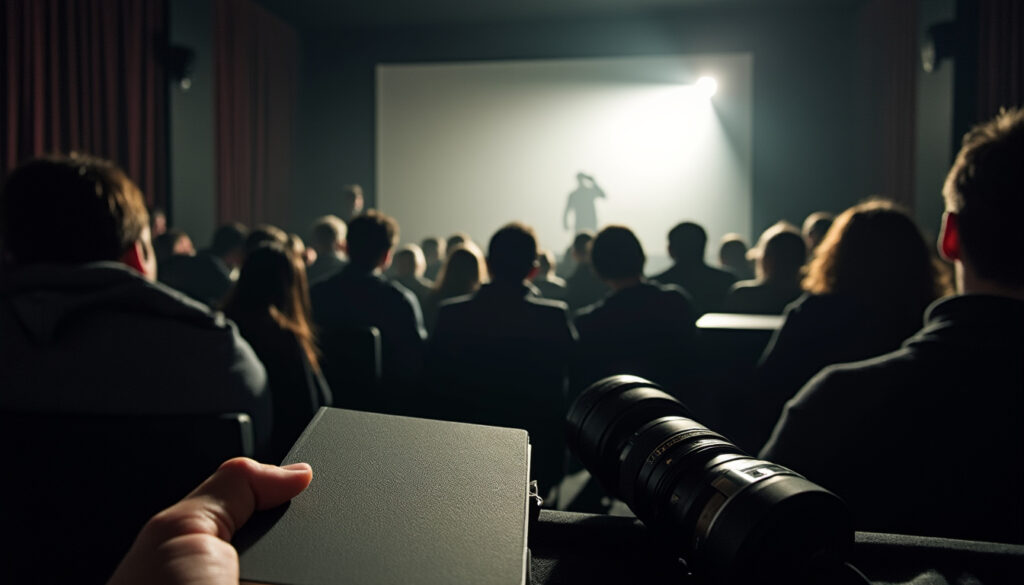
For its second report, LUFF 2026 unfolds a program as singular as it is electrifying: from Barbara Hammer’s archives to the unsettling fervor of Devi, and on to the political marathon of La Commune. Three works that make the Lausanne festival a terrain for cinematic discoveries and jolts.
In Lausanne, the Lausanne Underground Film Festival (LUFF) once again made room for singular works, unruly forms, and discoveries that slip beyond ordinary programming. This second look at the 2026 edition takes in three standout screenings: a documentary devoted to Barbara Hammer, Satyajit Ray’s mystical vision in Devi, and Peter Watkins’s collective immersion in La Commune. Three films, three eras, and a shared invitation to see cinema as a space for creation, memory, and debate.
A festival where the margins take center stage
Now in its twenty-fifth edition, LUFF still has a taste for unpredictable offerings. Its program does not seek to smooth over contrasts: it brings together experimental work, politics, overlooked classics, and genre cinema. For audiences, each screening can thus become a gateway to unexpected territory.
The festival has also established itself as an annual gathering for cinephiles seeking films rarely shown on the big screen. The Lausanne celebration favors works that disrupt familiar habits rather than reinforce expectations. Following an initial glimpse of the screenings, presented in this report on the opening of LUFF 2026, this second installment lingers on screenings whose reverberations extend far beyond their running times.
Barbara Hammer, a life in images passed on in the present
On Saturday afternoon, the spotlight fell on documentary with Barbara Forever (2026), directed by Brydie O’Connor. A pioneering figure in queer cinema and an experimental artist, Barbara Hammer had already been the subject of a major retrospective at the festival in 2019. The new film extends that encounter, turning her abundant archives into the material for an intimate and political portrait.
Archives assembled as a living legacy
Brydie O’Connor’s project began during her studies, when she was writing an academic paper on Hammer’s cinema. They exchanged thoughts about films and ideas, and then the director learned that the artist she was studying was seriously ill. Hammer had, however, anticipated the question of preservation and legacy: she organized her documents, digitized her reels, and considered what would remain of her work.
With the support of Florrie Burke, her partner, O’Connor was able to draw on this exceptional collection to develop her first feature film. The late filmmaker almost seems like a narrator, as her voice and images guide the story. The film does more than line up biographical fragments: it brings the traces of a life into dialogue with the struggles they illuminate.
The body, creativity, and queer memory
Scenes from everyday life alternate with visual experiments filmed by Hammer. We encounter a direct, sensitive, and sometimes vulnerable gaze that refuses to separate the personal from political commitment. The camera becomes a tool for making visible experiences too often absent from dominant narratives.
Illness and death run through the documentary without erasing the artist’s vitality. This attention to posterity is not an act of glorification; rather, it expresses the hope that past struggles will nourish those to come. In this respect, the film connects with other works that explore the return of images and moments, such as Sandra Wollner’s work on memory and what repeats itself. Carried by an ethereal score, Barbara Forever creates a generous portrait that is both tribute and passing on.
In Devi, Satyajit Ray probes faith
This year, the festival’s thematic program focused on religion. Following editions devoted to television and then music, this selection brought together Marjoe, The Devils, and Devi (1960), a film screened less often than Satyajit Ray’s best-known titles. The story follows a young woman whom her father-in-law believes to be the incarnation of a goddess.
An adaptation relocated to the modern world
Ray adapts a short story by Prabhat Kumar Mukhopadhyay, published in the late nineteenth century, but sets his story in an era closer to his own. This choice shifts the focus to the social mechanisms that confine the heroine. The film does not target faith itself: it denounces dogmatic certainty when it deprives a woman of her autonomy.
The direction makes this gradual confiscation of freedom palpable. A vision interpreted as a divine sign is enough to transform the life of young Doyamoyee, then draw her family into an unsettling spiral. Through this fable, the director questions how patriarchal institutions seize control of the female body and turn it into an object of belief.
Visual beauty in the service of suffocation
The film owes much to the performances of Sharmila Tagore and Soumitra Chatterjee, whose presence brings remarkable restraint to the tensions of the story. Ustad Ali Akbar Khan’s music, interwoven with devotional songs, evolves as the drama tightens. Its motifs grow barer and more dissonant, accompanying an atmosphere of mounting unease.
Ray’s realism is complemented by deep shadows and almost Gothic compositions. The beauty of the images does not relieve the claustrophobia: it intensifies it, highlighting the gap between sacred appearances and the very real consequences of fanaticism. Seen on the big screen, Devi reveals impressive narrative mastery and leaves the viewer facing a question that remains timely: who decides a woman’s freedom when those around her claim to speak in the name of the divine?
La Commune, five hours to set history in motion again
The screening of Peter Watkins’s La Commune (2000) gave Sunday a particular breadth. Running 345 minutes, the film reconstructs the events of 1871 while questioning how they are told. The French social and political context made this encounter between past and present especially striking for some of the audience.
A shoot conceived as a collective experience
Watkins brought together around 220 participants, many of whom were not actors. Rather than giving them only scripted roles, he allowed them to incorporate elements of their own experience into their performances. This method gives the film a distinctive energy: at times, the words seem to emerge from an exchange between the reconstructed history and the reality of those telling it.
The director also introduces an anachronistic television news format. Journalists appear to cover the events of the Commune live, as if the nineteenth century could be broadcast through modern media. This choice draws attention to how information is produced and how power relations shape public narratives.
A cinematic marathon with no shortcuts
The runtime might put people off, and the festival made no secret of this, presenting the screening as a demanding experience. Yet those extra hours are not simply a challenge: they give the revolutionary movement time to emerge in all its complexity. Watkins reduces neither the disagreements nor the collective fervor to an easy explanation.
The staging sometimes recalls theater, but the artifice gradually becomes a shared space. The viewer observes the discussions, hopes, and divisions without being pushed toward a simplified interpretation. This expansive and attentive form invites us to reflect on freedom as a concrete, fragile practice that requires collective action.
The screening also took on a commemorative dimension following Watkins’s death in 2025. Having lived in France for several years, the filmmaker had found a setting there conducive to his inquiries into authority, dissent, and the voice of the people. In the auditorium, the film therefore functioned not only as a reconstruction of the past but also as a space for discussion about what it means to reenact history in the present.
A program that still has surprises in store
These three screenings represent only part of this edition. The festival also offered a retrospective devoted to Robert Downey Sr., an exploration of Mexican underground cinema curated by Annalisa D. Quagliata Blanco, and midnight screenings with a decidedly camp tone. The competition also brought together singular films, with The Plan (2026) among the works recognized.
This journey confirms the diversity of an event that brings different forms together without trying to make them alike. An archival film, a mystical tragedy, and a several-hour historical epic all find a place in the same program, each with its own language and relationship to the audience. The screenings missed thus retain a certain mystery, while those discovered in Lausanne inspire a desire to keep exploring.
For its 25th edition, the Lausanne Underground Film Festival once again transformed the city into an observatory for singular cinema. This second journey through the program featured rare works, radical visions, and films that shift our perspective, whether they explore the archives of a life or the fractures of history.
With Barbara Forever, Brydie O’Connor creates an intimate portrait of Barbara Hammer, a pioneer of queer cinema. Drawing on archives carefully assembled by the filmmaker, the documentary brings creativity, memory, and commitment into dialogue. The images tell the story of a journey in which personal experience becomes a way to make visible lives too often erased. The film also evokes the act of passing things on: an artistic and political legacy intended to live on beyond illness and death.
The screening of Satyajit Ray’s Devi plunges the festival into another kind of vertigo. In this story, where a young woman is mistaken for a goddess, the direction reveals the ravages of dogmatism and the hold it exerts over the female body. The chiaroscuro, the music, and the performances of Sharmila Tagore and Soumitra Chatterjee give the work an almost fantastical tension without obscuring its social significance.
Peter Watkins’s 345-minute film La Commune, meanwhile, unfolds as a collective experience. Its fake television news format brings the 1871 uprising closer to contemporary concerns, while the participation of non-professional performers fuels a dense and lively reconstruction.
Alongside these screenings, LUFF also makes room for retrospectives, Mexican underground cinema, camp midnight masses, and films in competition. A rich program, traversed by forms and voices that continue to make Lausanne’s theaters vibrate.