
Back in Lausanne for its 25th edition, LUFF made October pulse to the rhythm of free, strange and untamable cinema. From the hard-hitting opening of Burn to underground rock and rediscovered classics, this first report explores a festival where discovery goes hand in hand with resistance.
In Lausanne, the festival’s twenty-fifth edition rekindled its taste for unruly works, unexpected encounters and experiences that spill beyond the screen. From the opening with Burn to a reunion with the Fugs’ rebellious rock, the first days alternated between emotion, provocation and discovery. This first festival journal also ventures into Ken Russell’s sultry visions and the handmade, disconcerting world of Mario Mercier.
An opening between memory and unease
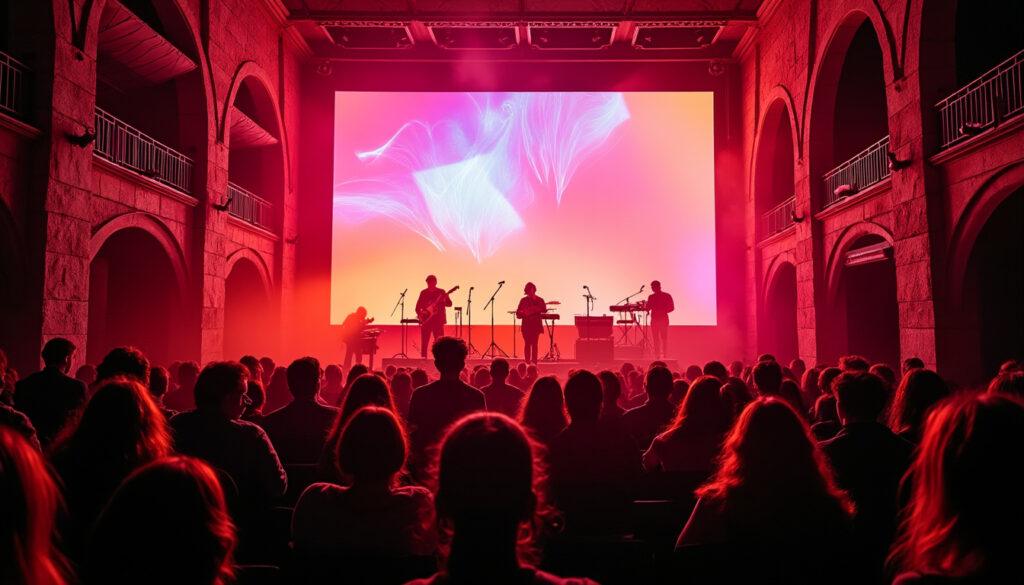
On Wednesday, October 14, the Paderewski hall hosted the opening night in an atmosphere that was both festive and laden with memories. Julien Bodivit, the festival’s artistic director, recalled the project’s beginnings in June 2002, when his team imagined a collective event in a former chemistry school in Lausanne. The building had become an alternative cultural venue before disappearing from the landscape.
This recollection went beyond mere nostalgia. Other independent spaces, in Switzerland and elsewhere, are being weakened by rising costs, renovation requirements and a growing uniformity that leaves little room for distinctive initiatives. The message to the audience was clear: these venues need support, resources and attention.
The festival itself must contend with the precariousness of these venues. The Casino de Montbenon, which usually hosts a significant number of screenings and concerts, is about to undergo major renovations. The team will therefore have to find a new home until 2029, though no solution has yet been decided.
Even so, the evening looked to the future with the announcement of a packed programme: 113 films and 33 sound events, offering festivalgoers a vast terrain to explore. The defence of independent cultural spaces thus found an echo in the programme itself. Here, resistance also means continuing to show free-spirited works.
Burn, an opening that favours contrasts
Abandoned childhoods in the heart of Tokyo
The opening film, Burn, Makoto Nagahisa’s second feature, plunges into the daily lives of the Toyoko Kids. These young people gather in the streets of Kabukicho, a Tokyo district associated with nightlife, often left to fend for themselves. The director focuses on their individual paths rather than merely the colourful surface of their world.
This attention gives the story a particular depth. Though fictional, the film draws on research conducted with people facing these realities, seeking to convey concrete experiences without reducing them to spectacular scenery. Yet the approach retains a playful visual energy, shot through with a measure of hope. The darkness never completely extinguishes the will to live.
A moving, sometimes harrowing experience
Opening-night screenings are sometimes attended out of habit or curiosity. This one quickly dispelled any sense of a routine engagement. Nagahisa crafts an unpredictable, generous film that moves from tenderness to brutality, then from an unexpected laugh to a deeply painful scene.
Lilya 4-ever may come to mind for its disillusionment, while the exuberance of Love Exposure seems to surface in certain flights of fancy. But Burn does not simply borrow colours from other works. It moves forward with an imagination of its own, unapologetic shifts in tone and a direction full of inventive touches.
The film deals with distressing subjects, including violence against children and sexual exploitation. These elements call for particular care and may make the screening difficult. In return, the characters are drawn with great precision, the casting is convincing, and several moments of grace emerge amid the turmoil. A theatrical release is worth watching out for if you’re drawn to contemporary Japanese cinema, while keeping its content warnings in mind.
The Fugs, rock as an act of resistance
On Friday, October 16, the festival screened Fugs Film, a documentary about a New York group whose story intertwines poetry, provocation and music. Its director, Chuck Smith, arrived in Lausanne just before the screening after a turbulent journey. Despite the last-minute rush, he was delighted to present his film to an audience who might not necessarily have known the Fugs.
For newcomers, the documentary offers an accessible entry point into the group’s world. Smith situates their journey amid the ferment of the Beat and psychedelic scenes, against the backdrop of the political and social upheavals of the 1960s. The sexual revolution, the Vietnam War and changes in popular culture intersect without turning the story into a rigid lesson.
Above all, the film conveys an infectious curiosity. Hearing a few songs onscreen may be enough to make viewers want to keep exploring, while the interviews shed light on the audacity of artists who refused to separate creativity from commitment. Key members have passed away, but Ed Sanders and Ken Weaver are still alive. Their presence reminds us that this legacy remains alive, far beyond mere nostalgia.
Chuck Smith does not mummify the group in an idealized past. Instead, he shows how song, literature and humour can nurture free thought in the face of authority. The documentary thus becomes a living archive, but also a toolkit for those creating today. Its energy comes as much from the Fugs’ legacy as from its ability to pass it on.
The Devils, the power of a shared screening
A rediscovered version, a festival event
The screening of Ken Russell’s The Devils lent the Paderewski hall the air of a ceremony. Before the film, programmer Eric Peretti recounted the lengthy search to recover scenes cut from the original version. Several enthusiasts, including Mark Kermode, pursued this quest for years, eventually persuading Warner to bring back footage long considered lost.
This restoration gives audiences access once again to a work whose history was marked by cuts and battles with censorship. Peretti’s introduction also touched on the filming conditions, the intensity of the work with the cast and the rumours surrounding the project. His animated account created a distinctive sense of tension even before the first images appeared.
A classic that still burns bright
On the big screen, the film retains its impressive visual power. Derek Jarman’s sets command attention with their beauty, while Russell’s world brings excess, desire and political violence together. Oliver Reed radiates magnetic charisma, opposite a riveting Vanessa Redgrave.
The rediscovered scenes add a more troubling, sensual dimension to the film. They deepen its questions about the repression of desire and the political use of justice—concerns that still resonate today. The screening also served as a reminder of what cinema can create when experienced together: as they left, the audience still seemed caught up in the screening’s dizzying spell. In a packed theatre, the film’s impact becomes almost a shared experience.
La Goulve, a strangeness that divides
After the intensity of The Devils, the festival shifted gears with La Goulve, directed by Mario Mercier in 1972. Eric Peretti warned the audience that this late-night screening would require a certain amount of open-mindedness. The film is part of a retrospective devoted to Mercier, whose imagination blends invented legends, esotericism and transgression.
The film was shot on a modest budget, with amateur actors and a production team intent on heightening the project’s erotic dimension. After its commercial failure, the work almost disappeared, until reels resurfaced in a cellar in the hinterland of Nice. Distributor Le Chat qui Fume then helped give it a new life on the big screen.
The screening did not leave everyone in the same place. Some viewers left very early, while others surrendered to its accidental charm. The mysterious dubbing, hesitant acting and sometimes laborious script can be disconcerting; yet this awkwardness also gives rise to a strange poetry, somewhere between sincerity and absurdity.
The film belongs to a family of oddities celebrated by the festival, alongside marginal productions that elude dominant conventions. Their value does not always depend on conventional success. Their freedom of form, rough edges and rejection of respectable good taste make them living objects. In this way, the screening extended the festival’s reflection on cultural resistance, albeit in a more chaotic mode.
A festival that makes room for unruly works
From contemporary stories about vulnerable young people to films long censored, the first days showcased a programme attentive to the margins. The forms were constantly changing: a music documentary, explosive Japanese cinema, a restored classic or a forgotten erotic poem. This diversity asked audiences to accept that they would not be able to master everything in advance.
This is also what sets an event like LUFF apart. A discovery can move you, make you laugh, irritate you or leave you perplexed; it does not have to conform to a single idea of what makes a successful film. In Lausanne’s cinemas, the differences between the works became a source of curiosity rather than an obstacle.
The first screenings thus turned the festival into a meeting ground for generations, sensibilities and cinematic histories. The announced sound programme promised even more boundary-pushing experiences, while the Mercier retrospective continued. In Lausanne, there were still plenty of rare reels waiting to emerge from the shadows.
LUFF 2026, a celebration already looking ahead
In Lausanne, LUFF 2026 began by reminding us that the underground scene depends as much on the venues that host films as on the films themselves. In the Paderewski hall, memories of the former École de Chimie and threatened cultural spaces gave this 25th edition a spirit of solidarity. The festival does more than seek out rare works: it also defends the conditions needed for their creation, distribution and encounter with audiences. The upcoming renovations at the Casino de Montbenon already raise a practical question: where will the festival set up home until 2029?
On screen, the programme more than delivered on its promise of transporting audiences elsewhere. Makoto Nagahisa’s Burn drew viewers into a Japanese story that was playful, dark and deeply moving, while the documentary about the Fugs brought the freedom of rock and rebellious poetry to life. The screening of Ken Russell’s The Devils, in its uncensored version, transformed the hall into a space of collective shock. At the other end of the spectrum, Mario Mercier’s La Goulve split the audience, between those who left in a hurry and those fascinated by its distinctive DIY approach.
These shifts in tone define LUFF: a programme where virtuosity sits alongside strangeness, where imperfect works also find a place, and where curiosity wins out over habit. With 113 films and 33 sound performances, the festival opens up all kinds of alternative paths and encourages unexpected discoveries. The first days thus set a mood of enthusiasm, debate and surprise, while more screenings still await Lausanne audiences. The rest of this edition promises to continue the exploration, without a set route.


