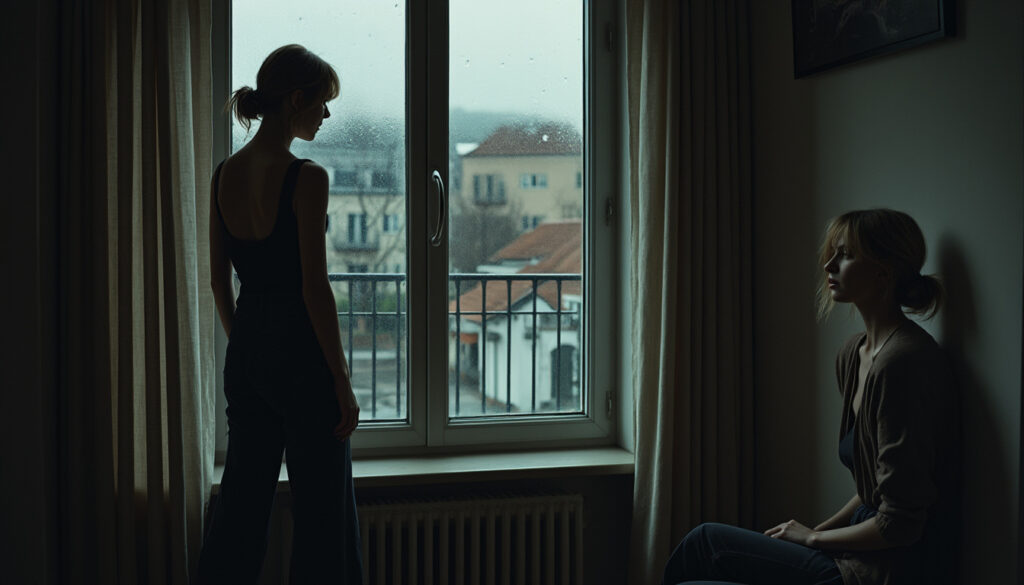
In Everytime, Sandra Wollner transforms grief into an experience in which time fractures and starts over. Between memories, digital images, and reenacted departures, Jessie’s loved ones are still searching for her echo, as reality grows blurred and every moment seems to return in a different form.
In Everytime, Sandra Wollner approaches grief as an experience that throws time, perception, and family ties into disarray. After Jessie’s sudden death, her mother, her sister, and her boyfriend try to carry on with their lives, while memories, images, and digital worlds constantly bring the past back to the surface. The film transforms this painful repetition into a daring form, in which strangeness becomes the very substance of emotion.
A family drama that makes reality waver
As the holidays approach, Jessie spends the night with Lux in Berlin. They both take drugs, and then the teenager falls from a roof while watching the sun rise. Her disappearance leaves her mother Ella, her little sister Melli, and Lux facing a catastrophe that no orderly narrative seems able to contain. Wollner does not try to explain what eludes the characters: she accompanies them in their disorientation.
The film quickly shifts attention from the event to its reverberations. Expected reactions and the moments that usually structure a family drama are often omitted or fragmented. This way of telling the story does not make the loss any less concrete; rather, it conveys how impossible it is to grasp. Grief appears as a rupture in the experience of the present, a breach through which everyday gestures lose their self-evidence.
An absence with no instructions
For those left behind, time does not simply resume its course. It seems to hesitate, move backward, or unfold according to a logic that has become alien. Life goes on around them, but this continuity can feel like a mistake. Wollner thus avoids the conventions of linear psychological storytelling: the characters do not progress from one clearly identifiable stage to another. They circle around the absence, with contradictory movements that are sometimes imperceptible.
Ella finds no lasting refuge in explanations, and Melli maintains a connection with her sister through messages. Lux, too, remains attached to the night before the fall, as if remembering it could change the outcome. Their ways of coping do not always converge. Yet together they form a sensitive portrait of loved ones each seeking, in their own way, a foothold in the inconceivable.
Broken time, returns, and ellipses
Sandra Wollner and Hannes Bruun’s editing makes cuts a central part of the experience. Extended stretches of black separate scenes, giving the viewer time to feel what is missing. The ellipses sidestep certain predictable moments without easing the shock. On the contrary, they create distance: after an interruption, the image returns, but the world it shows already seems displaced.
This structure echoes the way a memory can surface without warning, then vanish just as quickly. The hours and places do not always form a trajectory that is easy to reconstruct. The viewer must accept losing their bearings rather than searching for a chronology that would put everything back in order. The film’s form does not merely tell of the fracture: it makes us experience it.
The sun punctuates this unstable narrative with its appearances and disappearances, as if the natural cycle itself had gone awry. In Tenerife, the vacation seems by turns imagined, interrupted, or replayed. The journey then takes on a mental as well as a geographical dimension: it outlines a space in which the characters try to escape, but where the absence follows them. The landscapes offer no promise of a return to equilibrium.
Reenacting the past to stay close to Jessie
At one point, Ella takes drugs to recapture the sensations of her daughter’s last trip. Her question about the substance she was given makes visible an attempt that is at once intimate and vertiginous: to get closer to Jessie by repeating an experience of which she can know only fragments. Repetition promises closeness, but it does not bridge the distance. It can even trap the living in a loop of sensations and memories.
The film resonates with certain works that intertwine intimate stories with wider upheavals. In Aprile, Nanni Moretti interweaves fatherhood and political chronicle, offering another perspective on how family life unfolds amid an unstable world. Here, however, the balance is shattered by a disappearance that contaminates every space. The catastrophe ceases to be an isolated episode: it becomes the filter through which everything is perceived.
Screens as refuge and haunting
In Everytime, digital tools are used for more than just recording or communicating. Melli still writes to Jessie on WhatsApp, while home movies play on a loop. The images offer an indirect, fragile presence that can be revisited without ever bringing the person who is gone back. They thus sustain a paradoxical closeness: the memory becomes accessible, but the absence remains complete.
Video games open up another space shared by the characters. Their worlds, governed by repeated actions and simulated universes, echo the temptation to revisit what happened. The boundary between game and reality does not disappear entirely, but it loses its sharpness. The film’s interest in these digital landscapes recalls, in a more playful register, the place of video game memory: the new features in the Ocarina of Time remake also show how a game world can be rebuilt, recognized, and transformed.
In Wollner’s film, however, these returns are not simply a matter of the pleasure of revisiting a familiar world. They take on an unsettling tone, as images and messages risk trapping loved ones in a present with no way out. Phones, cameras, and drones seem capable of capturing reality, but they never make it clear who is looking, or from what point of view. Technology becomes both an archive and a screen, a passageway to memory as much as an obstacle to present reality.
Images whose point of view eludes us
The spaces themselves are reconfigured as the film unfolds. Characters we thought were separated by a door sometimes seem to be together in the same room; foliage blurs the boundaries between places; a luminous reflection on a screen lends the living an almost spectral appearance. These shifts do not work like puzzles to be solved. Instead, they transform the viewer’s perception, leaving them uncertain whether they are seeing observation, memory, or fantasy.
A soundtrack without stable boundaries
The sound design extends this hesitation. Noises emerge off-screen without being immediately identifiable, while dialogue, recollections, and ambient sounds sometimes seem to merge. A siren may extend into a musical note, then slide into the soundtrack of a game. The usual distinction between what belongs to the scene and what accompanies the film then loses its reassuring function.
This movement of sound invites us to listen to the film as a space traversed by traces. A character’s voice is not always separate from the place around it, and silence does not mean an absence of sensations. It can become a charged interval in which we wait for a sign or think we recognize a presence. The direction does not turn these perceptions into certainties; it preserves their disquiet.
The collaboration between cinematographer Gregory Oke and sound designer Dominik Leube contributes to this immersive experience. The film does more than illustrate its characters’ distress: it unsettles the visual and auditory bearings that usually help us find our way. This collective work with image and sound may, by contrast, evoke the precision of a musical ensemble in action. Philippe Béziat’s documentary about the orchestra offers a chance to discover another way of thinking about sound creation and the relationship between multiple presences.
An alien beauty, far from pathos
The direction refuses to reduce pain to a succession of emphatic scenes. Instead, it lingers over returns, dislocations, and spaces that are difficult to inhabit. The film’s beauty does not come from offering the characters consolation, but from the precision with which it embraces their fragmented perceptions. The viewer thus remains in contact with a grief that cannot be turned into a lesson.
At times, this strangeness brings the work close to fantasy cinema, without offering a single key to understanding it. Reality alters, figures seem haunted, and boundaries dissolve, but the source of the unease remains profoundly human. To explore another facet of fantasy and horror, read the article on Mother of Tears and the legend of the Three Mothers. In Wollner’s film, the threat does not come from a clearly identified monster: it lies in the persistence of a world that has become unrecognizable.
The portrayal of hardship also unfolds through relationships between generations, particularly between a mother and her daughters. In this regard, Barbara Lamballais’s direction in Le procès d’une vie offers another way to think about human experiences brought to the screen. For its part, Everytime chooses not to close off the meaning of loss. Its story remains open to contradictions: wanting to hold on to a voice, accepting that it is impossible to find it again, then starting over.
A film honored at Cannes
Filmed in Germany and Austria, this feature-length film in color runs for one hour and fifty-eight minutes. It received the Un Certain Regard prize at the Cannes Film Festival. Its theatrical release is scheduled for November 11, 2026, with New Story as distributor.
These details accompany a work whose distinctiveness lies less in its plot than in the way it makes that plot resonate. Sandra Wollner offers a sensory experience in which editing, images, and sounds all contribute to a loss of stability. The moments return, but their return repairs nothing: it further shifts the contours of the present, leaving the characters in search of a world made porous by disappearance.
Everytime: Sandra Wollner explores the echo of moments that return
In Everytime, grief does not follow an orderly trajectory. It returns in fragments, seeps into everyday gestures, and blurs the boundary between the present and memory. After Jessie’s death, Ella, Melli, and Lux each try to maintain a connection with her, without managing to recover the world as it was. The film focuses on this unstable experience: that of time moving forward, seeming to stop, then starting over somewhere else.
The vacation in Tenerife, alternately dreamed of, canceled, or replayed, gives this repetition a concrete form. Sunrises and sunsets no longer simply mark the passing hours: they become signs of a disordered rhythm. The ellipses, long stretches of black, and shifts in perspective prevent us from settling into a familiar chronology. Even the locations seem to shift, as if reality could no longer offer stable bearings.
Technology extends this uncertainty. Messages sent to Jessie, video games, and home movies sustain a presence that is as fragile as it is persistent. These images and sounds do not replace the person who is gone; instead, they open up spaces where memory, fantasy, and perception merge. The screen becomes both a window to her and a surface separating the living from what they seek to reach.
Through her work with images, editing, and sound, Sandra Wollner makes us experience this movement of return rather than explaining it. The catastrophe remains without a simple answer, while the characters oscillate between Jessie’s absence and her traces. Honored at Cannes in the Un Certain Regard selection, Everytime leaves us with a persistent question: what becomes of the present when every memory seems capable of shifting it?