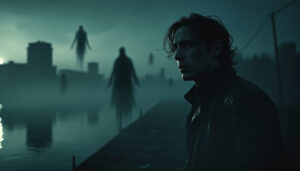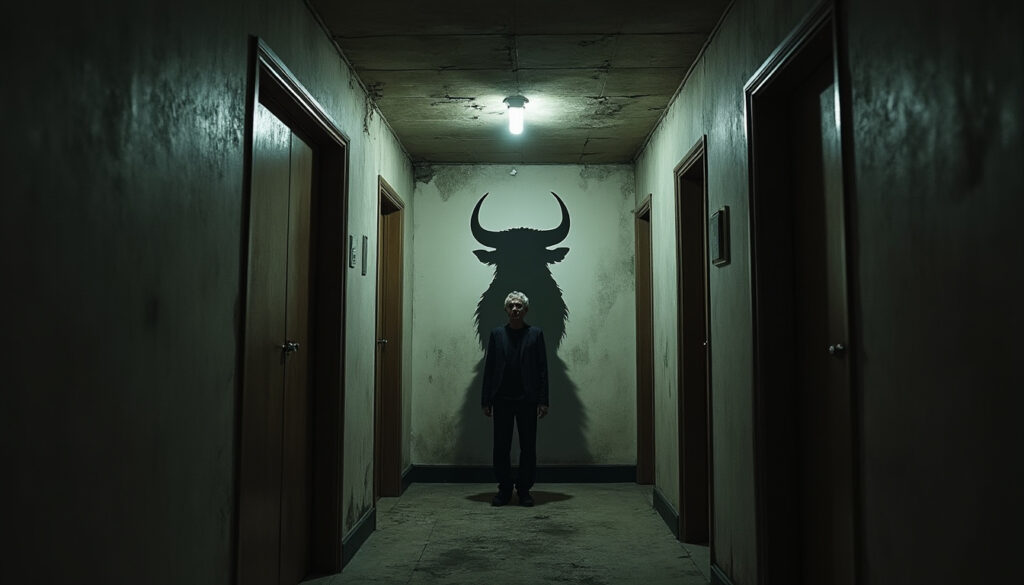
With Minotaur, Andrey Zvyagintsev transforms the Cretan myth into a dark portrait of power and compromise. When Gleb, a businessman close to the regime, must designate employees for the front, the cracks in his family life reveal the shadows of a society where everyone can become complicit in the sacrifice of others.
In Minotaur, Andrey Zvyagintsev transforms the ancient myth into a dark portrait of contemporary Russia. In 2022, an influential businessman receives the order to provide employees destined for the front, while his relationship crumbles in the confines of an isolated villa. Between political violence, a desire for revenge, and family silence, the film observes how a dehumanizing system invades even intimacy.
The narrative opens with an obligation that resonates like a cruel legend: delivering men to preserve the relationship with a stronger power. In the Cretan myth, Athens sacrifices its young to the monster of Minos; here, contemporary Russia supplies bodies to the war. The labyrinth is no longer a stone construction, but a political apparatus where responsibilities are lost.
Gleb, a wealthy entrepreneur and municipal advisor at the gates of federal power, initially seems protected by his status. He lives with Galina and their son in a secluded home, away from a small town whose name matters little. Then a request from the Kremlin makes him responsible for a list: he must designate the employees who will go to fight.
An ancient myth transposed into present-day Russia
The reference to the Minotaur serves not as a mere cultural ornament. It illuminates the mechanics of a regime that perpetuates its dominance by demanding sacrifices while keeping its decision-makers far from immediate consequences. Gleb becomes both the master of a private realm and the servant of a power that overextends him.
An order that reveals the true nature of power
Choosing who will be sent to the front transforms Gleb’s business into a moral issue. His local power does not allow him to refuse the order, but it gives him the opportunity to shift the burden onto others. This intermediate position reveals the oligarchic mechanism: everyone obeys upward and exerts their own authority over those below.
The threat is not abstract. It seeps into conversations, business decisions, and the balance of a family trying to preserve its habits. The film thus shows how the war, kept at a distance by the elites, approaches homes through the men who are designated and the loved ones who are abandoned.
The family cocoon, a mirror of a locked society
In Zvyagintsev’s work, family is often a space where power dynamics are reproduced. From The Return to Loveless, the intimate cell becomes a theater where absences, injunctions, and silences reveal a broader crisis. In Minotaur, the home offers no escape: it reflects the outside world and adopts its rules.
Gleb’s residence, built of glass and wood, seems bright at first glance. The bluish hues and orange glints create an ambivalent atmosphere, both elegant and unsettling. Gradually, the framing appears to confine the characters within this architecture, as if material comfort outlines the contours of their captivity.
This isolated house, located in the Latvian forests near Riga, represents a carefully reconstructed cinematic Russia. Its visual beauty attracts the eye, but this splendor contrasts with the moral harshness of the choices being prepared within. Opulence becomes a fortress: it protects its inhabitants from visible distress without shielding them from their own cowardice.
Galina, between erasure and silent resistance
Galina’s infidelity fractures the domestic balance, at least as Gleb perceives it. The staging remains close to his perspective and casts doubt on what he truly understands about his wife. However, the silences and expressions of Iris Lebedeva give Galina a presence that escapes her husband’s explanations.
In this house where outward signs matter more than feelings, she is often relegated to the periphery of decision-making. Her role as a trophy wife and caretaker of the home reveals the limits of her influence, without reducing the character to a mere narrative function. Her glances become a form of speech, discreet yet full of defiance.
The marital crisis is told from a male perspective that easily confuses betrayal with loss of control. However, the film does not transform infidelity into a sufficient explanation for the impending violence. Rather, it suggests that Gleb, unable to accept Galina’s autonomy, reproduces in intimacy a logic of possession akin to that of political power.
Private violence responds to political violence
When Gleb suspects his wife of being unfaithful, the family drama takes a thriller turn. He seeks the lover and mobilizes the resources at his disposal, even leading his former security chief into this hunt. Vengeance is constructed with methodical coldness, as if the businessman applies to his private life the procedures of a system accustomed to disposing of individuals.
The link between domestic violence and that exercised against Ukraine is one of the film’s most incisive gestures. In both cases, the emancipation of the other is experienced as an offense, and the desire for elsewhere is seen as a threat to neutralize. The control of bodies and intimate choices echoes the desire to subjugate entire peoples.
This reading falls in line with a body of work that has long scrutinized authoritarian structures. Léviathan already exposed the corruption and the alliances between institutions, political power, and the Orthodox Church; Loveless explored abandonment at the heart of a family. With this new film, Zvyagintsev directs his gaze more directly at the verticality of power and its ordinary ramifications.
A staging without moral refuge
The precision of the frames does not seek to beautify brutality. The movements and compositions organize space with rigor, but this formal mastery makes the confinement more palpable. The viewer observes a mechanism that moves forward, while the characters seem to gradually lose their ability to interrupt its course.
Dmitri Mazourov gives Gleb an apparent stability, behind which calculation, fear, and cruelty emerge. His performance avoids reducing the man to a pure monster: it reveals the contradictions of a character who believes he is in control of the situation while remaining subject to superior injunctions. This complexity makes his responsibility all the more troubling, not less real.
The writing, co-signed by Simon Liachenko, freely adapts The Unfaithful Wife by Claude Chabrol, a film from 1969. The shift to the Russian context modifies the story’s implications: the love suspicion is absorbed by a political landscape where the threat is already everywhere. The script thus maintains a tense balance between intimate drama and criticism of a regime.
A film marked by exile and rupture with power
The trajectory of Zvyagintsev sheds light on the weight of this work without exhausting its meaning. The filmmaker, originally from Novosibirsk, has seen his films develop in an increasingly conflictual relationship with the Russian authorities. After receiving public support early in his career, the reception of his critical works has made this closeness impossible.
The Return, awarded the Golden Lion in Venice in 2003, featured a father returning after a long absence and imposing his authority on his sons. Later, Léviathan painted a ruthless portrait of corruption and intertwined powers. Family already appears as a miniature of the structures that govern the country.
The funding for Loveless had turned away from state subsidies, favoring a European and Russian coproduction. For Minotaur, the separation becomes even starker: the film is primarily financed by French funds, with German and Latvian partners, while its director lives in voluntary exile. The production conditions thus extend, without conflating with it, the political fracture depicted on screen.
Premiered in France at the Lumière Festival 2026, the feature film was defended by a filmmaker whom Moscow has officially designated as a foreign agent. Its Grand Prix won at Cannes a few months earlier had already placed the work at the center of cinephile conversations. To extend this perspective on the films presented on the Croisette, one can read this review of the Cannes Festival 2026, dedicated to mathematics and ego in cinema.
A gaze that opposes impunity
The political frontal nature of the narrative lies in its way of following the consequences, rather than multiplying explanatory discourses. Decisions are made in protected offices or salons, while others pay the price of the orders received. The absence of counter-power becomes a tangible presence: it is felt in every gesture that no one can prevent.
The film also highlights the fate of those who attempt to leave the country to escape mobilization. This escape remains almost secondary in Gleb’s gilded daily life, while it constitutes a vital urgency for those concerned. The contrast underscores the gap between the privileged, who speak of others’ fates, and those who must risk their own.
In the end, a commemorative poster related to the former security chief has already been replaced. This detail, dry and almost administrative, summarizes the fragility of the traces left by those the system has sacrificed. Around Gleb, the elites continue to observe, seemingly fascinated, but their immobility suggests a fear they cannot abolish.
Images, between cold beauty and imminent threat
The frame gives the narrative an almost mythological dimension without detaching it from political reality. The forest, the glass house, and the paths leading out of the city draw a seductive yet closed territory. The beauty of the places acts as a veil: it makes the allure of comfort perceptible while exposing its moral reverse.
This atmosphere also stems from the way the characters occupy the space. Initially, the transparencies seem to promise an open and orderly life; later, they particularly reveal the impossibility of escaping the gaze of others. The setting becomes a cage without bars, where wealth merely delays confrontation with violence.
The Cretan land of the myth remains a symbolic reference, distinct from the landscapes of the film. It evokes the starting point of the legend and the fatality of sacrifice, while the Latvian forests represent the Russia of history. To discover the Cretan landscapes far from this dark allegory, this preview of Agia Pelagia and the Cretan coast offers a completely different view of the island.
The visual conclusion of the narrative leads the family near a porthole, facing a sky laden with clouds. The image invites thoughts of the bombs falling on Kyiv, without turning the war into an explanatory spectacle. The characters look into the distance, but their geographical and social distance is no longer enough to dissipate the threat.
The labyrinth, an image to think of the absence of exit
For the filmmaker, the myth offers no hero capable of restoring order to the world. Theseus is missing, just as the institutions capable of limiting the violence of power. This absence gives the narrative its tragic dimension: the characters move forward within a system whose rules they know, without having the means to escape it.
The title thus refers as much to the monster as to the space that houses it. Gleb may appear as a brutal creature, but he is also the product of an order he helps maintain. The film does not exonerate him: it shows how domination shapes individuals capable, in turn, of inflicting violence.
The fate of those sent to the front remains linked to the decisions made in this comfortable house, even when the victims seem distant. It is in this gap that the work places one of its most disturbing questions: what becomes of conscience when the sacrifice of others guarantees our safety? The narrative does not close this inquiry and leaves its images to continue their work after the final scene.
The Cretan myth also invites us to distinguish the legendary geography from the real places that travelers can discover today. To choose between the Greek islands, this comparative guide between Greece and Crete provides practical insights, far from the political and oppressive universe of the film.
The shadows behind the Minotaur
In Minotaur, Andrey Zvyagintsev makes the family unit a miniature reflection of a country where domination extends into intimacy. Gleb does not simply obey orders from above: he becomes the conduit for a violence he helps render acceptable. By designating those who will go to the front, he transforms a political injunction into a personal decision. Power thus infiltrates ordinary gestures, and responsibility blurs behind habits, privileges, and fear.
The house, vast and bright, seems to shield its inhabitants from the outside world. But its glass walls evoke less a refuge than a carefully arranged cage. In this space where everything seems controlled, Galina’s silences reveal the limits of her husband’s authority. To him, she exists as an unfaithful wife, a disorderly element to be corrected, rather than as a person free in her choices. Gleb’s jealousy thus becomes the domestic extension of a political logic: any emancipation is interpreted as a betrayal.
The ancient myth runs through the narrative without offering the promise of a liberating hero. In this contemporary labyrinth, victims are designated by men sheltered from harm, while those responsible can convince themselves that they have merely obeyed or preserved their positions. Zvyagintsev observes this mechanism with precise direction, where the frames gradually confine the characters and where the beauty of the surroundings contrasts with the brutality of actions.
The darkness of the film lies in this proximity between comfort and cruelty. Gleb does not initially appear monstrous: his power is manifested in cold decisions, imposed silences, and an ability to consider others as replaceable pieces. As violence seeps into private spheres and then into the collective space, the labyrinth reveals less a hidden beast than a system maintained by beings who learn to look away.