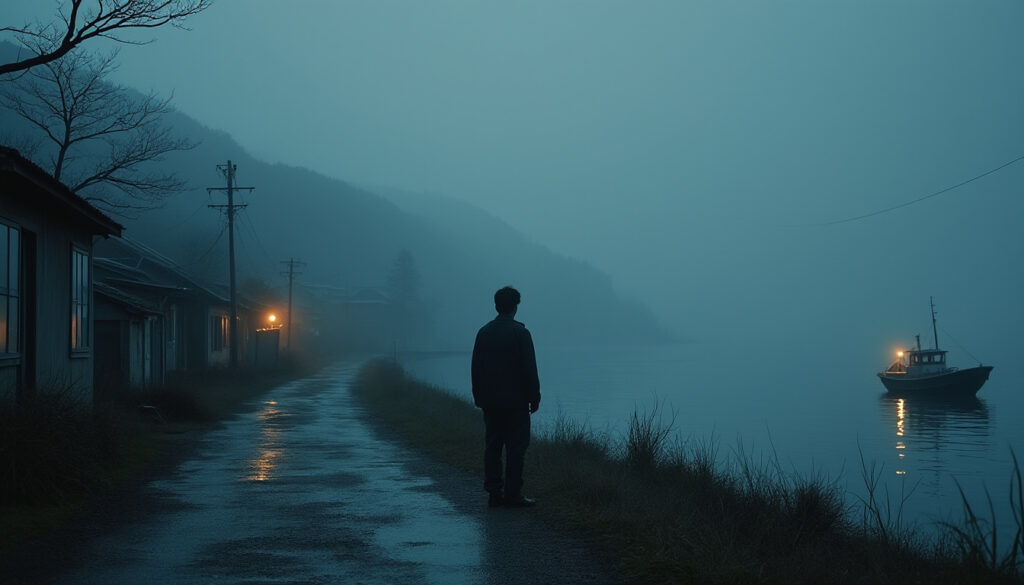
With “Hope”, Na Hong-jin marks a highly anticipated return and plunges the South Korean port city of Hope into mystery: after the discovery of a butchered bull, police and villagers embark on the trail of an elusive creature. Between horror thriller, a breathless chase, and reflection on coexistence, the film promises to shift the narrative towards unexpected horizons.
After establishing his cinema in the troubled territories of The Chaser and The Strangers, Na Hong-jin returns with Hope, a fantastical tale that begins with a rural mystery. In the port town of Hope, the discovery of an horrifically mutilated animal shocks the community and gives rise to a troubling rumor: an unknown force has ravaged the downtown area. But the film does not stick to the traditional game of monster hunting. Very quickly, the creature appears, and this revelation shifts the suspense towards a more disturbing question: what is it trying to escape from? The return of the South Korean filmmaker generates particular anticipation, as his work is known for unsettling the viewer’s benchmarks. Hope follows this continuity while daring to venture into a broader register, where the fantastical coexists with horror, humor, and science fiction. Its presentation at Cannes, announced in the official selection, already underscores the importance given to this new project. The plot opens with concrete, almost familiar elements, before gradually broadening its horizons. In this rural area of southern Korea, the discovery of a butchered bull transforms a diffuse concern into a tangible threat. A policeman and several residents are organizing to understand what is happening, while stories of a devastated downtown fuel their fear. The investigation then takes the form of a collective expedition, marked by distrust and ordinary courage. This community becomes the first observatory for a film that makes the unknown a presence both physical and elusive. The staging initially maintains tension through anticipation, sounds, and the reactions of those who believe they perceive a nearby danger. Yet, the narrative does not keep its antagonist off-screen for long: the creature eventually shows itself, imposing and singular. Its elongated silhouette, distorted musculature, and almost human gaze create an apparition that is hard to reduce to a simple threat. The suspense then changes nature, as the mystery no longer rests solely on its appearance, but on its intentions. In many monster movies, the revelation of the creature constitutes a dramatic peak, prepared by clues and disappearances. Here, the unveiling comes early enough to shift attention towards the being’s gestures and how humans interpret its behavior. It seems to flee more than attack, driven by a goal that the residents do not understand. Its power causes damage, but there is nothing to conclude that it is deliberately trying to kill or destroy. This ambiguity gives the action a disturbing quality: the threat is real, while its source remains opaque. The creature’s movement resembles less an offensive than a disordered flight, pressed by a vital necessity. The pursuers, on their part, engage in a hunt whose reasons blur together with fear, duty, and the desire to protect their village. Gradually, the two trajectories seem to progress side by side rather than converge towards a classic confrontation. The chase thus becomes a shared flight, where human and monster are driven by forces they do not fully control. A visual detail can then overturn the perception of an entire sequence: tears appear on the beast’s face. In an instant, its expression ceases to be only frightening and becomes readable as a sign of suffering. The film invites us to consider a consciousness behind the monstrous appearance, without erasing the danger posed by its body. This tension between compassion and terror constitutes one of the strongest springs of the narrative. It compels characters — and the audience — to revise their certainties without offering them easy answers. Movement seems to become the very principle of the staging, as if the film refuses to let the pressure drop. The runs, detours, and hurried movements give the scenes an almost exhausting energy. This tempo transforms the viewer into a tossed witness, unable to predict the next break. The rhythm is not just a tool for suspense: it also reflects the struggle for survival and the need to continue moving forward. This intensity is regularly interrupted, or rather bent, by humor that is willingly trivial. Offbeat exchanges and incongruous situations serve to loosen the grip, without erasing the discomfort. Some prolonged scenes play with excess and awkwardness, creating a deliberate contrast with the gravity of the stakes. Laughter then acts as a breath, but also as a way to destabilize the conventions of the horror film. Na Hong-jin can make dread, absurdity, and emotion coexist without seeking to make them perfectly comfortable. This blend of genres does not only rely on shifts in tone. It also alters the audience’s position, alternately drawn into action, amused by the absurd, and brought back to a form of compassion. The impression of losing one’s footing becomes a component of the spectacle. As events accumulate, the film seems to broaden its own ambition, until it transforms a local drama into the threshold of a conflict of much larger dimensions. This escalation promises an experience where the surprise lies not only in what leaps onto the screen, but also in the unpredictable direction the narrative takes. Horror enthusiasts can also explore other approaches to the genre, notably in this tale where faith, desire, and dread intertwine. This thematic proximity does not erase the differences between the works, but it sheds light on the diversity of paths taken by contemporary fantastic cinema. In Hope, horror seems to serve a questioning of appearances and the possibility of recognizing the other. The monster is not merely a riddle to solve: it becomes a presence whose vulnerability complicates any moral reading. The village and its surroundings initially form a small space, where survival seems dependent on immediate decisions and fragile solidarities. But the story gradually appears to pull the viewer out of this familiar framework. The stakes take on a broader dimension, evoking a confrontation between worlds or civilizations. This shift contributes to the unique identity of the project: the narrative does not merely continue a rural investigation; it changes its scale. The viewer must then accept not to control everything. This opening towards science fiction can give the impression that the story escapes its own limits. The shift does not seek necessarily to explain everything; it rather relies on astonishment and the breadth of new perspectives. This choice prolongs the logic of a film that constantly transforms its first impressions. The threat discovered at the side of a road becomes a possible sign of upheaval that transcends the inhabitants of Hope. Yet the small territory does not disappear: it becomes the starting point of a broader questioning concerning coexistence. At the heart of the narrative thus draws a tension that might seem irreconcilable, between beings separated by their appearance, origin, and means of action. However, the staging sometimes favors parallelism over direct confrontation. The trajectories respond to one another without necessarily converging, as if both camps share the same urgency without yet understanding each other. This geometry nourishes a hypothesis: the future might not necessarily be one of total victory, but one of a difficult coexistence. The fear remains, but it does not entirely forbid the idea of an understanding. This displacement echoes other works that choose to blur the boundaries of narrative and the imaginary. One can think, in a different register, of how the video game Myst continues to fuel the exploration of enigmatic worlds. The comparison does not diminish the film’s specificities, but it recalls the power of a universe capable of opening unknown spaces without immediately revealing all the keys. For its part, the Cannes programming also welcomes other singular proposals, as shown by the news of the Cannes Première selection. In this effervescence, Na Hong-jin’s project stands out for the breadth of its mix of terror, emotion, and cosmic imagination. The announced strength of Hope lies in its ability to shift expectations rather than satisfy them in a predictable order. The viewer initially believes they are following an investigation into a dangerous presence, only to discover a creature that seems cornered itself. The action does not slow down: it takes on new nuances, between survival instinct, misunderstanding, and compassion. This evolution brings the film closer to a modern tale, without removing its thriller energy. The result could rest as much on the unease felt as on the answers provided. Through its characters, the community of Hope embodies the contradictory reactions that the unknown provokes. Some seek to identify it, others want to stop it, while fear pushes everyone to interpret the events according to their own limits. Facing them, the creature does not present itself as a clearly defined antagonist. Its apparent silence and difficult-to-decode gestures fuel danger as much as empathy. Understanding then becomes an endeavor as urgent as survival, but nothing guarantees that these two objectives can align. The film also seems interested in the boundaries that humans erect between themselves and what they do not know. The encounter with a foreign form of life can quickly turn into conflict, especially when panic precedes any attempt at dialogue. By placing fear on both sides, the story sketches a relationship less simple than that of the hunter and its prey. This perspective does not promise immediate harmony. It rather suggests that coexistence could begin with a glance, a gesture, or a brief recognition of another’s suffering. This breadth may appeal to viewers drawn to tales that refuse to remain within a single category. Horror mingles with drama, the absurd traverses tension, and science fiction transforms the initial framework. The film thus seems to play with conventions rather than abandon them one by one, which gives its shifts in register their potential for surprise. The contrast between the small port town and broader stakes could be one of its main driving forces. The catastrophe is no longer just an event to contain, but a question about humanity’s place in a shared world. The landscapes and movements should also contribute to this feeling of openness. Like in a journey where every detour reveals an unexpected territory, the story seems to evolve its benchmarks as it progresses. For readers prompted by these horizons to change scenery, an itinerary in New Brunswick offers another way to discover landscapes, this time very real. In Na Hong-jin’s universe, however, the road leads to an uncertain encounter, where strangeness grows with each step. And when the narrative expands its scope further, the question of survival takes on a dimension that transcends the borders of Hope.An isolated village faced with an unknown presence
A creature that escapes the predator narrative
The chase, rhythm, and shifts in tone
From local drama to a science fiction fable
A film that transforms expectations
Na Hong-jin returns with Hope, a highly anticipated film
With Hope, Na Hong-jin returns to a cinema where anxiety arises as much from what escapes the gaze as from what suddenly appears on screen. In the port city of Hope, the discovery of a butchered animal and the reports of a devastating threat plunge the inhabitants into worry. A policeman and villagers embark on a search for explanations, but the investigation quickly takes on the dimensions of a frantic escape, as an impressive creature traverses their territory.
The film plays with the expectations of the monster tale. Rather than indefinitely delaying its revelation, it shows this massive and singular silhouette quite early on. However, the terrifying appearance does not reveal everything: the creature seems less driven by a desire to destroy than by the need to flee. This discrepancy transforms the chase into an ambiguous experience, where human fear responds to the monster’s distress. Na Hong-jin thus shifts the gaze: behind the apparent confrontation lies an unexpected closeness between beings who seek, each in their own way, to survive.
This tension is accompanied by a characteristic mix of registers from the filmmaker. Breathless action coexists with comical sequences, sometimes crude, that temporarily relieve the pressure without erasing the overall strangeness. Then the narrative broadens its horizon: what initially seemed to concern an isolated village takes on a broader, almost cosmic, scale. The shifting of genres thus becomes one of the driving forces of the film, which transitions from thriller to science fiction without ceasing to surprise. The anticipation surrounding Hope also lies in this promise: to follow a chase whose stakes change as the characters advance, and to discover how far Na Hong-jin will choose to shift the boundaries between fear, empathy, and imagination.