
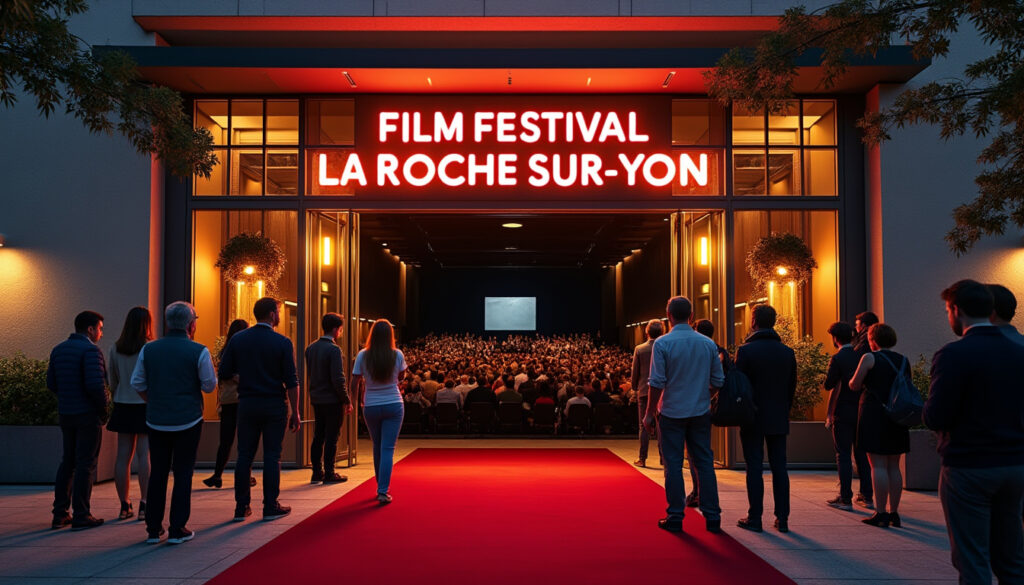
The 17th edition of the International Film Festival of La Roche-sur-Yon celebrated the diversity of independent cinema, from inventive documentaries to intimate narratives and unique experiences. Here’s a look back at some highlights and the award-winning films.
From October 12 to 18, 2026, the International Film Festival of La Roche-sur-Yon celebrated its seventeenth edition with a program open to the most diverse forms and sensitivities. Hybrid documentaries, American independent cinema, Chinese narratives, animation, and experimental offers made up a rich journey. Here’s a look back at the films that marked this week and at the awards from an event attentive to singular voices.
An edition focused on the diversity of independent cinema
The festival again made diversity its guiding theme. The selected films do not resemble each other in their subjects or forms, but share a freedom of tone that resists overly rigid categories. This choice allowed for a transition from an intimate story to a sensory experience, then from an animated film to a political chronicle, without reducing independent cinema to a single definition.
The programming offered around ten discoveries among the competitions and special screenings, within a much larger whole. This selection highlighted works capable of surprising while responding to the public’s desire for escape and entertainment. To place this event in context, one can also discover the presentation of the seventeenth edition of the Yonnais festival.
This curiosity fits into a broader cinephile current, where festivals serve as windows onto cinematographies that are sometimes barely visible in theaters. Other events also explore the margins, retrospectives, and new writings, as shown by this look back at L’Étrange Festival 2025. La Roche-sur-Yon, for its part, favored an eclectic panorama where each work could open a different conversation.
Documentary, a constantly renewed playground
The vitality of documentary has established itself as one of the major hallmarks of this edition. Filmmakers and real characters meet in shifting devices, sometimes borrowing from fiction, reporting, or television codes. The result blurs the lines without losing sight of human emotions and contradictions.
“Burgundy,” between wine chronicle and troubled fiction
Presented during the opening night, Burgundy takes the viewer into a Burgundy wine estate amid a period of transition. The elderly owner wishes to pass on his prestigious heritage to his grandson, while a young, experienced employee hopes to find his place in the vineyard. Around them, an apprentice sommelier doubts her vocation, and a maître d’hôtel prepares to leave the profession.
Michael Dweck and Gregory Kershaw transform these trajectories into a blend of tones and forms. The film draws from documentary, faux-reportage, and fiction, with a few nods to television magazines. This composition, both mischievous and sensitive, gives the whole a unique flavor; the two directors had already explored the boundaries between observation and narrative in The Truffle Hunter.
A sensory approach to Nino Rota
With Nino, a film about Nino Rota, Walter Fasano steers clear of the pitfalls of exhaustive biographical portraiture. The composer, whose music accompanies notably the films of Fellini, The Godfather, and Romeo and Juliet, appears through an evocation that is more sensitive than chronological. Nature and elements become pathways into his inner universe.
This approach avoids a static homage and rather seeks to convey how the musician addressed the public. Nino Rota appears as an artist of exceptional talent, yet not eager to place his own genius in the spotlight. The film, slated for release in Italy in February 2027, was still seeking a French distributor at the time.
American narratives attentive to the overlooked
Several American works directed their gaze toward lives far removed from dominant representations. Independent cinema here explores family ties, inherited wounds, and the margins of society, not always adhering to the same narrative paths. Two films inspired by the experiences of their directors thus proposed very contrasting results.
The road and reunions in “Hot Water”
In Hot Water, Ramzi Bashour relies on personal elements to construct a mother-son journey. The gradual rapprochement of the two characters and their encounters with marginal figures give the film a familiar structure. Despite some touching moments, the accumulation of conventions and good feelings ultimately limits its impact.
The restrained poetry of “If I Go Will They Miss Me”
The film by Walter Thompson-Hernández also addresses an intimate experience but chooses a more open path. It follows a child confronted with the challenge of reconnecting with his father, recently released from prison. Rather than explaining every emotion, the narrative leaves silences and images suspended, inviting each viewer to project their own story onto it.
If I Go Will They Miss Me draws its strength from this modesty. The parent-child relationship builds at a distance, in hesitations and tiny gestures, rather than through lengthy explanations. This restraint avoids demonstrative discourse and gives the film a poetry of its own.
Chinese imaginings, between technology and the search for filiation
Two films from China have sketched universes where isolation seems almost material. Technology, sounds, and landscapes become reflections of a dehumanized society, but the characters continue to seek reasons to believe in change. Their narratives thus transform worry into quest, without fully closing off possibilities.
Animation and virtual reality in “Light Pillar”
In Light Pillar, Xu Zao mixes real shots with animation. A drawn character dreams of becoming a flesh-and-blood man, and a virtual reality headset opens a gap between these two states. The visual disparity serves not just as a formal effect: it gives body to the desire to escape one’s condition.
This encounter of techniques installs a strangeness that accompanies the protagonist’s journey. The animated image and the real world respond to each other, as if one could reveal the lacks of the other. The film received a special mention at the Nouvelles Vagues prize.
The internal noise of “Atlantic Rhapsody”
Zhong Kaifeng centers Atlantic Rhapsody on a young man haunted by a noise he cannot silence. To understand its origin, he undertakes to find his father, and this search transforms the disturbance into movement. The work was awarded the Nouvelles Vagues prize, a recognition that underscores the uniqueness of its universe.
The film shares with Light Pillar an atmosphere of solitude, without adopting its visual choices. In both cases, the setting seems to distance individuals from each other, while an intimate quest pushes them to move forward. To prolong this exploration of the singular proposals presented at festivals, a detour through the fascinating retrospectives of L’Étrange Festival 2025 offers another insight into cinephile diversity.
French cinema between political unease and animated emotion
French films have also played a remarkable role in the programming, with very diverse tones. One scrutinizes contemporary political disorder; the other brought audiences together around a sensitive and accessible animation. This confrontation reminds us that a festival can allow for the coexistence of analysis of the present and the shared pleasure of a family screening.
The political malaise of “Un peu avant minuit”
Premiered as a preview, Un peu avant minuit, the new film by Nicolas Pariser, takes place in a context of social and political crisis. As protests spill over into the government and a state of emergency looms, Léo, portrayed by Melvil Poupaud, examines his own attitude toward women. He understands that, even if he does not belong to the most openly predatory figures, certain masculine behaviors contribute to reducing women to objects of desire.
The film blends this awareness with touches of humor and lengthy conversations filmed in long takes. However, its discourse sometimes tends to go in circles, and the repeated exchanges slow down the narrative. References to Rohmer do not suffice to regain the lightness and precision of its model; the theatrical release was slated for December 2.
“Le Corset,” an animation that touches multiple generations
In contrast, Le Corset by Louis Clichy won unanimous acclaim from both young and old. This animated film combines intelligence and emotion, without reserving its qualities for a single audience. Its commendation as a favorite among middle school students confirms the resonance it found with young viewers.
Cinephiles can also find the insights of Charlotte Serrand on the festival in this interview dedicated to the fifteenth edition. This perspective on the programming and the support of works complements the discoveries of this year. It reminds us of the importance of a rendezvous that connects films, artists, and audiences.
Cinema experiences off the beaten paths
Alongside more classic narratives, the festival offered several formal proposals that are difficult to reduce to a genre. They emphasize disturbance, memory, and fragmented perceptions, inviting the audience to complete the images with their own experience. Some are made to leave a lasting impression rather than deliver a definitive interpretation.
The maritime dream of “Rose of Nevada”
Mark Jenkin takes the audience into a dream with Rose of Nevada, a mysterious story of a ghost fishing boat returning to a port in Cornwall. Shooting in 16mm gives the images a rich texture, sometimes almost palpable. The precision of details creates a hypnotic atmosphere, even if this attention can sometimes verge on excess.
The originality of the perspective lies in this way of transforming a familiar place into an uncertain space. The port seems suspended between the everyday and the fantastic, while the ship appears to carry a memory that no one can completely grasp. The film favors enchantment over explanation, and that is precisely what gives it strength.
The intimate memory in María Silvia Esteve’s films
The focus on Argentine director and producer María Silvia Esteve allowed for the discovery of two works that are both intimate and formally audacious. The experimental short film The Spiral, made in 2022, assembles voice messages and digital creations to address traumas related to suicide. Its fragmented device gives a singular presence to the traces left by words.
In Silvia, her 2018 feature film, the filmmaker retraces her mother’s troubled fate using VHS tapes. The archive images become both a material for creation and a medium for memory. The film surpasses mere family homage: it transforms this personal exploration into a universal reflection on transmission, absence, and the possibility of rebuilding.
The competition awards
The juries have awarded works from various backgrounds and different sensitivities. The prizes reflect a selection that did not favor a single form of cinema. Here are the distinctions announced for this edition:
- Grand Prize of the International Jury Ciné+ OCS: Tristan Forever, by Tobias Nölle and Loran Bonnardot.
- Special Jury Prize: Radio Bonheur, by Valéry Rosier.
- Nouvelles Vagues Prize: Atlantic Rhapsody, by Zhong Kaifeng.
- Special Mentions of the Nouvelles Vagues Prize: Light Pillar, by Xu Zao, and Heat, by Jacqueline Zünd.
- Trajectories Prize: Takkuuk, by Zak Norman and Charlie Miller.
- Mad Movies Variety Prize: The Island of Memories, by Januel Mercado and Joel Crawford.
- Favorite of the IUT of La Roche-sur-Yon: Changing the Water of Flowers, by Jean-Pierre Jeunet.
- Favorite of Middle School Students: Le Corset, by Louis Clichy.
- Favorite of the Jury Classes: Little Jules, by Mathias Varin, and Toward the Forest, by Antonin Niclass.
The diversity of the awards truly reflects the spirit of this week of screenings. From contemplative narratives to more accessible works, the distinctions have accommodated various ways of capturing the world. This openness aligns with the interest in other international events, such as the panorama of the Locarno Festival 2026, where emerging perspectives and singular forms also take center stage.
The 17th edition of the International Film Festival of La Roche-sur-Yon: a look back at the highlights
The 17th edition of the International Film Festival of La Roche-sur-Yon once again highlighted the vitality of independent cinema. Through an eclectic selection, the screenings facilitated a dialogue between documentary, fiction, animation, and experimental cinema, while exploring narratives distant from the formats dictated by the market. This diversity gave the festival its rhythm: disorienting yet always attentive to human emotions and experiences.
The documentary distinguished itself by its ability to borrow the codes of other genres. Burgundy, balancing wine chronicle, reportage, and fiction, observes with humor and sensitivity the aspirations of several generations at the heart of a Burgundy vineyard. In a more sensory register, Nino, a film about Nino Rota offers a portrait of the Italian composer by prioritizing impressions, landscapes, and sensations rather than an exhaustive biography.
American independent cinema focused its gaze on fragile ties and existences on the margins. While Hot Water embraces familiar motifs of the road movie, If I Go Will They Miss Me stands out for the poetry of its narrative and its delicate way of evoking the communication difficulties between a father and his son. From the Chinese side, Light Pillar and Atlantic Rhapsody brought to life, within dehumanized universes, characters in search of a new drive.
The French selection notably presented Un peu avant minuit, a political chronicle permeated by contemporary debates, as well as Le Corset, an animated film noted for its intelligence and emotion. Among the singular experiences, Rose of Nevada enveloped the audience in its strange maritime atmosphere, while the films of María Silvia Esteve explored memory and trauma through intimate archives. The awards extended this diversity, rewarding notably Tristan Forever, Radio Bonheur, and Atlantic Rhapsody.


