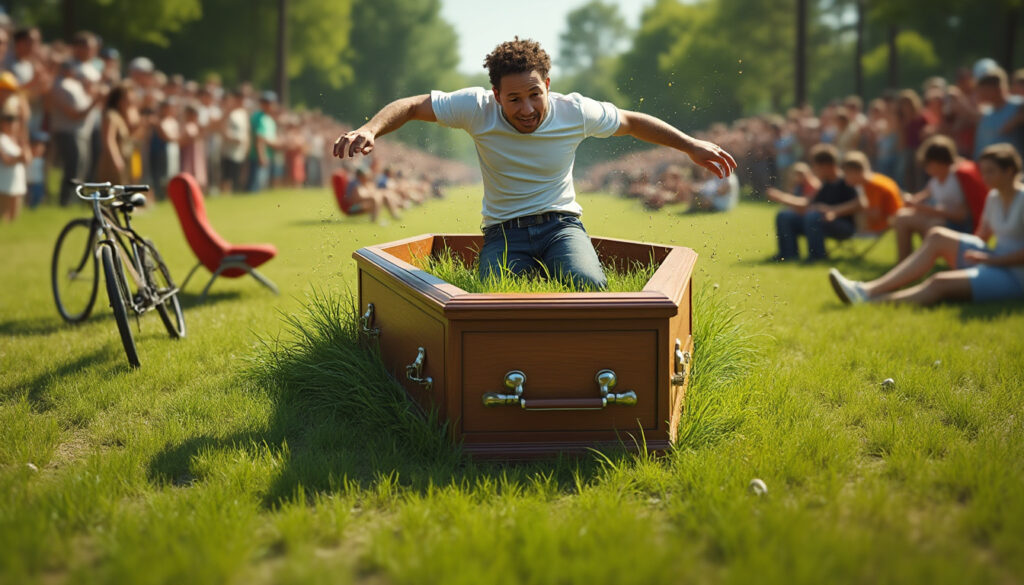
Between the sporting clumsiness of QWOP and the macabre humor of “Coffin Flop”, Fallbearers turns the transportation of a coffin into a funny balance challenge. Its demo from Steam Next Fest has already won me over: each step can tip the precious cargo… and the whole situation along with it.
The Steam Next Fest promises discoveries, but its abundance of demos can quickly turn curiosity into a chore. Among the games that nonetheless deserve a place in this avalanche, Fallbearers stands out with an idea as macabre as it is funny. Its mix of physical clumsiness like QWOP and absurd falls worthy of “Coffin Flop” convinced me right away with its trailer. Steam festivals are overflowing with games to try, and this profusion has its downside. Among intriguing projects, indistinguishable productions, and demos flagged as using generative AI, finding the rare gem takes time. For those who don’t have hours to devote to sorting, the initial enthusiasm can fade before the first launch. On social media, gamers share their selections without AI-generated content, as well as browser extensions to filter out certain results. These initiatives make spotting easier, but they do not make the vast catalog disappear. One still has to choose what to launch, and that’s where Fallbearers caught my eye. I stumbled upon the game while browsing Bluesky, and its presentation video led me straight to its Steam page. The concept can be summed up in a memorable image: two coffin bearers in Victorian times, tasked with transporting a deceased person to their grave. The comparison to QWOP becomes quickly apparent, while the humor of “Coffin Flop” hints at a taste for physical disasters. In Fallbearers, you can play alone or team up with another person. The bearers move on their own, but the player must manage their pace, jumps, and the height at which they keep their precious cargo. This apparent simplicity hides delicate coordination: the coffin must remain stable while the environment seems to do everything to tip it over. The journey to the cemetery winds through treacherous streets. A storm drain, a steep slope, or a particularly ill-tempered dog can turn a dignified procession into a scene of panic. Every obstacle requires readjusting the rhythm and position of the bearers, at the risk of seeing the deceased slip out of their box. And this fall is not just a visual gag: if the body leaves the coffin, the game ends. The number of tolerated failures varies depending on the chosen difficulty, allowing for adjustments in pressure level. Even solo, one can eventually find their bearings, but one must accept a few disastrous attempts before achieving a proper gait. The demo is short, almost frustrating in how it wants you to see more. It is enough, however, to reveal the central pleasure of the game: figuring out the right moment to lift or lower the bearers, and then starting over after a spectacular fall. Playing with two promises to be even more chaotic, as each partner will have to synchronize their commands with the other while maintaining their seriousness. This difficulty is anything but a dry or punitive obstacle. It instead transforms into a comic spring, as the slightest hesitation can produce a grotesque scene. The game thus plays on a very particular tension: you want to protect the coffin, but you often laugh when everything goes awry. The success of the formula lies in its contrast. The mission is solemn — transporting a deceased person to their final resting place — while its execution resembles a poorly-prepared balancing act. This disconnect gives every movement a comedic nervousness, without reducing the game to a mere succession of gags. The kinship with QWOP is found in the pleasure of mastering gestures that should be elementary. Walking, jumping, keeping balance: everything seems obvious until the moment comes to do it with an unstable coffin on uneven cobblestones. As in the most memorable physical mastery games, failure becomes almost as enjoyable as success. This idea reminds us that video games can draw a strong identity from a very simple device, as long as it is pushed in a unique direction. To place this kind of inventiveness within a larger story, you can read this overview dedicated to the influence of the Internet on the evolution of video games. The circulation of ideas and creations has profoundly transformed how small projects find their audience. The demo hints at a more comprehensive experience than its single route. The sequel should offer varied terrains, including snowy landscapes where the bearers will need to use skis. This promise opens up delightful possibilities: on a slippery surface, keeping the coffin upright could become an even more perilous exercise. No release date has been announced for now. This leaves time to imagine the next steps of this improbable procession, but also to keep an eye out for upcoming information. In the meantime, the demo already does the essential work: it makes you want to start over, and see how far the developers will push the concept. The game stands out in a saturated festival because it is immediately understandable, yet does not exhaust its idea in a matter of seconds. Its concept can be summarized in a sentence, but mastery requires finesse, observation, and sometimes a good dose of patience. This combination of accessibility and controlled clumsiness makes it a recommendation easy to share. Its demo will particularly appeal to those who enjoy physics-based games, absurd situations, and stories to tell afterward. It could also shine in cooperation, where the coordination of the two players is likely to cause as many disagreements as laughs. For a complementary perspective on how gaming communities evolve, this article revisits a British board game convention and its rules regarding AI. Ultimately, the demo reminds us that a catchy idea can still emerge amid an immense catalog. Recommendation lists and filters are helpful, but sometimes nothing beats a shared find at the right moment. In another vein, the changes in video game commerce show how the ecosystem surrounding games is transforming, while independent creations continue to seek their place within it. The choice of an absurd tone does not prevent the game from touching on surprisingly varied themes. Its Victorian setting and funeral ceremony contrast with the burlesque mechanics, as if the gravity of the subject crashes against each misstep. For another approach to youth and its representations, this portrait of Jérémie Battaglia offers a detour toward a very different cultural reflection. And if this meeting of cinema, black humor, and video gaming intrigues you, the link with images doesn’t stop there. Cinema can also transform an obsession into a hypnotic experience, as discussed in this article dedicated to Arrebato by Ivan Zulueta. For its part, Fallbearers still awaits the clarification of its release date, but its wobbling coffin has already found a place at the top of my list for the Steam Next Fest.When the demo hunt becomes an obstacle course
A trailer that makes you want to give it a shot
Two bearers, one coffin, and far too many obstacles
The delicate art of not dropping the deceased
Absurd humor serving a real challenge
The demo gives a taste, not yet the grand journey
Why Fallbearers deserves a spot in your selection
When the coffin becomes a test of skill
By crossing the absurd humor of Coffin Flop and the disarming difficulty of QWOP, Fallbearers has already found its place at the very top of my list for Steam Next Fest. The principle can be summed up in a few words: two Victorian bearers must transport a coffin to its final resting place while I strive to guide them without sending the deceased tumbling into the street. Simple on paper. Much less so when a storm drain, a slope, or an aggressive dog comes into play.
What makes the demo so delightful is this tension between mastery and imminent catastrophe. The bearers move on their own, but every adjustment counts: speeding up, jumping, lifting the coffin or lowering it at the right moment. You fumble, you correct too late, and then you witness a scene so grotesque that it turns failure into a comic reward. Yet, behind the falls and moments of panic, there is a real satisfaction in gradually understanding the rhythm of the game.
I tested the adventure solo, and coordination already requires a fair bit of patience. With two, each controlling their bearer, the journey promises to become a joyful exercise in communication — or a memorable argument over an unstable coffin. This idea makes me want to imagine the reactions around a couch when everyone is trying to save the convoy and the slightest misstep threatens to topple everything.
The demo is short, just enough to hint at the game’s potential without satisfying curiosity. Future segments could take place on varied terrains, even snowy landscapes where the bearers will have to put on skis. I can already picture uncontrolled slides, overly ambitious turns, and that precious coffin hurtling towards an unexpected destination. For now, I keep in mind those first chaotic meters and the desire to take the handles again to attempt a slightly more dignified crossing — if the deceased is willing to stay on board.