
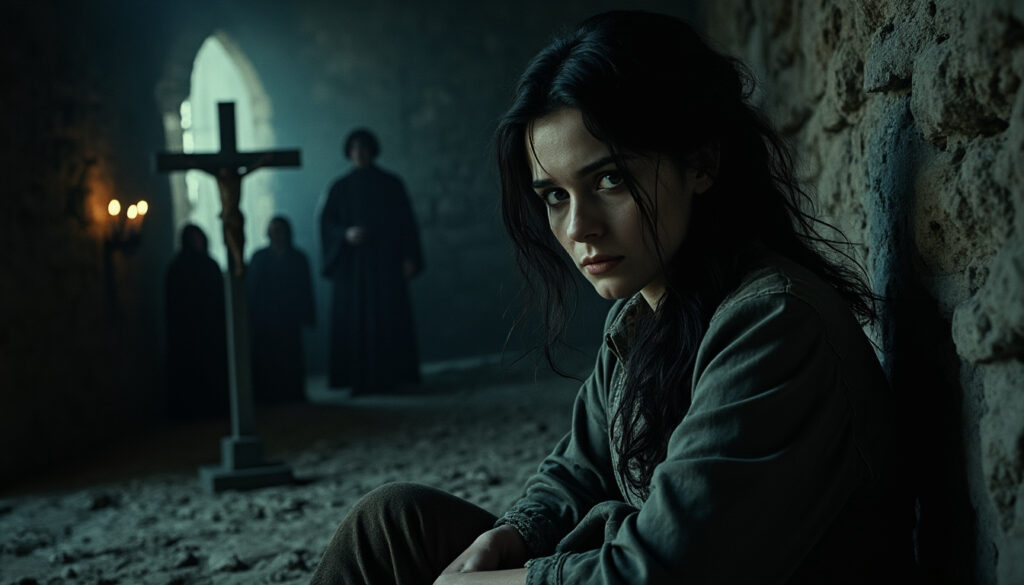
With The Possessed (1975), Amando de Ossorio revisits possession cinema through the fate of Susan, a child whose body is invaded by the vengeful spirit of a witch. While the film borrows from The Exorcist, it gradually imposes a unique Spanish tone, where supernatural horror intertwines with a poignant representation of an abused childhood.
Released in 1975, The Possessed takes the codes of the exorcism film and filters them through the dark and singular lens of Spanish cinema. The story follows Susan, a child whose body becomes the battleground for a witch’s vengeance. Although the film often references The Exorcist, it also finds its own path through striking Sabbath scenes and the painful portrayal of a battered childhood. Behind the terror, Amando de Ossorio reveals a more intimate tragedy.
A supernatural vengeance at the heart of Spain
The plot opens with the arrest of a witch who practices human sacrifices. Before dying, she decides to take revenge on the man responsible for her downfall by possessing his daughter, Susan. The child gradually changes, and her surroundings initially struggle to understand what is happening to her.
Susan, a trapped child
Susan’s transformation first manifests in unusual aggression. The adults seek ordinary explanations, while the girl becomes increasingly difficult to recognize. This discrepancy between the reassuring gaze of loved ones and the growing evidence of evil creates a lasting unease.
The governess, a privileged witness to this decline, ultimately seeks the help of Father Juan. The priest is called to intervene just as his faith wavers and events seem to defy any rational explanation. Possession thus becomes as much a trial for the child as a spiritual test for the one trying to save her. The narrative incrementally heightens this tension, allowing the unsettling signs to accumulate.
In the wake of “The Exorcist”
Directed by Amando de Ossorio, best known for his Blind Dead saga, the film appears two years after the success of The Exorcist. The kinship between the two works is evident, including themes related to adolescence, sexuality, and the skepticism of adults towards the supernatural. Father Juan’s doubt also echoes that of Father Karras, confronted with a crisis of faith at the moment help is requested.
This proximity may give the feature film the appearance of an exploitation movie that rehashes an already popular formula. However, Ossorio does not simply align the expected signs of the exorcism narrative. He gradually shifts the focus towards the cruelty inflicted on Susan and the powerlessness of the adults around her. Imitation then transforms into a horrific melodrama in places.
The film remains uneven, especially when its direction becomes clumsier or its characters seem reduced to familiar genre functions. But this weakness does not erase the moments when it breaks free from its model. A Spanish sensitivity, sometimes fierce and twilight-like, colors the whole and gives it a distinctive identity. It is in these deviations that the particular charm of this overlooked work emerges.
Black masses and the presence of evil
The sequences of black mass are among the most striking passages of the film. Their ritual atmosphere introduces a pagan dimension that distinguishes witchcraft from a mere spectacular manifestation of the demon. The gestures, symbols, and collective threat create a deliberately unsettling universe. Ossorio conveys the existence of an organized evil, capable of acting beyond Susan’s body.
The witch is a central figure of this threat, even when she does not manifest directly. Her control extends through the child, whom she uses to reach and torment her victims. This idea gives the story a particular cruelty, as Susan is both the visible face of horror and the one who suffers it. The possessed body then narrates a struggle that the child neither masters the rules nor the consequences.
These occult scenes have an effectiveness that contrasts with the production’s limits. The images rely not only on surprise but on the impression that a dark order has settled into daily life. The supernatural infiltrates a familial environment where one would still like to believe in rational causes. This confrontation between the mundane and the malefic nourishes several of the most memorable moments.
Susan’s face greatly contributes to this unease. Marian Salgado’s performance shifts from vulnerability to menace with great flexibility, without erasing the distress of the girl. This versatility makes the possession scenes more disturbing, as the monstrosity never completely obscures the child. A year later, the actress will also mark viewers in Revolt of the Year 2000, a film by Narciso Ibáñez Serrador.
An horror that takes the form of a drama
Ossorio films Susan’s ordeal up close, giving significant attention to her reactions and suffering. This choice sometimes distances the film from the almost clinical model of The Exorcist. The horror is no longer solely based on the spectacular confrontation between a priest and a demon: it resides in the gradual destruction of the child. The filmmaker’s gaze thus leads the narrative towards an increasingly tragic tone.
The violence that strikes Susan is both physical and psychological. Possession acts as a force that invades her body, but also as a negation of her identity. The film emphasizes the gap between the little girl her surroundings think they know and the creature that seems to take her place. This metamorphosis makes the narrative profoundly disturbing, without reducing its protagonist to a mere horrific effect.
A more painful reading emerges: childhood seems attacked by the adult world, its violences and its inability to protect the most vulnerable. The supernatural gives an extreme form to this idea, but the emotional consequences remain very concrete. The compassion aroused by Susan ultimately counts as much as the fear inspired by the witch. It is this melancholy that allows the film to occasionally transcend its status as a late copy.
The limits of the direction remain visible, and some narrative devices seem today conventional. However, these imperfections contribute to its singularity: the work constantly oscillates between exploitation, religious fantasy, and family drama. For those interested in the history of horror cinema, this period reveals many attempts by filmmakers eager to extend the success of possession narratives. In this regard, the genre’s relevance also includes tributes to creators, like this article dedicated to the demise of director Jeremiah Kipp.
The Possessed does not rival the masterpiece of William Friedkin, from which it openly borrows several mechanisms. Nevertheless, it remains endearing when its direction strays from the beaten paths to prioritize rites, the pain of the young heroine, and fate. These intermittent qualities make it one of the most interesting offspring of the great cycle of exorcism films of the 1970s. The film is available on Blu-ray from Le Chat qui fume, in an edition accompanied by supplements dedicated to Marian Salgado and to Ossorio’s work, as well as the trailer.
The Possessed: childhood trapped in horror
With The Possessed, directed by Amando de Ossorio in 1975, supernatural horror takes root in the daily life of a Spanish family. After her arrest, a witch chooses to take revenge by seizing Susan, the daughter of the man who had her arrested. The child gradually changes: her behavior becomes concerning, violence surfaces, and her body itself seems to bear the marks of a foreign presence. Faced with this evil that the adults struggle to understand, the governess seeks the help of Father Juan, a priest troubled by his own uncertainties.
The film follows in the wake of The Exorcist, a phenomenon from which it borrows several motifs: skepticism towards the supernatural, religious doubt, and the emergence of troubling bodily signs. But Ossorio gives this story a unique color, especially in the sequences of black mass and in the manifestations of the witch, whose influence transforms the possession into an unsettling spectacle. These passages, few but striking, reveal a more personal imagery than the familiar structure of the narrative would suggest.
The presence of Marian Salgado is essential to this atmosphere. Her face shifts from fragility to a striking hostility, while the direction remains attentive to Susan’s physical and psychological suffering. Possession then is not merely a horrific device: it becomes an ordeal inflicted on a child, observed closely, without detours. This dimension gives the film a progressively tragic and melancholic tone, where fear intertwines with discomfort at the destruction of innocence.
Uneven and sometimes marked by a dated direction, The Possessed thus retains its interest in the moments where it strays from its model. Its Spanish atmosphere, its occult visions, and Salgado’s intense performance shape a work where horror takes on a deeply human form, both brutal and painful.


