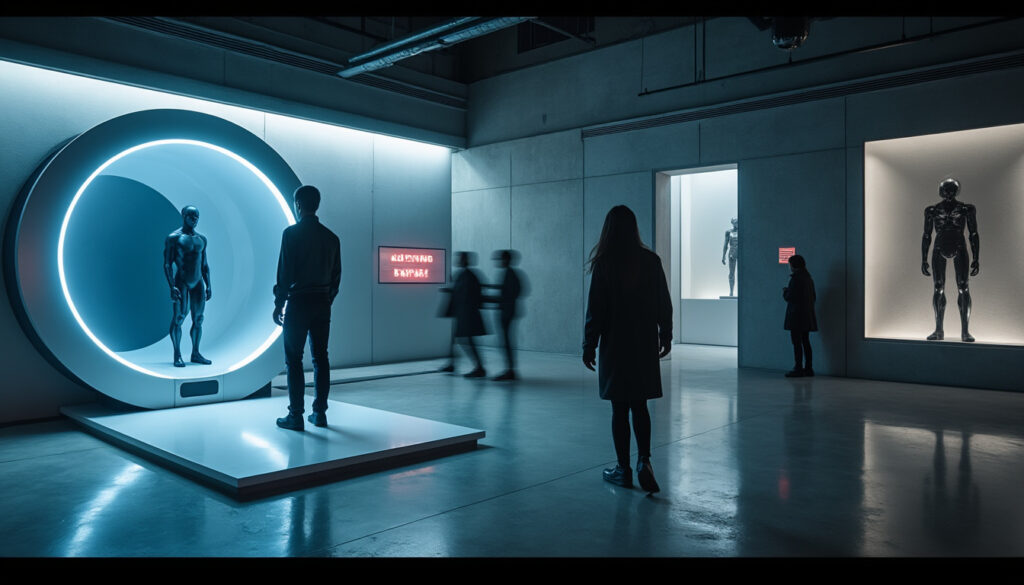
In Tokyo, the exhibition celebrating Kojima Productions’ tenth anniversary revealed a few intriguing clues: Physint appears to be set against the backdrop of a “coming Cold War,” while OD: Knock explores surprisingly advanced scanning techniques. Here are eight more revelations that shed light on the studio’s inner workings and upcoming projects.
In Tokyo, an exhibition dedicated to Kojima Productions’ first ten years reveals far more than development mementos. Between unseen sketches, tools developed during the pandemic and still-mysterious projects, it paints a picture of a studio that extends well beyond the world of video games. Here are the major revelations, from the Cold War imagined for Physint to OD: Knock’s visual experiments.
Physint and its “coming Cold War”
Among the few clues on display about Physint, one detail stands out: the story appears to be set during a “coming Cold War.” The document on display mentions three forms of intelligence — human, signals intelligence and publicly available information — that could shape this conflict. The game’s full title remains unknown, with part of its name obscured on the script’s cover, while some models bring to mind war machines from the Metal Gear universe. The information is therefore fragmentary, but it sketches out a spy game focused on contemporary tensions and information flows.
OD: Knock, between real footage and digitized sets
The exhibition also offered a glimpse into OD: Knock, the horror project being developed with Xbox. To prepare for its first-person movement, the team filmed real locations with GoPro cameras, then recreated their distorted framing and distinctive perspective in the game engine. The comparison between a dark kitchen, a window overlooking a damp street and its virtual version illustrates this very hands-on approach. The game thus seems to seek unease in familiar places rather than fantastical environments.
The digitization process was not limited to performers. Kojima Productions also scanned antique furniture and sets from the Japanese television series Sayonara, Maestro! to create convincing interiors. The contrast between a family drama and a horror game is intriguing, although the exact use of these elements in OD: Knock has not been specified. Above all, the method reveals an ambition: to build digital spaces rich in detail, wear and history.
Eight revelations about the studio’s games and methods
The exhibition displays also tell the story of how Death Stranding was made, from its earliest ideas to the tools used to coordinate teams. They feature preparatory documents, prototypes and creative choices that were sometimes abandoned along the way. Taken together, they offer a glimpse of a process in which several projects progress in parallel, from motion capture to character design. Some of these archives are particularly revealing about the evolution of the game and its sequels.
A video shows an early prototype of the first Death Stranding: a still-generic character picks up cargo and makes their way through a mountainous landscape that is already recognizable. The idea of a vast world to traverse was therefore present from very early on. Other images suggest that the BT creatures were once more aggressive, before their role in the final game was adjusted. The balance between exploration, tension and combat was thus shaped through trial and error.
The exhibition walls also feature previously unseen concept art, logo drafts and drawings by Yoji Shinkawa. Production documents annotated by Hideo Kojima sit alongside motion-capture images, props used during the sessions and a 3D-printed prototype of the capsules intended for the BBs. Some character designs differ considerably from the versions that were ultimately chosen, including an early interpretation of Fragile. The documents sent to Sony to pitch the project explain the “Strand” gameplay concept: allowing players to encounter one another indirectly and contribute to a shared world. This idea of connection, summed up by the desire to “bring us together,” was already at the heart of the journey.
A reworked sequel, a redesigned logo and a studio connected remotely
Early concepts for Death Stranding 2 differed significantly from the story that was ultimately released. Design documents refer to a happier ending in which several characters found a measure of peace, as well as ideas for traveling underground and extending the network to South America. The Covid-19 pandemic led the team to rework the story, as the world had just experienced a period of separation and uncertainty. Some initial proposals nevertheless left their mark on the vision for the sequel. Elle Fanning’s name already appeared in notes associated with the character of Tomorrow.
Kojima Productions’ mascot and emblem also underwent several transformations. Early versions sometimes showed the character in a full-body spacesuit, waving a flag, while another sketch evoked a knight. The current figure, a skull wearing a space helmet, gradually took shape. This creative process reflects the desire to give the studio a memorable visual identity, extending to clothing and merchandise.
When it became necessary to continue performance capture despite closed borders, the team turned to Mado, a remote-presence system developed with MUSVI. More immersive than a simple video call, the tool connected the Los Angeles and Tokyo studios, among others, to facilitate directing the actors. The setup on display in Tokyo provided a live window into Kojima Productions’ offices, where visitors could catch a glimpse of the actors’ scanning area. Team members sometimes appeared on screen and, during some visits, Hideo Kojima himself exchanged a few words with the public.
The experiments also extend to mobile: an augmented-reality demonstration, Death Stranding: Odradek (Tokyo Prototype), invites visitors to make deliveries in the neighborhood around the exhibition. The phone is used to observe the surroundings, spot signs left by other players and, at times, detect BTs. Participants can also care for their BB and give “likes” to helpful contributions, extending the Strand concept into real streets. For now, the experience is limited to a specific area and set routes, but it shows how the series’ mechanics could move beyond the screen.
A universe that extends beyond consoles
The visit gives considerable space to external collaborations, from animated projects related to Death Stranding to music partnerships and products created with various brands. One section also brings together storyboards associated with Death Stranding Isolations, while commercial collaborations demonstrate how the logo has become a recognizable emblem. The studio even took part in creating credit cards with Japanese bank MUFG. The exhibition thus showcases a company cultivating several forms of public presence, with games at the center, but not standing alone.
The items on display extend this strategy down to the details: a customized RIMOWA suitcase linked to OD: Knock, clothing designed with F.C. Real Bristol and a caricature plush of Kojima are among the standout pieces. The director also maintains the studio’s visibility through appearances, posts and audiovisual projects. This dimension goes hand in hand with an industry in which producing big-budget games requires building a lasting community around each universe. To follow the reactions sparked by Physint, read our article on Bill Skarsgård’s enthusiasm for the project, while speculation about the relationship between Kojima and PlayStation is covered in this article about the rumored split.
Physint, OD: Knock and behind the scenes at a studio in motion
With Physint, Kojima Productions is sketching out a return to espionage in a world gripped by a “new Cold War.” The documents presented in Tokyo mention three forms of intelligence — human, electronic and open-source — that could shape the plot. The final title remains mysterious, as does the role of the machines seen in the models. These first clues suggest a game in which infiltration and intelligence gathering will be central to the experience, without yet revealing the exact shape this adventure will take.
The exhibition also shed light on the making of OD: Knock, a horror project being developed with Xbox. To create its first-person perspective, the team filmed real locations with GoPro cameras, then recreated their framing and wide-angle effect in the game engine. The scans are not limited to actors: antique furniture and sets from a Japanese television series were also digitized to give the environments a familiar, almost tangible presence.
Other revelations chart the studio’s journey: its logo and mascot went through numerous versions before taking on their current appearance; Death Stranding prototypes show how the movement and enemies evolved; and a wealth of previously unseen drawings, notes and production documents reveal the extent of the preparatory work. The sequel, too, initially followed a different path: the pandemic led to changes to its story and ending.
To keep production going remotely, Kojima Productions created Mado, an immersive communication system used, among other things, between Tokyo and Los Angeles. The exhibition also highlighted the studio’s cultural and commercial partnerships, as well as an augmented-reality mobile prototype, Death Stranding: Odradek, in which deliveries, signs left by other players and encounters with BTs bring the universe into the streets of Tokyo.