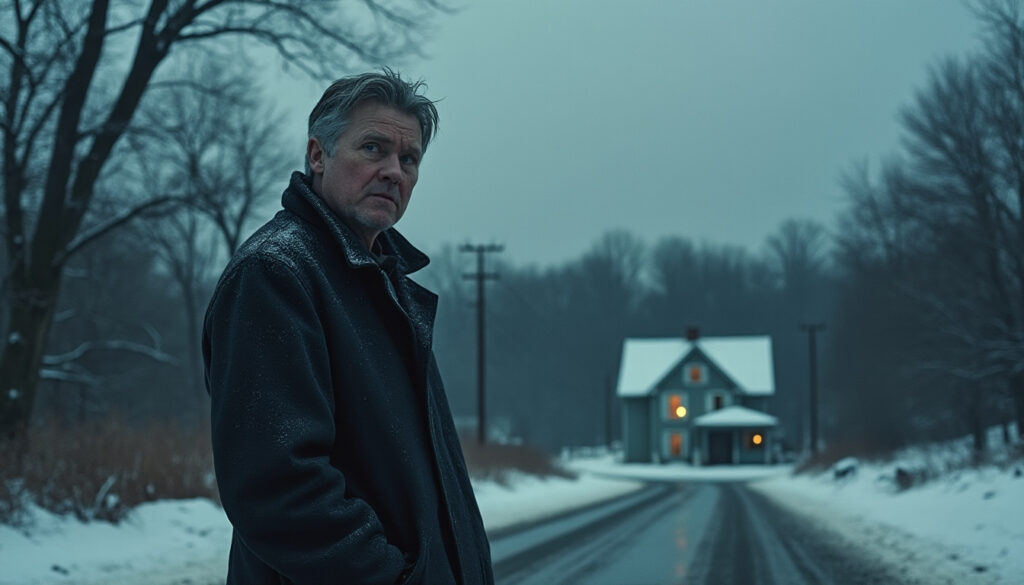
In “Affliction”, Paul Schrader follows Wade Whitehouse, a New Hampshire police officer whose investigation into a suspicious death revives the wounds of a childhood marked by a tyrannical father. Led by Nick Nolte, this wintry drama examines the transmission of violence and the slow decline of a man who confuses justice, revenge, and redemption.
In Affliction, Paul Schrader follows Wade Whitehouse, a small-town police officer in New Hampshire whose investigation revives old family wounds. The suspicious death of a hunter gradually becomes a mirror for long-standing anger, fueled by the violence of a tyrannical father. Led by Nick Nolte and James Coburn, the film blends a crime story with the portrait of a man seeking justice in the outside world while unable to escape his own demons. Beneath the persistent snow, this intimate tragedy explores the transmission of violence and the fragile possibility of putting an end to it. In 1997, for many moviegoers, the name Paul Schrader first brings to mind major screenplays associated with other directors. He notably wrote Taxi Driver and Raging Bull for Martin Scorsese, two landmark works that have had a lasting impact on the image of American cinema. This reputation as a screenwriter nevertheless tends to overshadow an already rich and distinctive career as a director. From Blue Collar to Mishima, then from Patty Hearst to Light Sleeper, Schrader builds a cinema populated by isolated individuals, consumed by the quests that consume them. His only major commercial success, American Gigolo, had come nearly twenty years earlier. Behind its sophisticated appearance, the film conceals a radicalism that makes it difficult to define the filmmaker’s place in Hollywood in simple terms. Financial obstacles and the difficulty of finding an audience accompany several of his projects. From the 1990s onward, he more often turns to literary works, following The Comfort of Strangers, adapted from Ian McEwan, and Touch, based on Elmore Leonard. This shift does not signal a relinquishing of his obsessions, but gives him new characters and material with which to explore guilt, isolation, and the need for redemption. Russell Banks’s 1989 novel Affliction gives Schrader familiar territory to explore. Banks is interested in ordinary lives, in people made vulnerable by their circumstances, and in families whose wounds are passed down. His characters are often on the verge of breaking point, without the resources they need to escape their situation. This vision echoes that of the director, who had already portrayed workers caught in social and economic power struggles in Blue Collar. For both artists, violence does not erupt as an isolated accident. Instead, it seems to build over time through humiliation, frustration, and silence, until it becomes, in the eyes of those who suffer it, a response that is as destructive as it is inevitable. Wade’s journey gives concrete form to this fatalism. He is divorced, the father of a little girl, and ill at ease in his relationships, while alcohol and outbursts of anger further complicate his daily life. His existence already seems bound up in wounds he can neither name nor share. The filmmaker had hoped to make the film earlier, but the bleakness of the story put financiers off. He also insists on casting Nick Nolte in the lead role; the actor was in high demand after several hits and difficult to secure right away. The project is put on hold as the actor slowly immerses himself in a character who demands both a physical presence and great emotional restraint. In a small, snowbound town in New Hampshire, Wade works as a police officer and takes an interest in the death of a wealthy businessman during a hunting trip. The circumstances strike him as suspicious, and he latches onto the details with growing determination. The case finally gives him a purpose, but the energy he pours into it also reveals an anger that was there long before. Wade’s search leads not only to a potential culprit. It takes him back to his father, a brutal man whose authority left its mark on both sons and deeply affected their relationships with others. The father’s presence turns the investigation into a family confrontation, in which the past is no longer merely recounted. The story is punctuated by the voice of Rolfe, Wade’s brother, played by Willem Dafoe. He comments on events from a curious position, at once close to the story and largely outside the action. His perspective does not dispel the shadows, but subtly guides the viewer toward the wounds that shape his brother’s behavior. This offbeat narration recalls a figure dear to Schrader: a character haunted by his thoughts, like Travis Bickle in Taxi Driver. Here, however, the voice is not that of the man who acts. The narrative separates Wade, trapped in the urgency of his actions, from Rolfe, who tries to make sense of them afterward. As the investigation progresses, the search for the truth becomes entangled with a quest for personal redress. Wade wants to identify someone responsible, but he can no longer clearly distinguish justice from revenge. Believing he is getting closer to an explanation, he sinks into a spiral in which every answer seems to fuel his rage. Snow almost constantly envelops the setting, giving the landscapes a deceptively still quality. Schrader favors precise, sometimes static compositions in which the characters’ movements seem like contained agitation. From the opening credits, the composition of small frames and Michael Brook’s music establish an atmosphere that is both cold and unsettling. Family memories interrupt this apparent stability. They appear with shifts in aspect ratio and texture that break the continuity of the image. Black and white, handheld camerawork, and abrupt zooms give the past a particular roughness, as if memory itself could not be recounted without violence. These flashbacks show the two brothers as children and their father, whose brutality shaped how they inhabit the world. The staging does not turn these scenes into mere psychological explanations. Instead, it makes them weigh on the present, where every conflict seems to awaken an older experience. When the father finally appears in the present-day action, he is no longer merely a feared memory. The confrontation with Wade gives visible form to years of resentment and fear. The family is reunited, but reconciliation seems impossible, so deeply are their words and gestures marked by conflict. Nick Nolte portrays a deeply fractured hero without trying to make him likable at all costs. His heavy gait, silences, and sudden changes of mood convey the constant effort it takes him to maintain the semblance of control. His performance allows Wade’s vulnerability to coexist with the threat he poses to those who come near him. James Coburn, in the role of the father, exudes an unsettling authority, while Willem Dafoe gives Rolfe a detachment threaded with compassion. The three actors’ performances bring out different ways of carrying the same legacy: confrontation, withdrawal, and an attempt to understand. To continue exploring authority figures and inner conflicts in cinema, you can also discover this exploration of Paul Schrader’s world, as well as an analysis of Spike Lee’s vision in Malcolm X. The film does not offer a police investigation designed to end with the comfort of a definitive answer. Rather, the murder serves as a catalyst for a crisis that was already there, latent in Wade’s actions and family history. Schrader thus subverts the conventions of the crime thriller to observe the moment when obsession becomes a way of life. Male violence emerges as a legacy that men may, perhaps, refuse to perpetuate. In the final minutes, Rolfe’s words open a crack, without erasing the damage or promising a happy outcome. This gives the film an unexpected nuance: at the heart of despair, a new distance might still make it possible to break with revenge. Presented in Venice in 1997, Affliction was not released in the United States until late 1998, and then in France in 1999. It received a highly favorable critical reception, and James Coburn won the Academy Award for Best Supporting Actor, while Nick Nolte was nominated. The film nevertheless remained little known to the general public, making its rediscovery in high definition particularly rewarding. A Blu-ray edition now makes it possible to appreciate the precision of the compositions, the variations in texture, and the silent presence of the wintry landscapes. It also includes a feature on the film with Samuel Blumenfeld, who revisits its choices and influences. This curated restoration brings renewed attention to a major work by Schrader, whose bleakness is matched by exceptionally controlled writing.Paul Schrader, from writing to directing tormented souls
Meeting Russell Banks and an America of the forgotten
A criminal investigation that opens the door to the past
Staging a violence that seeps into the present
An intimate tragedy at the heart of America
With Affliction, Paul Schrader does more than tell the story of a criminal investigation: he observes a man who seeks, in the violence of a murder, an explanation for the violence shaping his own life. Wade Whitehouse believes he can restore order to the world by uncovering the truth about a hunter’s death. But every clue leads him back to an older wound, to a father whose brutal authority left deep scars. The investigation thus becomes a distorted mirror of his family history, and the promise of justice gradually merges with the desire for revenge.
The film’s strength lies in this spiral, portrayed without indulgence and without reducing Wade to a simple monster or victim. Nick Nolte gives him a rough-edged presence, full of awkwardness, anger, and contained fragility. Opposite him, James Coburn plays a father whose violence seems to have endured through the years without fading. Wounds are passed down, bonds unravel, and the snowbound community becomes the enclosed setting for a past that refuses to stay behind its characters.
Yet Affliction is not merely a despairing account of a legacy that cannot be broken. Rolfe’s quiet, grieving voice introduces a distance that makes it possible to see this story differently. In the final moments, it hints at a fragile possibility: acknowledging the violence one has suffered may be the first step toward refusing to pass it on. Schrader promises neither easy redress nor certain redemption. He simply leaves a crack in the fatalism, a narrow space where detachment might take the place of revenge.
Nearly thirty years after it was made, the film remains moving in the way it turns a crime thriller into an intimate tragedy. Beneath the snow, through a quest that devours the man pursuing it, it explores family, masculinity, and the ravages of silence. A stark, deeply felt work whose pain lingers long after the investigation has ceased to be the real point.