In “Aprile”, Nanni Moretti intertwines his life as a filmmaker, his concerns about political Italy, and the anticipation of his first child. Between biting satire and unexpected tenderness, the film transforms the hesitations of its author into an intimate chronicle of a country in full mutation.
In Aprile, Nanni Moretti brings together political anxiety, a filmmaker’s hesitations, and the anticipation of a child. Shot like a personal journal, both funny and insightful, the film captures an Italy shaken by electoral tremors. The birth of Pietro gradually transforms the director’s view of his time, without erasing the contradictions that trouble him.
A Self-Portrait Between Observation and Staging
Released four years after Journal intime, Aprile extends its autobiographical vein while changing pace. Moretti appears under his own name, in a subtle game between the real person and the character shaped by cinema. Roman walks and island escapes give way to a tighter narrative, where private and collective concerns intersect, respond, and sometimes jostle.
In Front of the Television, Political Italy Enters the Home
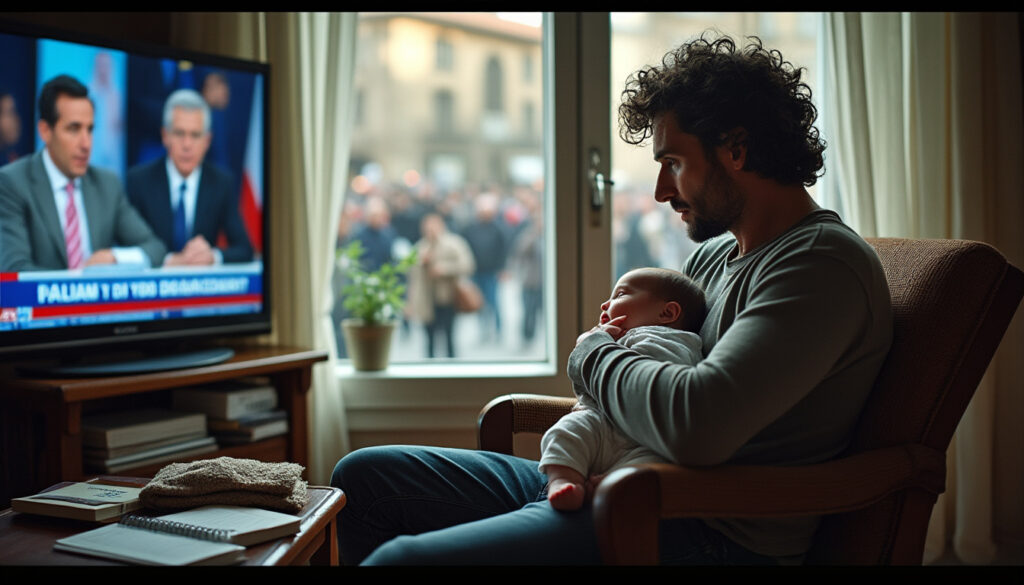
At the beginning of the film, the announcement of Silvio Berlusconi’s electoral victory in 1994 catches Moretti in front of the family television. The scene immediately establishes an atmosphere of dismay, but indignation does not take the form of a solemn speech. While a presenter respectfully addresses the new leader, the filmmaker prepares to smoke an oversized joint, an absurd gesture that responds to the gravity of the moment with comic extravagance.
This reaction makes television a central element of the narrative, both a window on current events and an almost invasive presence in the home. Political statements resonate even in private life, as if national events were preventing any true retreat. Moretti then considers making a documentary about the Italian situation, but the intention soon encounters the delays, doubts, and detours that characterize his working style. Engagement is indeed there, without it becoming a simple or immediate action.
Political Compromises and Creative Impediments
The film progresses in fragments and brings together ideas that seem, at first glance, to belong to very different registers. An election, a letter never sent, or a project for a historical musical film can thus find themselves side by side, without explanatory transition. This rapid construction recalls Moretti’s early films, where one thought leads to another before the previous one could transform into a decision.
Among the recurring projects is the story of a Trotskyist pastry chef in Stalinist Italy. This historical and musical film contrasts with the political documentary that Moretti struggles to finish, and its appearance highlights the gap between creative momentum and its concrete realization. Ideas abound; their implementation, however, remains uncertain. In this unstable space, the film humorously observes the mechanisms of procrastination, without reducing them to a simple weakness.
The angry letters that the character writes and then keeps illustrate this tension with comic precision. He formulates his grievances, constructs them carefully, but does not send them to their recipients. The act of writing thus becomes a substitute action: it allows the expression of opposition while postponing real confrontation. This form of self-impendence nourishes creation but also complicates the possibility of intervening effectively in public debate.
The satire also focuses on changes in vocabulary and party calculations. Moretti questions the place of the left, its alliances, and the compromises that seem to blur the benchmarks. In this context, staying against appears sometimes easier than choosing a cause and sticking to it. The film does not present this hesitation as a heroic posture; rather, it shows the comfort and powerlessness within, with an irony that targets both the character and the political landscape.
Fatherhood, a New Center of Gravity
In 1996, as a new electoral deadline approaches, Moretti and his partner Silvia are expecting their first child. This personal evolution does not replace other subjects, but it gradually gives them a new perspective. The pregnancy introduces a very concrete anticipation into a narrative so far dominated by unfinished projects and civic anxieties. The future ceases to be only an abstract idea: it takes the form of a child to welcome.
The prospect of the birth changes the way the couple views the world around them. A particularly revealing scene shows Moretti anxious after a film they have just seen in the cinema: he wonders if this experience could harm the intellectual development of the unborn child. The fear is obviously exaggerated, but it tenderly expresses the anxious imagination of future parents. Cinema, daily life, and family responsibility then converge in the same joke.
The birth of Pietro also gives the film an emotional anchor. The debates and hesitations do not disappear, but they are reorganized around a bond that cannot be treated as a provisional commitment. Fatherhood thus opens a new perspective, characterized by attachment and vulnerability, while awakening older memories. When Moretti reflects on his childhood and interacts with his mother in a relaxed atmosphere, the scene contrasts with the family conflicts found in some of his earlier films.
This softness does not transform the narrative into a refuge cut off from current events. Politics remains a source of unrest, and joy neither erases disagreements nor anxieties. It coexists with them, as a way to continue inhabiting the present without claiming to resolve all its tensions. The film’s tone can then shift from disarray to lightness, and from jest to emotion, without seeking to confine these states into separate registers.
Daily Life as Cinematic Material
For Moretti, the ordinary deserves serious attention, but this attention never deprives it of humor. A newsstand becomes the setting for a meticulous enumeration of magazine titles; the choice of the future child’s name takes on the appearance of a sports competition. These scenes start from banal concerns and enlarge them through rhythm, repetition, or staging. They thus reveal the filmmaker’s ability to find a form of poetry in the most familiar habits.
The mixing of subjects contributes to this uniqueness. Sports, food, human relationships, cinema, and politics coexist without rigid hierarchy, but their proximity does not mean their stakes are equal. Moretti uses the gaps between them to observe how a real existence circulates from one concern to another. An apparently light question can suddenly illuminate a deeper anxiety, while a serious subject can be approached through a burlesque image.
A backtracking shot from an aerial perspective on a vast collage of newspaper clippings gives a visual form to this reflection. The fragments of articles compose a dense surface, where media discourses seem to level and blur. The character ultimately wraps himself in this image, as if seeking to give it relief and sharpness. The gesture transforms a set of news into cinematic material, without claiming to dissipate the noise they form.
The ending revisits the musical film project mentioned earlier. Moretti, dressed in an incongruous fabric, rides his Vespa under the early spring light, while the filming can finally resume. The movement echoes the escapades of Journal intime, but the road no longer quite serves the same function: it here accompanies a return to work and a singular way of taking a stand. In the face of political deadlocks and personal detours, cinema remains an independent practice, capable of embracing contradictions without simplifying them.
This re-release fits into a gradual rediscovery of Moretti’s films in theaters. After Palombella Rossa, the program announced by Malavida Films also includes the return of Journal intime. This circulation between the works allows for the measurement of the continuities of his cinema, but also the shifts of an author who confronts his gaze with the upheavals of his country and the transformations of his life. Aprile is being re-released in theaters starting September 30, 2026.
Intimacy, Engagement, and Fatherhood in Aprile
In Aprile, Nanni Moretti transforms the hesitations of a filmmaker into material for personal chronicle. The film shows him confronted with an Italy traversed by political tensions, notably after Silvio Berlusconi’s electoral victory. Faced with televised images and opportunistic speeches, Moretti oscillates between indignation, irony, and a desire to act. His project for a political documentary becomes clearer, then gets bogged down in the doubts and detours that nourish his cinema.
This difficulty in moving from intention to action becomes one of the comic springs of the narrative. Letters never sent, abandoned ideas, overlapping projects: the film observes with cunning a mind in motion, capable of formulating a scathing reaction while deferring the decisive gesture. The satire does not solely target political leaders. It also addresses the artist’s position, caught between his need to take a stand and his mistrust of collective compromises.
As the narrative unfolds, the anticipation of the first child shifts the center of gravity of this agitation. Silvia’s pregnancy and Pietro’s birth introduce a new scale of time and responsibility. Political concerns remain, but they now intertwine with the concrete worries of family life. Moretti, for example, wonders about the influence of a film seen in the cinema on his unborn child, transforming parental anxiety into a scene of tender humor.
The editing thus brings together worlds rarely separated: politics, cinema, food, sports, and family relationships. These rapid associations give the film its unique rhythm, made up of breaks and digressions. The joy linked to fatherhood does not dissipate the gravity of the Italian context; rather, it opens another space of perspective, closer and more intimate. Between the news broadcasts, the birth preparations, and the historical musical project, Moretti continues his work amid the contradictions of his time.