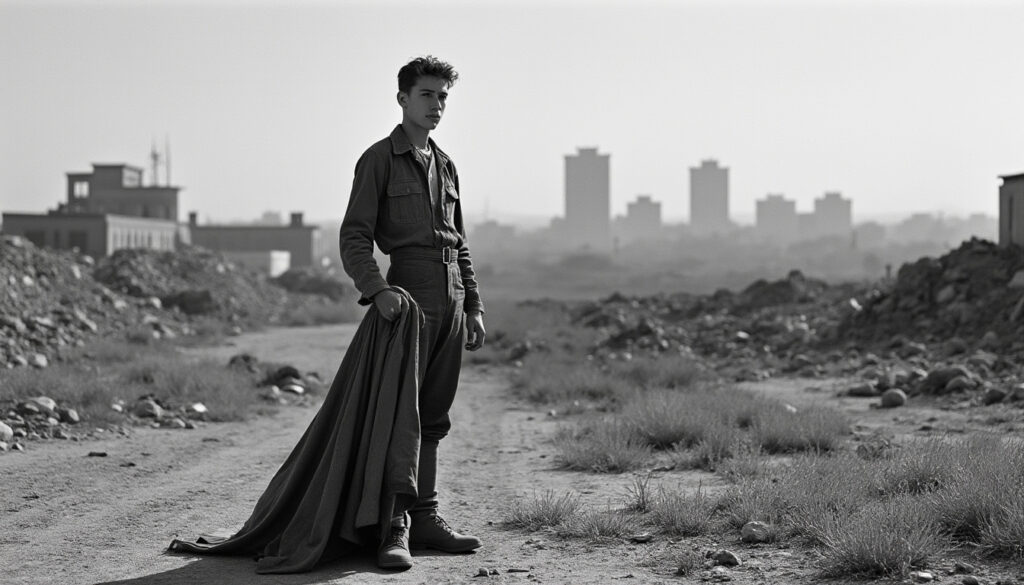
With Los Golfos (1959), Carlos Saura takes his camera to the margins of Madrid, where a group of young people tries to escape poverty by betting on Juan’s bullfighting dream. Between brutal realism and fragile hope, this first feature film paints the portrait of a raw youth, now rediscovered thanks to Tamasa Distribution.
With Los Golfos, his first feature film, Carlos Saura draws the viewer into the margins of Madrid, among young people confronted with poverty, violence, and a lack of horizons. At the center of their precarious existence, Juan dreams of becoming a bullfighter, and his friends place their hopes for escaping their daily lives on his ambition. The physical release offered by Tamasa Distribution sheds light on a singular film, infused with the energy of social cinema and a raw youth.
It would be tempting to seek in this first film a definitive formula for Saura’s cinema. However, his work does not allow itself to be confined to a fixed identity: it will change in tone, form, and concerns over the decades. Los Golfos stands out precisely because of its particular place, straddling almost documentary observation and tragic narrative.
The film follows a group of young men who survive through petty thefts and increasingly risky schemes. Their common project is clear: to gather the necessary money to allow Juan to fight in the arena. This prospect gives direction to their days but also increases the pressure on each of them.
A troubling kinship with Luis Buñuel
The kinship with Los Olvidados by Luis Buñuel is evident in both the motifs and the gaze directed at urban poverty. The improvised bullfighting games played by the boys echo those in the Mexican film, while the theft committed at the expense of a blind man resonates with a famous scene from the earlier work. Saura is said to have discovered this precursor after making his own film, but the similarities remain striking. They sketch a cinematic encounter that is all the more striking because it seems not to have been premeditated.
Filming the street, gestures, and margins
Like Buñuel, Saura observes disadvantaged neighborhoods without transforming them into picturesque backdrops. Filming in real locations, employing non-professional actors, and the sobriety of resources bring the work closer to an approach attentive to daily life. Sometimes it is the tiniest gestures that give the film its strength: a work garment put on, a glance exchanged, a song heard at the market.
The inhabitants of the margins are not reduced to abstract symbols. Their habits, ways of moving, and relationships with others create a concrete, sometimes harsh, material, always closely observed. Poverty appears as a lived condition, rather than a mere backdrop meant to underscore the characters’ courage.
This approach fits into a broader tradition of European social cinema. After the war, Italian neorealism placed the camera in close contact with the material difficulties and the violence they can nurture. In the late fifties, new forms of cinema also emerged in France and Britain, with renewed attention to ordinary young people and their environment.
A youth without horizon, but driven by a dream
Saura’s boys are not presented as exemplary figures. They commit condemnable, sometimes dangerous acts, and the narrative does not seek to excuse them through a simplistic morality. Instead, it shows how a lack of resources, boredom, and the desire for another life intertwine to make violence almost daily.
In 1959, rebellious youth traverse many films, from working-class neighborhoods to bourgeois settings. Les Quatre Cents Coups by François Truffaut also places a teenager at odds with his surroundings and institutions at the forefront. In different registers, these works question a society that aspires to modernity while not offering the same possibilities to all.
Saura films the gangs and the wastelands without glorifying their brutality. He does not bestow upon each violent act the beauty of choreography: here, the confrontation remains raw, awkward, sometimes ridiculous. This restraint distances Los Golfos from the aestheticization that the filmmaker would later explore in some films dedicated to movement and dance.
Yet, the narrative is organized around a luminous aspiration. Juan’s friends believe in his talent and follow his training with admiration, as if his success could provide an escape for the entire group. The bullfighter’s dream becomes a collective promise, fragile and almost unreal, but powerful enough to guide the characters’ choices.
Juan, a figure of hope and responsibility
Juan is not only pursuing a personal ambition. Through him, his companions envision an ascent that would lift them from their dilapidated shelters and precarious daily lives. But financing his entry into the arena requires money, and this sum pushes the group toward increasingly numerous and dangerous acts. The dream, instead of immediately freeing the boys, thus contributes to the cycle that threatens them.
The group’s fascination with the young man gives the film a particular tension. His friends watch him fight even before they can truly help him, captivated by the precision of his passes and by the possibility he represents. This admiration is sincere, but it also makes Juan the bearer of expectations that he may not be able to fulfill.
Bullfighting itself carries an ambiguity. It is a practice deeply rooted in the Spanish imagination, but the film presents it neither as a univocal emblem nor as a guaranteed path to salvation. For the young men, it becomes primarily a stage where they can measure a dream, an existence, and the possibility of being recognized.
As the crimes accumulate, the atmosphere tightens. The open spaces of the wastelands gradually give way to more closed, more mineral places, which seem to foreshadow confinement. The narrative thus conveys, through its landscape and frames, the growing weight of guilt and anxiety.
The gang is not an idealized community. Solidarity coexists with rivalries, recklessness, and the irreversible consequences of committed acts. A death particularly upsets the balance of the group, reminding them that the common project is already based on violence that escapes its authors.
The final bullfight: from the fate of one man to that of a generation
The final bullfight condenses the hopes that the boys have placed in Juan. At first, the young man seems inhabited by the role he is about to play and dedicates his performance to Visi and his friends. The gesture with which he throws his cape to the young woman resembles a self-assertion, but also a challenge thrown at fate.
When the muleta comes into play, the camera moves closer to the arena and the physical ordeal. Juan is no longer observed from afar as a promise: he becomes a man exposed to failure, fear, and the beast. The dreamed hero then collides with reality, without the film seeking to soften the disappointment.
The performance turns into disaster. This setback concerns not only Juan, as the entire gang had tied their future to his success. The collective dream collapses with the spectacle of the arena, and the violences committed to support it take on an even heavier weight in retrospect.
The editing then shifts the center of gravity of the scene. Attention does not remain fixed on the defeated bullfighter or the spectators’ reactions: the bull takes on a new place in the frame, isolated and vulnerable. This change in perspective shifts the finale from an individual narrative toward a broader image of abandonment and suffering.
The shadow of censorship and the circulation of the film
The ending we discover also bears traces of the interventions of Francoist censorship. Some cuts have removed moments from the film, while an addition linked to judicial punishment alters the significance of the final sequence. These interventions testify to the difficulties faced by a work that shows poverty and violence without reducing them to a reassuring lesson.
Despite a notable reception in Cannes, the distribution of Los Golfos in Spain was heavily impeded. The film circulated poorly and remained little seen in its own country. The presence of Buñuel alongside Saura at a Cannes screening, reported in relation to the work, highlights the closeness between two filmmakers whose approaches bring them together without conflating them.
This distribution history gives the physical release a particular dimension. The film returns in a context where it can be approached as a work of youth, but also as a milestone of Spanish cinema. The release by Tamasa Distribution offers the opportunity to rediscover a first feature film long hindered in its public journey, without erasing the marks of its history.
What the film announces is not an immutable style, but an attention to the structures that confine individuals. In Saura’s subsequent works, metaphors will sometimes take on a more affirmative place to evoke the immobilism and slow agony of Francoism. Here, the critique passes primarily through the bodies, places, and ordinary gestures of a youth without protection.
The Madrid of Los Golfos is far from a postcard. Its wastelands, its precarious shelters, and its urban spaces tell of a city that leaves part of its youth aside from its promises. This reality gives the film a resonance that transcends its era, particularly when collective expectations shatter against material inequalities.
A work to rediscover in its time
Watching today this group of young men is also to measure how juvenile delinquency occupied cinema in the fifties. Films addressed very different social environments, but often returned to a common question: what becomes of a generation when adults and institutions offer it no credible place? Saura observes this concern without claiming to resolve it.
The filmmaker does not confuse understanding with approval. He makes visible the circumstances surrounding the acts while allowing the damages they provoke to emerge. This unflinching gaze gives the film a unique harshness, but also a form of humanity attentive to the characters.
The image of the young bullfighter remains at the heart of this tension. Juan carries a desire for recognition, while his friends see in him a chance to transform their condition. In the arena, this collective projection encounters its limits, and the spectacle exposes as much the fragility of a man as that of those who have placed their future in him.
The rediscovery of Los Golfos finally allows us to grasp a pivotal moment when European cinema renewed its ways of filming the street. Saura adopts a stripped-down form here, attentive to real spaces and relegated lives, without renouncing dramatic construction. The result lies in this alliance between social observation and tragedy, amidst a Madrid filmed at the level of wastelands.
A dream of light amidst the wastelands
In Los Golfos, the Madrid of 1959 is sketched at the periphery: wastelands, dusty streets, and precarious shelters compose the backdrop of a youth searching for an escape. Carlos Saura films these spaces without beautifying them. Daily gestures, petty thefts, and silences give poverty a concrete presence, almost documentary. The camera observes a group of young men whose acts unfold under the weight of scarcity and the absence of prospects.
At the center of their expectations stands Juan, drawn to bullfighting and the possibility of becoming a matador. For his friends, his dream is not just a personal ambition: it becomes a collective promise, the prospect that one of their own might surpass the limits imposed by their condition. Saura makes the arena the symbolic continuation of the wastelands. There, the hope of rising intertwines with danger, while the group’s efforts to finance Juan’s career lead to choices increasingly heavy with consequences.
The tension of the film arises from this contrast between the aspiration for a new life and the violence that obstructs it. Without turning his characters into exemplary figures, Saura watches them evolve in a world where solidarity, enthusiasm, and brutality coexist. Bullfighting, filmed both as a spectacle and as a trial, crystallizes their desires as much as their fragility. Juan’s fate thus takes on a significance that transcends the individual: it engages the dreams of all those who accompany him.
Long hindered by censorship and little shown in Spain, this first feature film today regains a visible place thanks to Tamasa Distribution. Its re-release allows for the discovery of a singular work, attentive to the margins and thwarted aspirations, where the face of a young bullfighter stands out for a moment against the harsh horizon of a city that promises him almost nothing.