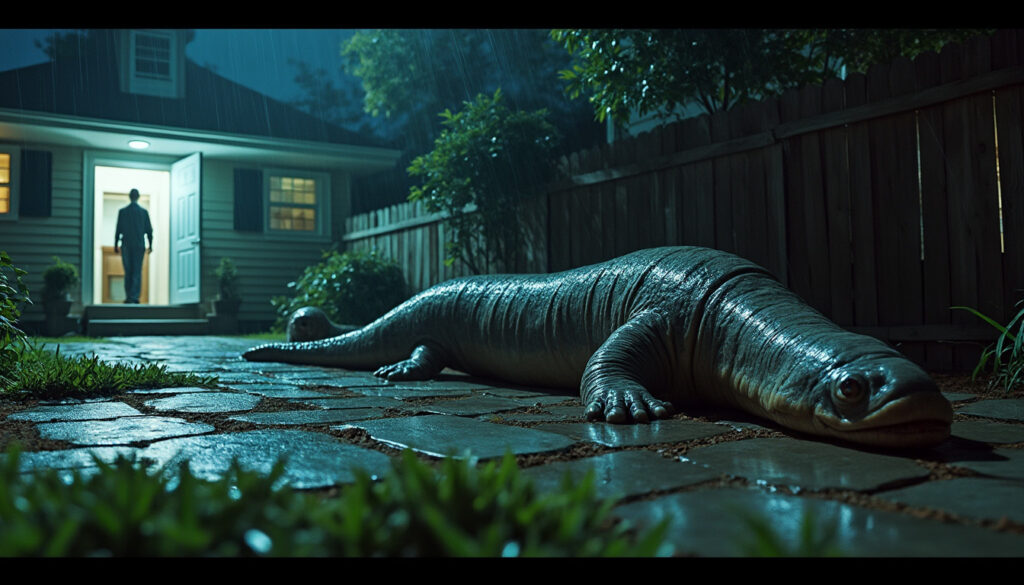
In Slugs (1988), Juan Piquer Simón turns a mundane animal into a slimy and murderous threat. As an investigation unfolds into mysterious deaths in a small American town, the slugs multiply and spread a gore-filled horror typical of B-movies, as surprising as it is enjoyable for genre enthusiasts.
In Slugs, ordinary mollusks become the drivers of a bloody nightmare. Directed in 1988 by Juan Piquer Simón, the film combines police investigation, animal horror, and gory effects. Its modest yet inventive direction gives this slimy menace an unexpectedly unsettling presence. The recent video edition from Rimini also allows for rediscovering a unique filmmaker and an overlooked aspect of Spanish genre cinema. In a small American town, residents die under circumstances as horrific as they are incomprehensible. Mike Brady, a sanitary agent, joins the sheriff to examine the sites and understand the origin of the tragedies. His initial conclusions seem absurd: slugs would have attacked the victims, and these little creatures would be capable of devouring human flesh. Yet, the deaths multiply, as clues gradually confirm his hypothesis. The premise of the film lies in a delightful contrast: a slow and familiar creature becomes the center of a macabre catastrophe. Simón exploits this idea seriously, without giving up the pleasure of excess. From the opening credits, bluish slugs slide across the screen, announcing a spectacle where slimy matter and shocking scenes will have their place. However, horror does not emerge immediately in every sequence. It settles in gradually, through repulsive hints, unexplained deaths, and fleeting appearances that suggest the worst. The characters, on the other hand, often fall into cliché. We encounter cruel youths, authority figures unable to take the threat seriously, and scenes of kitschy intimacy, sometimes outright vulgar. This simplistic characterization lends the narrative the flair of a B-movie, where psychology matters less than the effectiveness of situations. But this weakness also becomes a component of its tone: the film does not seek to build a subtle social drama. It prefers to confront a clean, respectable setting with a horror that contaminates it, even in the most mundane spaces. Juan Piquer Simón, who was also known as J. P. Simón, long operated on the fringes of the industry. Active since the 1960s, this Spanish filmmaker navigated between science fiction, adventure, and horror, often with limited means. His career gains more visibility with The Fantastic Continent, an adaptation of Jules Verne released in 1977. The French writer will reappear in his journey, while Simón also dabbled in superheroes with Supersonic Man, and in the crossover of giallo and slasher with The Sadist with the Chainsaw. This filmography outlines a trajectory of resourcefulness, wherein technical ambition sometimes exceeds the available resources. This ingenuity appears in the way the filmmaker composes his images. He dreams of being a Spanish Ray Harryhausen and prioritizes effects made directly on set, notably forced perspective. These techniques do not always produce a perfectly convincing result, but they testify to a concrete know-how and a desire to create spectacle with what is at hand. His work has been reevaluated long after its initial releases, and some commentators note his influence on Spanish filmmakers such as Álex de la Iglesia, Jaume Balagueró, or Alejandro Amenábar. A body of work long reserved for fans of genre cinema thus finds new appreciation. In Slugs, the crescendo operates through an accumulation of signs and incidents. A man, overwhelmed by unbearable pain, has to cut off his hand; a mouse is torn to shreds; then a meal in an elegant restaurant turns into a scene of horror when one of the diners, contaminated by a salad, begins to implode. The slugs then appear everywhere, in the faucets, toilets, sewers, and pipes. The film transforms these ordinary passages into invasion routes, and both the house and the restaurant cease to be refuges. Certain sequences push the gore representation to the point of disgust, particularly that of a couple massacred after a moment of intimacy. The progression relies less on the depth of the protagonists than on the inventiveness of the dangers that ensnare them. The Rimini edition, integrated into its Angoisse collection, accompanies the feature film with several supplements that shed light on its context. The interview “J. P. Simón, master craftsman of the bis,” proposed by Alexandre Jousse, revisits the director’s career, his methods, and the belated recognition of his work. A presentation dedicated to the attack of the killer slugs, signed by Lilyy Nelson from the podcast Jumpscare, places the film within the history of the animal sub-genre and discusses the novel by Shaun Hutson it adapts. The program also includes an audio interview with the writer recorded in 2024. Hutson explains that his publisher had encouraged him to develop an idea of a giant slug seen in one of his stories. Hutson’s testimony adds an interesting nuance to the reception of this adaptation. He explains that he initially did not appreciate the film much, only to revisit it years later with more indulgence. This perspective invites a distinction between literal fidelity and the energy unique to a transposition. The script retains the principle of a monstrous invasion, but Simón takes it towards a series of crude sequences, sometimes clumsy, often memorable. The narrative also borrows from the codes popularized by Jaws, showing authorities slow to recognize the danger. It does not claim to rival Spielberg’s model: rather, it adapts certain mechanisms to serve a much grimier and more direct horror adventure. The climax relies on quantity, with growing attacks and contamination, even if a final special effect may dilute the overall impact. This imperfection belongs to the rough charm of the film, whose ambitions regularly overflow the budget. The restoration and extras of the edition allow for an appreciation of both its limits and its discoveries, without transforming each flaw into a quality. Slugs remains a modest genre work, aimed at those who enjoy bloody makeups, improbable concepts, and murderous animals. Here, terror crawls at ground level, infiltrating conduits and invading banal daily life before anyone can stop it.A creeping threat at the heart of an unapologetic B-movie
Juan Piquer Simón, craftsman of Spanish genre cinema
A video edition that enriches the discovery of the film
From ordinary slugs to slimy horror
In Slugs, Juan Piquer Simón takes a familiar, slow, and almost insignificant creature and turns it into a threat capable of contaminating an entire town. The idea seems ridiculous: slugs attack the inhabitants of a small American municipality. Yet, the filmmaker precisely exploits this gap between the mollusk’s harmless appearance and the brutality of its attacks. Their progression, initially discreet, installs a persistent unease, as if danger could spring from any damp corner.
The narrative follows Mike Brady, sent to investigate a series of mysterious deaths. His hypothesis—that carnivorous slugs are responsible for the injuries—meets the incredulity of the authorities, as the victims multiply. This classic motif of animal invasion films takes on a resolutely B-movie hue here: the characters often lack depth, the situations flirt with bad taste, and the dialogues willingly fall into clichés. Simón does not attempt to mask these rough edges; he integrates them into a direct spectacle, designed to surprise and shock.
Horror advances in stages. Some writhing appearances precede increasingly graphic images: a mutilated hand, a devoured mouse, and then attacks that transform ordinary spaces into traps. Pipes, toilets, and even a plate become access routes for these creatures. The restaurant scene, where a contaminated meal turns into a collective nightmare, summarizes the film’s macabre pleasure: bringing the grotesque to life amidst a respectable setting.
The direction prioritizes efficiency and accumulation, leading up to a final confrontation where special effects prolong this sticky atmosphere. With its unabashed excesses and unique idea, Slugs makes disgust a true mechanism of suspense, driven by a tiny threat that progressively takes over the screen.