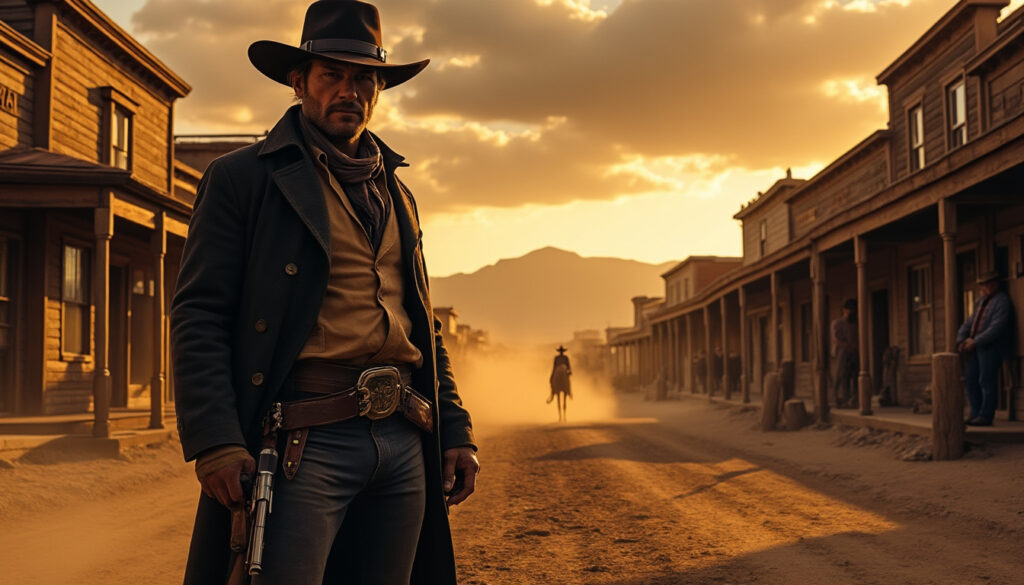
Directed by Franco Giraldi, Sugar Colt revisits the spaghetti western with an unconventional lightness. Its hero, a charming detective and master of disguise, breaks with the taciturn cowboy archetype to pursue a revenge investigation in which colorful female characters bring a distinctive touch.
Released in 1966, Sugar Colt is one of Franco Giraldi’s early westerns. The filmmaker quickly explored the genre’s possibilities before turning to comedy. Beneath the surface of a fairly conventional revenge investigation, the film cultivates a light tone and favors an eccentric hero over a taciturn gunslinger. Its charm also lies in its female characters, shifts in tone, and restrained direction.
The film arrived at a time when European westerns were multiplying their variations, from tales of revenge and outlaw figures to solitary heroes. Giraldi, who made several films in the genre early in his career, nevertheless had no desire to mechanically reproduce its conventions. He bends them with a playful spirit that gives this adventure a distinctive personality.
A revenge investigation with a comic edge
The story takes place after the Civil War, when Union soldiers have disappeared and are being held prisoner. Investigator Alan Pinkerton calls on Sugar Colt, but he initially refuses to leave his pursuits. He teaches self-defense to women, an activity that already hints at the film’s irony and its way of subverting expectations associated with the cowboy.
A hero far removed from the silent gunslinger
Pinkerton’s death, murdered before Sugar’s eyes, changes everything and gives the hero a personal reason to take up the case. The trail is quickly laid out: the adversaries are identified from the outset, which diminishes the suspense and leaves little room for surprises. The story moves forward less through its twists and turns than through the temperament of its main character.
Played by Jack Betts, Sugar Colt stands out for his lightness and flair for showmanship. He disguises himself, plays with appearances, and approaches situations with a smile that contrasts with the gravity expected of a quest for revenge. Rather than portraying a man sealed off in silence, Betts creates a charming, wily, and playfully mischievous adventurer.
At times, this persona makes him seem more like a dashing detective than a vigilante defined solely by his skill with a revolver. His womanizing, scheming side does not erase the genre’s conventions, but makes them more flexible. With his taste for gadgets and trickery, the character even brings to mind a modern adventure hero transplanted to the Wild West.
Female characters who shift the conventions
Josepha and Bess bring an energy to the film that is sometimes missing from its male-driven plots. Both have a real place in the story rather than appearing as mere decorative silhouettes. Their personalities are not enough to make the writing complex, but their confidence pleasantly shifts the usual balance of power.
Josepha, a saloon waitress, is proud, mischievous, and not inclined to let anyone dictate how she should behave. Soledad Miranda gives her a vivacity that comes through as much in her lines as in the way she occupies the space. The character thus breaks away from the female figure often reduced, in Italian westerns, to a victim or a secondary role with no meaningful interaction.
Bess brings a more painful note to this adventure dominated by whimsy. Fragile but tenacious, the bar owner gradually emerges as one of the film’s most memorable characters. Gina Rovere’s performance gives this character a dramatic depth rarely found in such a carefree film.
Her presence opens a breach in the general lightness and brings out an emotion that the screenplay does not always fully develop. Bess seems to carry, all by herself, some of the tragedy that the story prefers to leave in the background. This contrast enriches the film, even as it reveals the imbalances in its writing.
A deliberately mixed, but uneven, tone
Moving between investigation, romance, humor, and revenge, the film sometimes shifts registers without trying to smooth over the transitions. This freedom is one of its attractions: Sugar Colt’s upbeat tone coexists with more melancholic characters and potentially serious situations. The result remains uneven, but these contrasts keep the adventure from becoming a mere formula.
However, the screenplay does not make the most of its crime-story premise. Since the culprits are known from the outset, the investigation lacks mystery and the stakes struggle to develop. The humor and the hero’s personality partly compensate for this weakness, but cannot make every stage equally compelling.
Restrained direction and a carefully crafted edition
In his direction, Giraldi favors a measured approach, far removed from the most showy effects of some westerns of the period. In particular, he avoids an abundance of zooms, emphatic close-ups, and unusual visual compositions. This restraint gives the film an atypical quality, more focused on characters and situations than on formal excess.
Alejandro Ulloa’s cinematography helps establish the settings and atmospheres without weighing down the story. It works equally well in open spaces and more confined locations, where conversations take precedence over action. Enrique Luis Bacalov’s score supports the adventure with an appealing musical color, well suited to its blend of lightness and tension.
The film does not have the visual vigor of the most celebrated spaghetti westerns, and its pace has some less inspired stretches. Not all of its scenes build lasting tension, while the investigation’s progression remains fairly predictable. But the direction maintains a sense of cohesion, and its refusal to overdo things suits the ensemble’s nonchalant character.
The release of Sugar Colt in a 4K edition from Artus draws attention to a lesser-known title in Giraldi’s career. A restoration of this scale may seem unexpected for a modest work, but it offers an opportunity to appreciate its visual qualities and directorial details. This edition also places the film within a fertile period of European popular cinema, when genres were being transformed by new sensibilities.
An endearing curiosity in Giraldi’s career
Franco Giraldi’s early career included a series of westerns made in quick succession, before he turned to comedy with La Bambolona. Sugar Colt already reveals his interest in incongruities and characters who escape the dominant models. The film is not a high point of the genre, but it testifies to a craftsman attentive to the tonal possibilities of popular cinema.
The screenplay, to which Fernando Di Leo contributed alongside several collaborators, is built around a familiar plot and underdeveloped antagonists. This simple framework nevertheless gives the performers room to shine, particularly Jack Betts, Soledad Miranda, and Gina Rovere. Their performances give the story different colors, from mischief to gravity.
One can also recognize in this work an interest in hybrid forms that would take on different shapes in the director’s later films. Here, the western serves as the backdrop for a lighthearted adventure, sometimes lopsided but rarely austere. Giraldi favors entertainment and variations in character over an entirely bleak reinterpretation of the myths of the West.
This approach does not overcome all the film’s limitations: the pace is uneven and the investigation does not always sustain interest. Nevertheless, its shifts in tone, gentle humor, and memorable female characters give it a flavor of its own. This Italian western curiosity is thus an engaging piece of entertainment, carefully directed and carried by a hero against type and characters who sometimes exceed the expected bounds.
A spaghetti western between investigation and whimsy
With Sugar Colt, Franco Giraldi has fun shifting the conventions of the spaghetti western. The premise seems familiar: at the end of the Civil War, Union soldiers have disappeared, and an investigation must bring the truth to light. But the hero chosen to lead it is nothing like the taciturn gunslinger. Sugar Colt would rather teach self-defense to women, happily plays with appearances, and faces danger with a lightness that gives the story its distinctive flavor.
Played by Jack Betts, this charming and often wily character stands apart from the genre’s solitary cowboys. The film draws some of its appeal from this nonchalance, its disguises, and its gentle humor. The crime plot, however, holds few surprises: the culprits are known from the outset and the antagonists lack depth. The investigation therefore progresses without any real tension, while the pacing occasionally falters.
The presence of Josepha and Bess brings a more distinctive energy. The former, proud and mischievous, refuses to be reduced to a decorative silhouette. The latter, portrayed with intensity by Gina Rovere, introduces a fragility and gravity that contrast with the film’s cheerful tone. Soledad Miranda gives Josepha an assertive temperament, far removed from the often passive female characters of Italian westerns.
Giraldi’s restrained direction lets the settings breathe and is supported by the cinematography of Alejandro Ulloa and the score by Enrique Luis Bacalov. Without overturning the conventions or achieving perfect consistency, the film cultivates a blend of crime story, comedy, and adventure. Its whimsy, female characters, and atypical hero give it a distinctive flavor within the director’s early career, marked by several westerns.