With “Mother of Tears”, Dario Argento closes his trilogy of The Three Mothers by bringing forth a pagan threat at the heart of Rome. Far from the baroque colors of Suspiria and Inferno, the film blends brutal horror, disturbing visions, and contemporary chaos, continuing the bold evolution of a filmmaker who refuses to repeat himself.
The final installment of the trilogy that began with Suspiria and Inferno, Mother of Tears brings Dario Argento back to the universe of The Three Mothers but refuses to reproduce the visual enchantments of his classics. The filmmaker transforms Rome into a battleground for paganism and prefers raw violence to the supernatural colors of his earlier films. Long derided, this uneven and bewildering film deserves today a more nuanced view, particularly thanks to a reissue that allows for a rediscovery of its audacity.
The last mother has awaited her hour for centuries. When a box containing evil statuettes and a singular tunic is opened, her slumber comes to an end and evil spreads throughout the city. The plot initially seems familiar, almost classic, but it serves as a threshold to a film that favors explosion over the comfort of expected stories.
A long-awaited return, immediately contested
After Suspiria and Inferno, the third chapter was burdened with immense expectations. It took Argento twenty-seven years to revisit the trilogy, a gap that fueled both impatience and doubt. How to reconnect with such a baroque world without creating a mere repetition?
The reception was largely hostile. Many ridiculed the film or dismissed it as an unintentional comedy, as if it were necessary to reprise the same colors, effects, and figures as its predecessors. Yet, Argento never seemed intent on creating a docile copy of his own past.
This freedom runs throughout his career. Where some filmmakers regularly return to the forms that brought them success, he shifts, searches, and takes the risk of displeasing. Works once rejected, such as Opera or The Stendhal Syndrome, have since found new admirers; others remain fiercely debated.
From dream colors to the darkness of Rome
The film does not seek to recapture the multicolored splendor of its two predecessors. Its darker aesthetic responds to a different ambition: to bring ancient forces into a recognizable contemporary world. The break is clear, yet it does not erase the links with the trilogy; it displaces them.
Rome becomes a fully-fledged protagonist. Argento films its gigantic monuments, ruins, and corridors with a scale that renders the characters tiny, sometimes lost in the scenery. Camera movements prolong this feeling of disorientation, while the spaces seem to lead into buried depths.
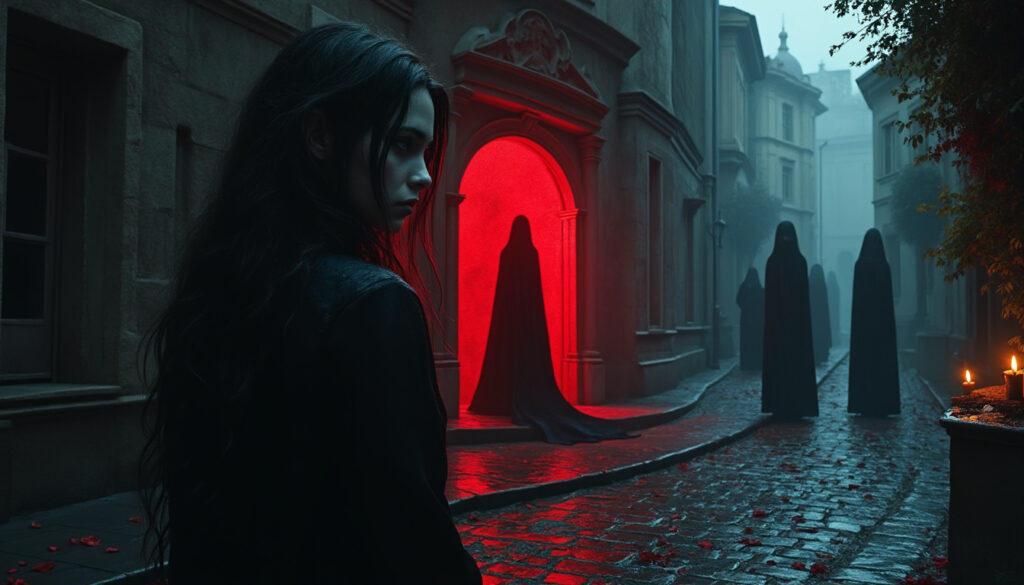
The light juxtaposes thick shadows with orange hues, occasionally evoking the contrasts of Rembrandt or Caravaggio. Even in broad daylight, the image retains an unease, as if the city had already tipped into an inner night. Museum halls, sculptures, and paintings contribute to this atmosphere of both threat and fascination.
Paganism at the heart of the present
Witchcraft is not strictly tied to a Judeo-Christian imaginary here. Argento favors older rites, cruel deities, and a pagan energy that transforms horror into wild celebration. This orientation gives the narrative an archaic dimension, without cutting it off from modernity.
The witches serving the Mother of Tears don modern gothic looks, provocative and grimacing. They recall the bacchae and maenads of Dionysian cults, figures in trance ready to punish those who stray from their fervor. The ancient myth thus slips into the present streets, among passersby and urban tumult.
This encounter between the sacred and the everyday nourishes one of the film’s strongest ideas. Horror does not come from a distant elsewhere: it seems to settle into our world, with no clear boundary between the real and the supernatural. One can find another way of making cinema a journey through time and the intimate by discovering the Wives trilogy by Danja Brejen, which also explores the traces the past leaves in the present.
A pictorial violence, between discomfort and excess
Brutality occupies an important place, but it does not function merely as a promise of spectacle. Argento dwells on pain and long agonies, which he embeds in an almost ritualistic staging. The images can be harrowing; they remain linked to the general madness of the narrative.
The filmmaker invents a gore that is both frontal and crafted, nourished by a dark history of art. Some visions evoke Bosch, Goya, or Bacon, as if the tormented bodies joined a gallery of haunted paintings. This ambition does not make every scene successful, but it distinguishes the film’s violence from mere provocation.
The limited means are sometimes felt, particularly in the visible use of digital images. Argento does not always seek to disguise their artificial nature; rather, he seems to accept the naivety that recalls the peplums and Italian gothic films of the 1960s. The monsters and fiery backdrops already had an imperfect materiality, yet deeply popular.
The result remains uneven. Some discoveries hit the mark, while easy effects, clumsiness, or tonal shifts weaken the whole. However, the film does not allow itself to be confined to good or bad taste: it oscillates between horror, naive wonder, and homage to neighborhood cinema, with an unpredictability that is its own.
A narrative that embraces disorder
The narration moves in fits and starts. Intense sequences briefly emerge, then give way to moments of wandering or slowdowns that seem to suspend the story. This irregularity is disorienting, but gives the film a convulsive form, as if its rhythm seeks to join the chaos it portrays.
The witchcraft scenes, concentrated toward the end, do not resolve all the uncertainties. On the contrary, the final movement prolongs the discomfort, and the last shot retains an ambiguity tinged with irony. Argento does not completely close the door to interpretation.
Rewatching the film in 2026 also allows for a different assessment of its depiction of a world in crisis. Collective hysteria, assaults, and cries that seem to come from everywhere compose an apocalypse rooted in the everyday. For another cinematic exploration of the links between individuals and history, Jim Jarmusch’s family odyssey in Father, Mother, Sister, Brother offers a more intimate counterpoint to this spectacular chaos.
Culture, too, traverses the narrative as an ambivalent force. Books sometimes protect, works of art disturb, and the traces of the past seem capable of transmitting as much knowledge as threat. This place granted to images and objects reminds us how Argento views cinema as a dialogue with other arts.
Rediscovering a film that does not seek to please
Mother of Tears is not a perfectly controlled work, and its difficult reputation does not stem solely from a misunderstanding. Its weaknesses exist, as do its abrupt choices. But to reduce the film to its flaws is to overlook its obstinate refusal to conform to nostalgic expectations.
It possesses a singular beauty, less immediately seductive than that of Suspiria, but haunted by the idea that art can become unsettling. The vast sets, endless corridors, and lost characters compose a geography of fear. Each space seems to retain the memory of an older world, ready to resurface.
This rediscovery is part of a resurgence of interest in works long judged by their reputation. The dossier dedicated to Floriane Devigne’s call with Allô la France offers another example of cinema that questions our relationship to territory and its narratives. These propositions vary, yet all invite a look beyond a first impression.
The film does not reveal itself completely in a single viewing. Its unstable balance, sudden changes in speed, and sometimes excessive images require an available gaze, ready to embrace contradictions rather than smooth them out. This is also what makes its experience persistently unsettling.
Finally, its imagery overflows the cinematic frame to join popular codes, subcultures, and contemporary narratives of the fantastic. In this regard, the reading of the appropriation of the Barbie Dream Fest by its fans, renamed “Barbie Nightmare Fest”, humorously reminds us how audiences sometimes transform the universes offered to them. In Argento’s work, this freedom takes a much darker form, yet it participates in the same taste for imaginaries that overflow their initial framework.
An edition designed to prolong discovery
The reissue by Extralucid Films collects the Blu-ray of the film and a forty-eight-page booklet. It offers the uncut version, not restored, as well as the French version, allowing for a rediscovery of the montage and directorial choices in a new presentation. The editorial content accompanies the screening without claiming to erase the film’s rough edges.
Jean-Baptiste Thoret devotes thirty-five minutes to analyzing the work. Olivier Desbrosses, for his part, discusses the music during a ten-minute interview. These bonuses provide reference points to understand the filmmaker’s choices, his references, and the film’s place in his career.
The music deserves particular attention, as it contributes to the instability of the atmosphere and accompanies tonal shifts. The proposed analysis allows for an observation of how sound supports images without always seeking to make them more reassuring. The booklet complements this journey with a reading space dedicated to the film.
Another poetic journey into contemporary reality, Promised Sky by Erige Sehiri invites us to discover in 2026 a work attentive to human trajectories. In contrast to the supernatural tumult of Argento, this film offers another gateway to cinema that observes the present and its transformations.
The lingering trouble of The Three Mothers
With Mother of Tears, Dario Argento brings the legend of The Three Mothers into a world that no longer has the unreal colors of Suspiria nor the dreamlike labyrinths of Inferno. The supernatural no longer constitutes an elsewhere: it infiltrates contemporary reality, at the heart of Rome, among its streets, buildings, and crowds. This proximity transforms the threat into an urban experience and gives the film an apocalyptic tone, where chaos seems ready to erupt at any moment.
The third installment also renews the imagery of witchcraft. Argento abandons the familiar markers of gothic horror to draw from pagan rites, ancient myths, and artistic representations of Evil. The witches take on the appearance of modern bacchae, while works of art and historically charged places become the unsettling witnesses of a culture permeated by violence. The gore, sometimes extreme, fits into this ritual vision: pain is disturbing, yet it participates in a staging where horror takes on an almost ceremonial dimension.
The form, too, rejects regular paths. Brief, brutal sequences coexist with moments of wandering, sudden accelerations interrupt the narrative, and some images seem to extend their own discomfort. These breaks can be disorienting, just as the sometimes clumsy effects or deliberately naive visual choices can be. But this irregularity accompanies the representation of a world losing its bearings. Even the beauty of the sets, chiaroscuro, and camera movements seems tainted by unease.
Viewed today, the film invites observation of its blend of ancient references and modern terror from a different perspective. Its final image, ironic and undecidable, does not dissipate the unease: it leaves it suspended, as if the legend of The Three Mothers continues to lurk outside the frame.