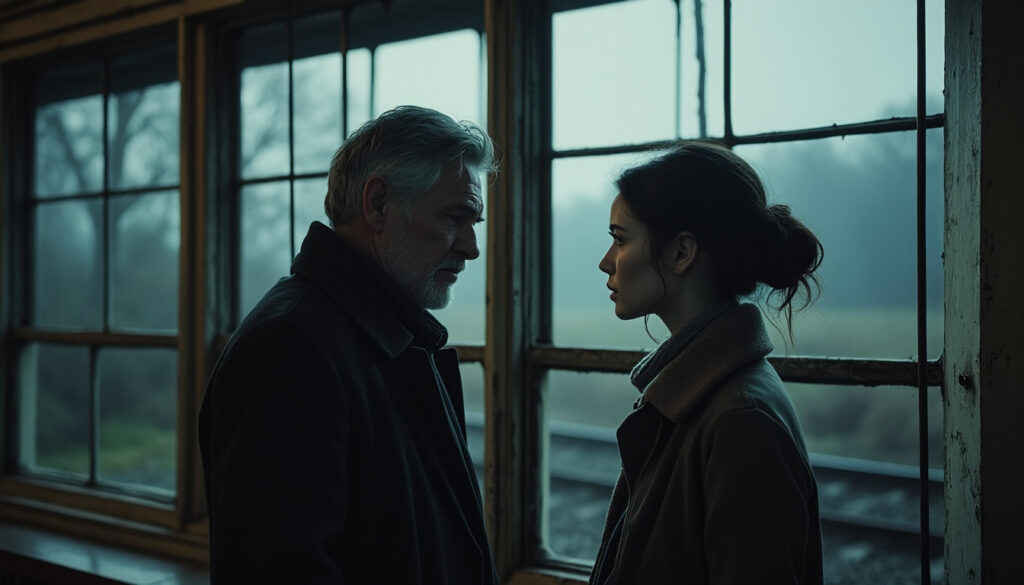
With Ulya, Latvian filmmaker Viesturs Kairišs goes back to the 1960s to tell the story of Uļjana Semjonova’s childhood, before she became a basketball legend. Far from the podiums, his film observes a young girl whose unusual stature disrupts the frame and reveals the price of a life spent under other people’s gaze.
With Ulya, Latvian filmmaker Viesturs Kairišs returns to the childhood years of Uļjana Semjonova, a future basketball legend, to tell a story that begins far from the podiums. In the Latvian countryside of Latgale, an extraordinary teenager grows up under curious stares, medical measurements and the expectations of a world that does not know where to place her. The film thus explores how a body becomes at once a person, a spectacle and a political issue.
Two names for an extraordinary journey
Viesturs Kairišs and Uļjana Semjonova are linked by a story that does not follow the usual path of a sports biopic. The former is a Latvian filmmaker whose films explore memory and the traces of Soviet history. The latter, known by the nickname Ulya, would become an exceptional player, but the film chooses to meet her before she becomes famous.
This distance from the legend is essential. Rather than re-creating her great victories or stringing together competition scenes, Kairišs focuses on the young girl from Medumi, a village in Latgale in eastern Latvia. At the time, her height already sets her apart from everyone, without giving her a place where she can feel at ease.
A child at the center of the frame
The film opens with a classroom image, a familiar composition in which faces are arranged in a pyramid. But the expected balance is disrupted: one student visually towers over the group and even seems to surpass the teacher. In just a few moments, the viewer understands the problem that will run through the story: how do you make room for someone who does not fit within the ordinary frame?
Ulya’s height is not just a number. It transforms everyday gestures, changes her relationships with others and turns every room into a space designed for someone else. The film observes these disparities without reducing its heroine to a curiosity, letting doors, corridors and furniture express what the dialogue leaves unsaid.
A medical examination scene makes this obsession with measurement especially tangible. A nurse has to stretch her arm as high as she can to adjust the measuring rod, while the parents watch their daughter with a mixture of admiration and concern. In this room, everything seems designed to classify the body: her eyesight is tested, her height measured, and a convenient explanation sought for what falls outside the norm.
Latgale, between landscape and memory
Her native village is not simply a picturesque backdrop. Latgale emerges as a borderland, shaped by religious traditions and a history distinct from that of the country’s center. Ulya grows up in an Old Believer community, among icons, farm work and livestock.
Before becoming an athlete, she puts her strength to use in rural labor. Carrying hay or herding cows is part of her daily life, and the film conveys how adults may already see her body as a tool. This country life is filmed with particular attention to texture: straw, wood, deep shadows and shafts of light passing through the barn.
An image shaped by memories
The past as filmed by Kairišs sometimes seems to come from a rediscovered family album. The filmmaker draws part of his visual imagination from his father’s photographic negatives, lending some images the patina of inherited memory. The viewer is therefore not only looking at a reconstructed era; they also sense how memories settle upon it.
Cinematographer Wojciech Staroń creates nuanced black and white, suffused with frost, mist and reflections. The outlines sometimes dissolve, then regain an almost stark sharpness. Optical imperfections, far from being systematically corrected, remind us that an image is always created from a particular point of view, through a lens, a frame and a distance.
This aesthetic may evoke certain contemporary European works, but it draws its strength from the specific situations it accompanies. A doorframe forces Ulya to tilt her head; a corridor prompts her to bend her knees. Without heavy-handed commentary, these gestures reveal how ill-suited a space built to average measurements can be.
A body under scrutiny, a person searching for a place
In the village, the way people look at Ulya shifts between astonishment, concern and fascination. Her body easily becomes the subject of gossip or an unintentional attraction, as if her singularity gave others license to talk about her without really knowing her. The film portrays the violence of this exposure with restraint, focusing more on her reactions than on the judgments surrounding her.
In one intimate scene, she holds a small mirror above her face. She can see only part of it at a time, as though the object can reflect only a fragmentary portrait. This adolescent moment, touched by the desire to feel pretty, echoes the group photographs: once again, the frame seems too narrow to hold her entire presence.
The role is played by Kārlis Arnolds Avots, a male actor who portrays Ulya without prosthetics designed to artificially alter his appearance. His performance is built on details: a slightly hunched posture, a cautious gait, eyes that shy away. Then, suddenly, a smile lights up his face, revealing an unguarded joy.
The gentleness behind the stature
This casting choice invites us to look differently at questions of the body and identity. In the late 1960s, female athletes could be subjected to procedures intended to verify their femininity; in the village, similar questions already arise in a more everyday form. The film does not turn these suspicions into a spectacle, but shows how much they can intrude upon a young woman’s private life.
The character’s femininity does not depend on demonstrative imitation. It emerges in a sense of modesty, a hesitation, a way of standing or waiting for someone to offer a tender gesture. Through this understated approach, Avots brings out a vulnerable presence, far from the simplified image of a giant whose strength sums up her entire existence.
From the farm to the basketball court
When Ulya arrives in Riga, the story does not turn into a triumphant sports montage. Learning takes time and involves awkward gestures: running, pivoting, adjusting her strength and understanding the distance between the players. Her height, which at first seems to promise an immediate advantage, also makes those first movements laborious.
The court, however, changes the rules of her relationship with space. Its lines are drawn, its boundaries visible, and the game gives a purpose to dimensions that had seemed cumbersome until then. Little by little, Ulya discovers a new ease; a smile appears in the middle of a game, while a camera in the background is already recording this transformation.
This scene captures the ambivalence of her entry into sports. Basketball opens up a field where her singularity can become an asset, and perhaps offers her her first experience of bodily freedom. But the institution also recognizes an athlete to be shaped and presented in her, so the young girl’s joy mingles with the feeling of being watched.
Fame before the legend
Semjonova’s career would be immense: she would win Olympic gold and play for many years with the TTT Riga club. She would also become the first non-American player inducted into the Basketball Hall of Fame in Springfield. Yet these achievements remain on the horizon of the film, which prefers to show the moment when a talent is spotted and then gradually taken under an organization’s wing.
This approach sets Ulya apart from sports stories centered on victory. The camera is less interested in the making of a champion than in how a young woman is removed from her environment to serve the ambitions of a system. Soviet sport thus appears behind its showcase, through its mechanisms of selection, discipline and representation.
To discover more about the film and its director, read this article featuring a conversation with Viesturs Kairišs: an in-depth look at Ulya with Viesturs Kairišs, presented in Cannes’ Un Certain Regard selection. This discussion extends the film’s interest in the making of images and the place given to its heroine. It also situates the work within the career of a filmmaker attentive to Latvian stories.
The right to escape the gaze
Photographs, mirrors and the measuring rod recur as instruments of observation. They promise to capture Ulya, measure her or fit her into a legible image. Yet the most delicate moments come when the film stops trying to show everything.
Behind a frosted pane or a curtain, her face blurs and momentarily escapes the inventory of features and dimensions. This shadow does not erase her: it restores a private space, sheltered from gazes that seek to define her. The story then lingers on a teenager from Latgale, her ordinary desires and her need to be accepted, while the story of her fame remains in the background.
Viesturs Kairišs – Ulya: two names, a story to discover
With Ulya, Viesturs Kairišs chooses to tell a life story before it becomes a sports legend. The film dwells neither on medals nor on great victories: it returns to the beginning, in a village in Latgale where a young girl grows up with a body that others watch, measure and comment on. This shift in the story turns the portrait into a sensitive exploration of what it means to be different in a world designed for the norm.
The filmmaking makes the frame a central concern. Doors, mirrors, photographs and rooms all seem too narrow to accommodate Ulya, while the black and white gives her face a presence that is at once fragile and monumental. Every image reveals the weight of the collective gaze, while also making room for moments when the young girl escapes observation. This delicacy allows the film to see its heroine as more than a curiosity or a future champion.
At the heart of this journey lies a tension that is rarely simplified: basketball offers Ulya a space where her stature becomes a strength, but this recognition comes with a new form of control. The sports institution sees her potential and intends to direct it, while her desire to be loved, choose her place and live at her own pace remains. Success therefore erases neither loneliness nor the need for privacy.
By giving full attention to hesitant gestures, smiles and silences, Kairišs creates a film that looks without reducing. Ulya invites us to meet a young woman rather than gaze at a phenomenon, and to understand the cost of having one’s singularity exposed to the world. The two names, the filmmaker’s and his heroine’s, thus open onto a profoundly human story: that of a body searching for its place, and a gaze that finally learns to stop measuring it.